
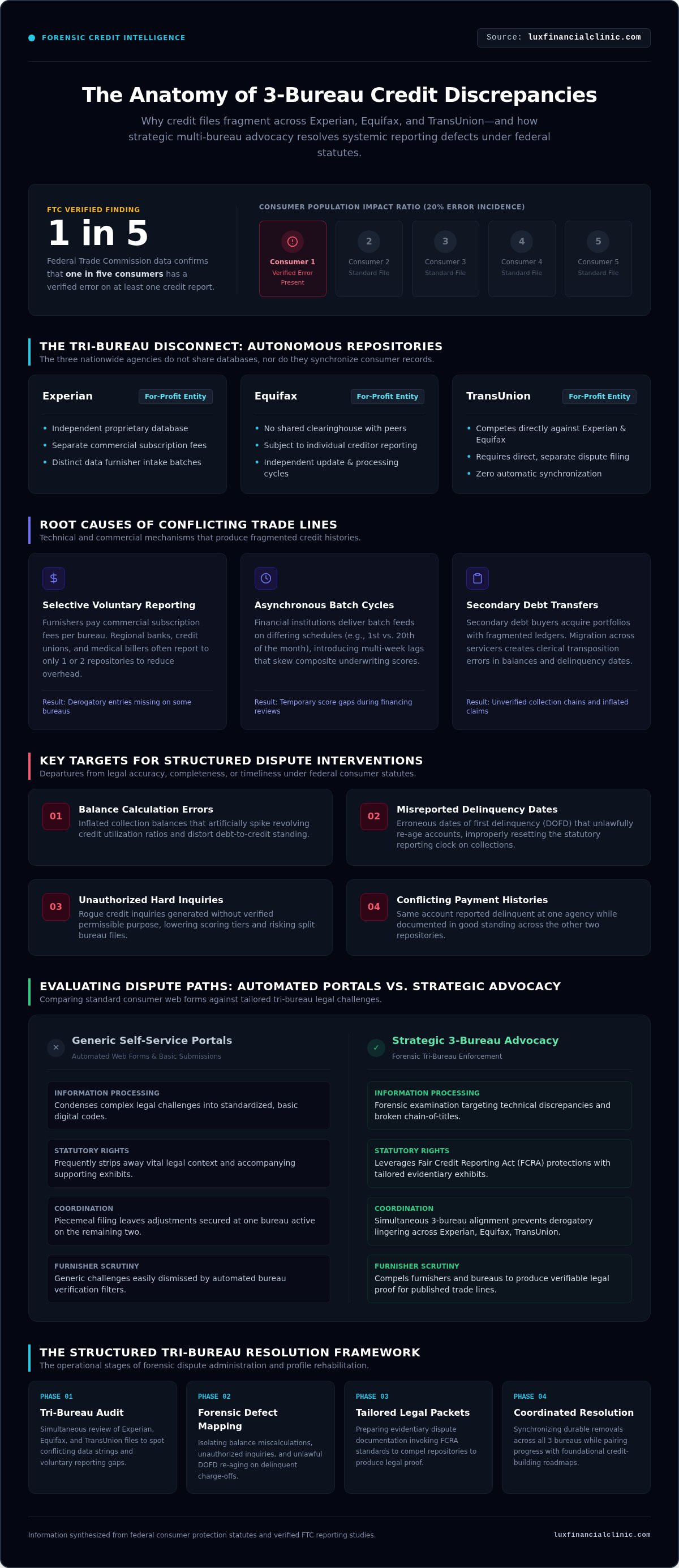
According to the Federal Trade Commission, one in five consumers has a verified error on at least one of their credit reports. If you have ever felt the exhaustion of correcting an erroneous collection with one agency only to watch it linger on another, you know how fragmented reporting can be. Generic automated dispute portals often condense complex reporting errors into basic digital codes, leaving legitimate concerns unresolved while critical mortgage or auto financing approvals hang in the balance. Partnering with an intentional 3 bureau credit dispute service replaces that reactive cycle with an aligned, strategic approach across Experian, Equifax, and TransUnion simultaneously.
In this guide, you will discover how professional three-bureau credit dispute services audit conflicting trade lines, challenge discrepancies under federal consumer statutes, and coordinate durable resolutions across all three repositories. We will explore the mechanics of tri-bureau forensic audits, look at how structured protocols bypass automated filters, and examine the foundational credit-building habits that support lasting financial mobility.
Key Takeaways
- A dedicated 3 bureau credit dispute service synchronizes forensic reviews across Experian, Equifax, and TransUnion to eliminate blind spots caused by voluntary creditor reporting and mismatched data cycles.
- Online self-service dispute portals frequently strip away vital legal context and supporting exhibits, whereas tailored dispute packets preserve your statutory protections under federal consumer law.
- Strategic dispute management targets substantive reporting defects, such as unverified collection chains, obsolete charge-offs, and inconsistent payment dates, rather than submitting generic automated challenges.
- True credit restoration combines methodical bureau dispute administration with personalized credit-building roadmaps to ensure your repaired profile supports future funding opportunities.
- Partnering with an aligned advisory practice transforms credit recovery from an isolated administrative chore into an intentional step toward personal and commercial wealth expansion.
What Is a 3-Bureau Credit Dispute Service and How Does It Work?
A professional 3 bureau credit dispute service provides an orchestrated, forensic examination of your credit files across Experian, Equifax, and TransUnion. Rather than submitting piecemeal corrections through basic web forms, this consultative approach conducts a simultaneous audit of all three profiles. It uncovers technical discrepancies, misaligned data strings, and unverified negative entries that dilute your financial standing.
When you engage an experienced advocacy team, the process moves far beyond generic dispute letters. The service relies on Fair Credit Reporting Act protections to compel both data furnishers and bureaus to produce verifiable legal proof for every trade line they publish. By presenting tailored evidentiary documentation, a comprehensive 3 bureau credit dispute service ensures an adjustment secured at one bureau isn't left lingering as an active blemish on the other two.
The Role of the Three Major Consumer Reporting Agencies
Experian, Equifax, and TransUnion are independent, for-profit corporations that compete directly against each other. They do not share databases, nor do they synchronize consumer records. Because data furnishers choose where to report based on commercial subscription fees or regional preferences, conflicting entries are common. These discrepancies often suppress composite credit scores, particularly when mortgage or commercial underwriters evaluate your file using tri-merge reports.
Inaccuracies That Justify Formal Dispute Interventions
A formal dispute is appropriate whenever reported information departs from legal accuracy, completeness, or timeliness. Typical targets for structured dispute interventions include:
- Balance calculation errors: Inflated collection balances that artificially spike credit utilization ratios.
- Misreported delinquency dates: Erroneous dates of first delinquency that unlawfully reset the statutory reporting clock on collections or charge-offs.
- Unauthorized hard inquiries: Rogue inquiries generated without permissible purpose that trigger split files or lower score tiers.
- Conflicting payment histories: Accounts marked delinquent with one bureau while reported in good standing with the other two.
Resolving these items restores balance to your credit narrative, ensuring each bureau reflects verifiable data that supports your future financial milestones.
Why Inconsistencies Emerge Across Experian, Equifax, and TransUnion
Credit files rarely align across all three major repositories. Rather than maintaining a central shared clearinghouse, Experian, Equifax, and TransUnion function on fragmented data feeds. This structural disconnect explains why a single derogatory entry can surface on one agency report while remaining completely absent from the others, creating unpredictable score volatility during financing reviews.
Lenders and debt collection agencies must pay individual subscription fees to transmit account data to each repository. To manage overhead, many regional banks, credit unions, and medical billing agencies choose to report to only one or two bureaus. When secondary debt buyers purchase delinquent accounts, they inherit fragmented balance ledgers and incomplete chain-of-title records. As these portfolios migrate between servicers, clerical transposition errors frequently corrupt original delinquency dates or balance figures on select files.
Furnisher Reporting Dynamics and Asynchronous Updates
Timing issues multiply these discrepancies. Financial institutions operate on distinct technical batch schedules rather than continuous real-time feeds. A creditor might furnish updated payment balances to Equifax on the first of the month, yet deliver data to TransUnion on the twentieth. These asynchronous reporting cycles introduce multi-week data lags across your profiles. Without a methodical 3 bureau credit dispute service conducting unified audits, these diverging trade lines can quietly derail time-sensitive borrowing plans.
Automated Bureau Processing and Dispute Rejections
When consumers challenge these contradictions independently, they encounter rigid automated screening systems. Credit bureaus frequently channel dispute entries through digital intake engines like e-OSCAR, which condense detailed disputes into standardized two-digit codes. Vague online submissions often trigger automated rejections labeled as "frivolous" before any human analyst reviews the underlying documents.
Effective dispute resolution requires bypassing superficial web interfaces. Adhering to structured CFPB credit dispute instructions while pairing them with customized, physical documentation packets forces furnishers to conduct genuine factual investigations under federal oversight. If you are noticing persistent contradictions across your profiles, scheduling an objective review with Lux Financial Clinic can bring clarity to your multi-bureau standing and set a grounded path toward credit restoration.
Evaluating Credit Dispute Paths: Self-Service Portals vs. Strategic Advocacy
Choosing how to challenge reporting discrepancies shapes your entire recovery timeline. Many individuals begin by submitting disputes through the free web tools hosted by individual bureaus, only to encounter rigid operational constraints. A tailored 3 bureau credit dispute service approaches the task with a completely different standard of documentation, evidentiary depth, and legal leverage.
What appears convenient on a digital screen often limits your legal remedies. Enrolling in bureau portals routinely requires accepting extensive terms of service that mandate binding arbitration, which can forfeit your statutory right to trial should significant damages occur. The FTC guide on disputing credit errors emphasizes preserving complete written records, yet web dashboards restrict character counts and attachment file sizes, preventing you from conveying nuanced transactional histories.
The Functional Realities of Do-It-Yourself Online Disputes
Portal forms force complex inaccuracies into simplified dropdown menus. When you select a generic prompt like "account not mine," the system strips away crucial context. These digital submissions get translated directly into automated codes that furnishers match against raw database records, often verifying faulty trade lines within minutes. Tracking separate 30-day response clocks across three distinct agency accounts also demands sustained administrative energy that quickly drains personal productivity.
The Methodical Value of Dedicated Dispute Management
Professional dispute management approaches credit file rehabilitation with systematic precision. Rather than relying on superficial form letters, a boutique 3 bureau credit dispute service builds tailored evidentiary packets sent directly through traceable postal mail to both repositories and furnishers. This dual-track strategy provides several clear advantages:
- Preserved statutory records: Physical, certified correspondence creates an indisputable paper trail that holds furnishers accountable to strict federal verification standards.
- Comprehensive cross-bureau alignment: Dedicated strategists manage rolling response calendars simultaneously across all three agencies, preventing resolved accounts from resurfacing elsewhere.
- Deep file diagnostics: Experienced advisors identify technical reporting defects that casual reviews overlook, such as subtle inconsistencies in historical payment ratings.
Handing over these recurring administrative burdens protects your time while ensuring every challenge adheres to rigorous procedural standards.
The Structured 3-Bureau Dispute and Rehabilitation Process
Restoring personal credit files requires a disciplined, multi-phase methodology rather than isolated disputes. When handled systematically, credit correction unfolds through measured cycles that blend evidentiary demands with forward-looking profile design. An experienced 3 bureau credit dispute service guides you through distinct, orderly milestones that build lasting stability.
Every profile follows a dedicated progression designed to resolve lingering trade line conflicts while strengthening your foundational borrowing power.
Tri-Bureau Forensic Auditing and Strategy Mapping
The journey opens with pulling complete consumer disclosures from Experian, Equifax, and TransUnion simultaneously. Specialists conduct a line-by-line cross-examination across all three records, identifying conflicting dates of delinquency, inconsistent balances, missing payment histories, and unverified collection accounts. Rather than disputing every trade line at once, which can trigger automated processing filters, your strategist develops a sequential action plan. This roadmap prioritizes high-impact derogatory records first to establish momentum while gathering targeted exhibits for subsequent rounds.
Statutory Reinvestigation Timelines and Escalation
Once dispute packets are formally delivered, the 30-day statutory reinvestigation window established under federal law begins. Your strategist monitors these rolling deadlines across all three agencies, reviewing incoming bureau disclosures to confirm permanent trade line deletions or accurate updates. When a furnisher improperly verifies a defective entry, the advocacy team escalates the matter directly. They issue formal administrative demands to executive consumer office teams and submit detailed complaints through federal regulatory portals, holding data furnishers strictly accountable to verification standards.
Concurrent Credit Building and Profile Modernization
Removing inaccurate derogatory marks addresses only half of the restoration equation. A thin credit file stripped of negative entries still leaves you vulnerable to financing denials. Strategic profile modernization runs alongside dispute administration to establish dependable credit architecture:
- Balance optimization: Strategically lowering revolving balances below 10 percent of available limits delivers immediate score stabilization.
- Installment diversification: Adding structured credit-builder accounts or secured installment loans creates a balanced profile history.
- Authorized user alignment: Leveraging seasoned trade lines with clean payment histories adds depth to an otherwise young file.
If you are ready to move beyond piecemeal corrections and build a resilient borrowing profile, explore credit restoration programs with Lux Financial Clinic to map your customized path forward.
Navigating Your Financial Future with Lux Financial Clinic
Credit restoration serves as the cornerstone for your broader financial life. Resolving reporting inaccuracies isn't merely an administrative exercise; it clears the runway for meaningful personal investments and commercial ventures. Lux Financial Clinic operates as a boutique financial advisory practice, delivering bespoke dispute protocols designed around your individual credit narrative. Rather than relying on rigid automated pipelines or pressure-driven sales cycles, the clinic structures transparent, tiered flat-rate programs, ensuring you receive focused advocacy grounded in complete compliance with federal consumer protection statutes.
A Dignified, Strategic Path to Credit Health
Facing credit reporting challenges often brings unnecessary stress and uncertainty. At Lux Financial Clinic, dedicated credit strategists replace anxiety with quiet clarity through thoughtful, non-judgmental counsel. Each engagement begins by evaluating the unique composition of your profile to target inaccurate collections, unverified charge-offs, and misreported late payments across all three repositories. Through transparent milestone tracking, you maintain total visibility over your file's progress. Choosing an intentional 3 bureau credit dispute service ensures that every challenge is handled with measured care, protecting your peace of mind while your files are methodically realigned.
Aligning Restored Credit with Capital and Life Goals
A polished credit profile opens doors that extend well beyond everyday borrowing. Once inaccuracies are corrected and foundational positive accounts take root, your profile transitions naturally toward high-value opportunities. Clients routinely leverage their restored credit standing to secure advantageous terms through real estate brokerage consulting and auto brokerage consulting, avoiding the inflated interest rates associated with compromised files.
For entrepreneurs and founders, personal credit integrity forms the primary gateway to commercial expansion. Through tailored business funding consulting and strategic tax preparation, the clinic harmonizes your personal and commercial files, preparing your venture for substantial growth capital. If you are ready to experience the difference of an aligned 3 bureau credit dispute service and take command of your borrowing future, schedule a Financial Diagnostic Consultation to begin your tailored restoration journey.
Taking Command of Your Tri-Bureau Standing
Reclaiming control over your credit narrative is an empowering investment in your long-term autonomy. Moving beyond disjointed portals and reactive fixes, partnering with a dedicated 3 bureau credit dispute service establishes structural harmony across Experian, Equifax, and TransUnion. By pairing rigorous evidentiary audits with sustainable credit-building practices, you eliminate hidden discrepancies while actively reinforcing your baseline borrowing profile.
At Lux Financial Clinic, dispute administration is only the beginning. Our dedicated strategists deliver discreet, compassionate guidance designed to align clean consumer credit files with broader business funding consulting and lifestyle acquisitions. You don't have to manage complex reporting contradictions alone. Step forward with executive confidence and Schedule Your Financial Diagnostic Consultation to begin your journey toward lasting financial restoration.
Frequently Asked Questions
How long does a 3-bureau credit dispute service typically take to show progress?
Initial updates usually surface within 30 to 45 days of formal submission, matching the statutory investigation windows mandated by federal law. However, enduring file rehabilitation rarely concludes in a single cycle. Complex discrepancies, unverified charge-offs, and stubborn collection records often require iterative rounds of evidentiary review, meaning overall progress develops across several structured review periods depending on individual report complexity.
Can a credit dispute service guarantee the removal of all negative items?
No reputable credit restoration practice guarantees the removal of items or promises specific score increases. Federal consumer statutes prohibit firms from guaranteeing credit outcomes because data furnishers and bureaus maintain legal rights to report items that are completely accurate, timely, and verifiable. Legitimate dispute services concentrate on identifying reporting defects and ensuring that unverified, erroneous, or non-compliant records are systematically challenged.
What is the difference between a single-bureau dispute and a 3-bureau dispute service?
A single-bureau dispute addresses records housed within an isolated repository, leaving conflicting entries active on competing networks. In contrast, an integrated 3 bureau credit dispute service audits Experian, Equifax, and TransUnion simultaneously. This multi-agency approach reconciles inconsistent balance figures, unifies conflicting payment dates, and prevents repaired entries from lingering on alternate bureau files during major multi-repository loan evaluations.
Will challenging negative accounts on my credit report lower my credit scores?
Challenging erroneous records does not harm credit scores. Submitting formal dispute notices initiates a neutral compliance review rather than an adverse scoring event. If an older collection trade line with substantial historical age is removed, minor short-term adjustments can occur in average credit age, but eliminating severe derogatory marks typically reinforces long-term profile stability and overall creditworthiness.
Why do the three credit bureaus show different information and credit scores?
Bureaus show diverging data because creditors and collectors choose where to report based on commercial subscriber costs. A local lender might send payment updates exclusively to Equifax, while an auto servicer transmits account records only to TransUnion. Differing batch update schedules and independent scoring model variations amplify these gaps, leading to distinct profiles across repositories.
What documents are required to initiate a comprehensive 3-bureau credit audit?
Initiating a thorough tri-bureau review requires proof of identity, legal residency, and access to complete credit disclosures. Standard verification documents include a valid government photo identification, a recent utility bill or bank statement confirming your physical address, and your social security number. Strategists use these credentials to pull full disclosures across all three agencies and establish compliant representation files.
How do credit building roadmaps complement the credit dispute process?
Credit building roadmaps establish active, positive history while disputes eliminate inaccurate derogatory marks. A 3 bureau credit dispute service that pairs dispute administration with credit architecture helps you balance revolving utilization, add primary installment lines, and structure positive reporting data. This dual-track approach ensures your restored credit profile possesses both cleanliness and the substantive depth needed for major lending approvals.