
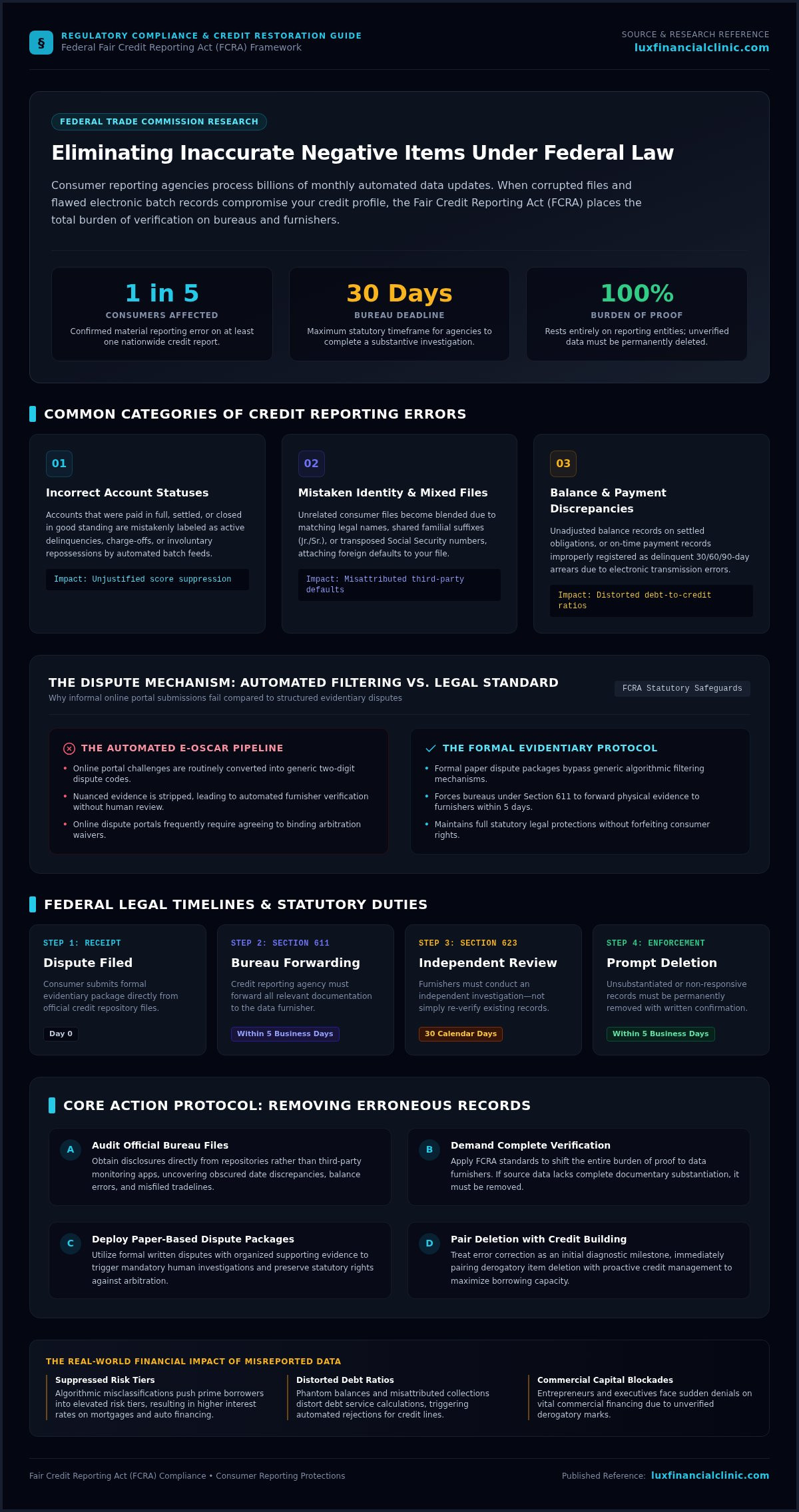
According to Federal Trade Commission research, one in five consumers has a confirmed material error on at least one credit report. When automated screening algorithms misinterpret your payment history, learning how to remove inaccurate negative items credit bureaus improperly report becomes essential to reclaiming your financial momentum.
You already know the quiet anxiety that follows an unjustified credit denial, especially when automated online portals reject your legitimate disputes as frivolous without a genuine investigation. It's exhausting to watch a single reporting discrepancy compromise a mortgage application, an auto loan, or vital business funding when your actual payment record tells an entirely different story.
This guide walks you through the exact legal process to identify, dispute, and permanently eliminate erroneous marks from your profile using proven regulatory standards. Together, we'll examine your core statutory protections under federal law, outline a repeatable protocol to draft and track compelling dispute packages, and explore how to systematically restore an accurate credit profile to unlock capital opportunities with lasting confidence.
Key Takeaways
- Conduct comprehensive audits using official bureau files rather than consumer monitoring apps to reveal hidden reporting discrepancies and inaccurate dates.
- Leverage the Fair Credit Reporting Act to place the legal burden of verification entirely on data furnishers and credit bureaus.
- Implement a formal, paper-based dispute protocol to remove inaccurate negative items credit bureaus report without surrendering your legal protections to online arbitration waivers.
- Structure your dispute packages with clear evidentiary documentation to bypass automated bureau filters and trigger substantive investigations.
- Treat record correction as a diagnostic starting point, pairing file restoration with deliberate credit-building habits to unlock future capital opportunities.
Understanding Inaccurate Negative Items on Your Credit Report
An inaccurate negative item is any derogatory mark on your credit profile that is factually erroneous, outdated, or fundamentally unverifiable. Consumer reporting agencies process billions of monthly data updates through automated batch files. When financial institutions transmit corrupted or incomplete electronic records, routine clerical oversights quickly translate into misattributed collections, phantom charge-offs, or blended files. Under the federal Fair Credit Reporting Act (FCRA), credit bureaus must maintain procedures designed to ensure maximum possible accuracy. You hold an explicit statutory right to challenge these flaws and remove inaccurate negative items credit repositories maintain against your profile.
Common Categories of Credit Reporting Errors
Reporting discrepancies rarely occur at random; they typically emerge from specific operational breakdowns within data furnisher systems:
- Incorrect account statuses: Accounts paid in full or closed in good standing that are mistakenly labeled as active delinquencies, charge-offs, or repossessions.
- Mistaken identity and mixed files: Separate consumer files blended together due to identical names, familial suffixes, or transposed Social Security digits, attaching an unrelated person's defaulted debt to your profile.
- Balance and payment discrepancies: Unadjusted balances on debts resolved through settlement agreements, or payments recorded as delinquent despite being submitted on time.
The Measurable Impact of Erroneous Negative Marks
Derogatory errors inflict immediate, tangible damage on your borrowing power. An erroneous collection or misreported charge-off can abruptly suppress your credit profile, pushing prime borrowers into higher risk tiers. This algorithmic misclassification leads to higher interest rates on mortgages, auto financing, and consumer credit lines, costing thousands in unnecessary finance charges. For entrepreneurs and executives, misreported liabilities distort debt service ratios, triggering automated rejections when applying for commercial credit or business lines. Taking deliberate steps to remove inaccurate negative items credit bureaus record isn't merely about correcting a score; it's a vital strategic measure to preserve your financial credibility and protect access to institutional capital.
Federal Consumer Protections: Your Legal Rights Under the FCRA
Federal law provides strong safeguards against inaccurate reporting, establishing that the burden of proof rests entirely on the institutions reporting the data, not on you. Under the Fair Credit Reporting Act, consumer reporting agencies must conduct a timely, reasonable reinvestigation whenever you dispute an entry. In practice, bureaus often route consumer challenges through e-OSCAR, an automated clearinghouse that reduces nuanced disputes into generic two-digit codes sent to furnishers. Knowing this mechanic allows you to structure evidence that demands genuine human review rather than passive automated verification. Aligning your strategy with official FTC guidance on disputing credit report errors ensures you hold these agencies to their explicit statutory duties to remove inaccurate negative items credit bureaus verify without substantiation.
Key Protections Under FCRA Section 611 and 623
The law divides accountability cleanly between credit bureaus and data furnishers through two complementary statutory mechanisms:
- Section 611 bureau obligations: Major nationwide credit reporting agencies have 30 calendar days to investigate disputed items. They must forward your documentation to the furnisher within 5 business days of receipt.
- Section 623 furnisher duties: Lenders and collection agencies must conduct an independent investigation of the forwarded dispute. They cannot simply confirm matching profile data.
- Mandatory prompt deletion: If a furnisher cannot substantiate every detail of the record within the statutory timeframe, the bureau must promptly delete the item and provide written confirmation within 5 business days.
Statutory Limits on Derogatory Information Reporting
How long can adverse data legally remain on your file? Section 605 sets rigid obsolescence timelines. Most derogatory tradelines, including late payments, collection accounts, and charge-offs, must be purged after 7 years. This retention clock is governed strictly by the original Date of First Delinquency (DOFD) with the original creditor. Debt buyers frequently attempt illegal re-aging by updating activity dates to make aged accounts appear current. Chapter 7 bankruptcies can be reported for up to 10 years, whereas public civil judgments and tax liens are excluded nationwide under established reporting standards.
Navigating these regulatory nuances requires disciplined record-keeping and strategic precision. Engaging a structured credit repair program can help ensure your dispute packages strictly enforce furnisher compliance while helping you systematically remove inaccurate negative items credit reporting agencies fail to verify.
How to Audit Your Credit Reports and Spot Inaccuracies
Precision begins with full visibility. Consumer-facing monitoring applications offer convenient top-line tracking, but they frequently compress or omit the underlying raw data fields where reporting errors thrive. These third-party interfaces rarely disclose granular Metro 2 reporting codes, precise delinquency dates, or complete account history matrices. To establish an unassailable evidentiary paper trail, you must audit the unedited consumer disclosure files issued directly by Equifax, Experian, and TransUnion. Aligning your diagnostic review with official CFPB credit dispute instructions allows you to pinpoint systemic reporting defects and remove inaccurate negative items credit bureaus maintain across your profiles.
Accessing Official Disclosures Across All Three Bureaus
Access your complete disclosures through AnnualCreditReport.com, which provides permanent free weekly online access to files from all three nationwide repositories. Requesting these consumer disclosures counts as a soft inquiry, meaning your credit scores remain entirely unaffected. Save complete, unredacted PDF copies of each bureau's report on the exact same date to create a clean analytical baseline. You'll notice each agency presents information using distinct formatting standards. Cross-referencing them side by side exposes discrepancies that single-bureau viewing hides.
The Comprehensive Account Audit Checklist
Work through your files systematically, using this diagnostic framework to identify conflicting data across bureaus:
- Personal demographic identifiers: Check every variation of your legal name, previous addresses, and employer entries. An unrecognized address often indicates a blended file or fraudulent identity exposure.
- Granular tradeline mechanics: Compare original opened dates, payment history strings, credit limits, and historical high balances. An account showing as open on TransUnion while marked closed on Experian represents an immediate reporting defect.
- Collections and public records scrutiny: Look for duplicate collection listings where both an original creditor and a third-party debt buyer report active balances for the exact same underlying balance. Verify that zero-balance medical collections or accounts under $500 are not being reported unlawfully.
Obscure error markers often provide the strongest leverage. Inconsistent account numbers across bureaus, conflicting dates of first delinquency, or mismatched payment ratings provide clear, documentable grounds to dispute and remove inaccurate negative items credit repositories cannot reconcile.
A Step-by-Step Protocol to Dispute and Remove Inaccurate Marks
Disputing reporting errors effectively requires disciplined process rather than emotional reactions. Online dispute portals tempt consumers with instant submissions, yet their electronic terms of service often include binding arbitration clauses and class action waivers that surrender vital consumer protections. These web forms also force disputes into rigid dropdown menus that strip out supporting context. Building a formal, paper-based dispute packet sent by USPS Certified Mail with Return Receipt Requested preserves your full legal remedies while creating an irrefutable, timestamped record. Following an orderly multi-round cycle is the most reliable way to remove inaccurate negative items credit reporting agencies erroneously confirm.
Drafting Clear and Factual Dispute Letters
Every dispute letter should open with your complete legal name, current address, Social Security number, and date of birth. Explicitly cite the target account name and truncated account number alongside the exact factual defect. Avoid confrontational language or generic template scripts that bureau optical scanning systems easily dismiss. Instead, calmly articulate the reporting breakdown, reference applicable sections of the Fair Credit Reporting Act, and attach legible supporting exhibits like billing records, payment receipts, or cleared checks.
Managing Timelines and Evaluating Bureau Responses
The reinvestigation window demands active calendar tracking:
- Log the receipt date: Your 30-day statutory response clock begins the day USPS tracking verifies physical delivery at the bureau's processing facility.
- Analyze the formal determination: Bureaus must issue written findings within 5 business days after concluding their review, accompanied by an updated consumer disclosure showing any tradeline modifications or deletions.
- Escalate when needed: If a bureau claims verification despite clear documentary proof of error, submit a direct dispute to the furnisher under FCRA Section 623 or file a formal complaint through the Consumer Financial Protection Bureau portal.
Navigating Frivolous Rejection Claims and Stalls
Credit repositories routinely deploy automated rejection letters labeling substantive disputes as frivolous under Section 611(a)(3). When this occurs, remain composed and focused. Respond immediately by referencing your initial certified mailing tracking number, highlighting the enclosed exhibits, and clarifying the unresolved factual questions. A structured multi-round approach systematically closes operational loopholes until the reporting agency satisfies its verification obligations.
Managing this methodical documentation cycle requires sustained attention to detail. If you prefer professional oversight to manage your three-bureau correspondence and enforce furnisher compliance, you can schedule a financial diagnostic consultation to evaluate your profiles and design an individualized dispute roadmap.
Building Long-Term Financial Strength After Item Removal
Purging erroneous records from your credit file marks an important diagnostic milestone, but deletion alone does not constitute financial resilience. When you successfully remove inaccurate negative items credit bureaus verified in error, your profile is essentially cleared of misleading drag. What remains is a blank space that must be populated with deliberate, positive reporting depth. Sustainable financial credibility requires an active transition from corrective disputes to strategic credit optimization, establishing an enduring architecture capable of supporting institutional lending requirements.
Proactive Credit Profile Optimization
Transforming a clean profile into an asset demands systematic attention to core underwriting dynamics:
- Revolving utilization thresholds: Maintain aggregate credit card balances strictly beneath 10% of total limits, ensuring individual card balances never cross 30% reporting thresholds on statement closing dates.
- Tradeline diversification: Establish a healthy mix of revolving and installment accounts, utilizing primary secured lines or credit-builder accounts to construct structural depth without incurring unnecessary high-interest liabilities.
- Automated protection schedules: Implement automated dual-cycle payment schedules to prevent minor administrative oversights from marring an otherwise pristine payment history string.
When to Partner with Professional Dispute Strategists
Certain credit reporting complications require more sophisticated, persistent intervention than routine administrative disputes can provide. Severe identity theft entanglements, blended files involving complex familial public records, or furnishers repeatedly ignoring federal statutory requirements often stall independent consumer efforts. In these scenarios, high-touch professional guidance provides the structured framework necessary to break through institutional friction.
Rather than treating credit restoration as an aggressive, transactional gamble, modern advisory programs pair compliance-driven dispute protocols with proactive financial roadmaps. These holistic pathways prepare you for milestone transitions, whether that means structuring profiles for commercial lines, business funding consulting, or institutional mortgage readiness. To evaluate your files and design a comprehensive dispute protocol tailored to your broader capital goals, you can schedule an exploratory review through Lux Financial Clinic to receive dedicated strategic guidance.
Advancing Toward Financial Clarity and Enduring Capital Growth
Achieving an accurate credit report isn't about exploiting loopholes; it's about holding reporting repositories accountable to federal standards. By auditing unedited three-bureau disclosures and establishing an evidence-backed paper trail, you can systematically remove inaccurate negative items credit agencies fail to substantiate. Pairing these corrections with disciplined utilization and steady account management ensures your profile remains resilient against automated scrutiny.
Financial restoration is an empowering, dignified step toward lifestyle elevation. When facing stubborn reporting barriers or preparing for significant capital milestones, you don't have to navigate institutional resistance alone. You can begin your journey toward financial elevation with Lux Financial Clinic. Through structured three-bureau dispute programs targeting collections, charge-offs, and reporting errors, paired with dedicated strategist support delivering personalized credit-building and funding roadmaps, our compliant, high-touch consultative approach focuses entirely on your long-term empowerment. Reclaiming your profile creates lasting peace of mind, and the path to renewal begins with a single deliberate step.
Frequently Asked Questions
How long does it typically take to remove inaccurate negative items from credit?
Federal law requires credit reporting agencies to complete their investigation within 30 calendar days of receiving your dispute, extended to 45 days under specific disclosure conditions. However, addressing complex inaccuracies often spans two or three structured dispute rounds. If a furnisher fails to verify the record promptly, deletions can happen within the initial month. A thorough multi-bureau resolution process generally concludes within 60 to 90 days from initial submission.
Can accurate negative items be removed from my credit report before seven years?
Legally, credit reporting agencies aren't required to delete negative records before the statutory seven-year obsolescence window if the furnisher verifies the data as completely accurate. The Fair Credit Reporting Act protects your right to challenge errors, meaning you can only lawfully remove inaccurate negative items credit bureaus maintain without proper substantiation. If an adverse mark is entirely factual, verified, and timely, it remains visible until the seven-year timeline from the original delinquency concludes.
Why should I dispute credit errors via certified mail instead of online portals?
Disputing by Certified Mail with Return Receipt Requested creates an indisputable legal paper trail establishing precise delivery dates. Online dispute portals routinely require users to accept terms of service containing mandatory arbitration clauses and class action waivers, forfeiting key judicial rights. Web interfaces also reduce detailed complaints into generic electronic dropdown codes. Physical letters ensure your customized narrative and attached exhibits arrive intact, demanding substantive review by compliance personnel.
What should I do if a credit bureau ignores or rejects my dispute?
If a bureau dismisses your dispute as frivolous or fails to respond within 30 days, review the specific reasoning cited in their written notice. Submit a follow-up packet referencing your initial certified mail tracking number and include additional clarifying exhibits. You can also file a direct furnisher dispute under FCRA Section 623. When bureaus exhibit persistent non-compliance, submitting a formal administrative complaint through the Consumer Financial Protection Bureau portal provides decisive regulatory leverage.
Does disputing an inaccurate negative item lower my credit score during investigation?
Filing a formal dispute never damages your credit scores. The credit bureau simply attaches a temporary electronic notation indicating that the account is currently under consumer reinvestigation. Certain automated credit scoring algorithms and mortgage underwriting systems temporarily exclude disputed balances from risk calculations while the inquiry remains active. Once the bureau verifies and corrects or deletes the inaccurate tradeline, your overall credit profile reflects the updated status without any punitive score penalty.
What is the difference between a direct dispute and an indirect bureau dispute?
An indirect dispute is submitted directly to Equifax, Experian, or TransUnion under Section 611, prompting the bureau to notify the underlying furnisher electronically. A direct dispute is submitted straight to the reporting lender or collection agency under Section 623. Bypassing the bureau's automated intake systems allows you to engage the furnisher's internal compliance department directly. This dual-track approach proves highly effective when seeking to remove inaccurate negative items credit furnishers fail to reconcile against their own records.
Can credit repair companies guarantee the removal of specific negative accounts?
No legitimate credit repair firm can guarantee specific account deletions or promise predetermined score outcomes. Under the Credit Repair Organizations Act, making absolute outcome guarantees is strictly unlawful because final reporting determinations rest entirely with furnishers and consumer reporting agencies. Reputable advisory practices instead provide structured, compliance-driven dispute protocols paired with diagnostic evaluations. They focus on holding furnishers accountable to federal accuracy standards rather than making unfounded promises about rapid score increases.
