
A collection account on your credit file isn't an irreversible verdict; it's a claim that requires strict statutory proof under federal law. Understanding how to remove collections from credit report profiles begins with recognizing that the reporting system demands total accuracy, not blind compliance with third-party collectors.
Watching your score drop after an unexpected collection appears can feel deeply unsettling, especially when conflicting bureau requirements and aggressive collection notices disrupt your major life plans. It's completely understandable to feel frustrated when trying to determine whether settling an account helps your standing or simply resets a stressful cycle.
You don't have to navigate this uncertainty without guidance. In this guide, you'll learn the exact legal protocols to dispute, validate, and remove inaccurate collection accounts from your credit profile. We lay out a clear, step-by-step roadmap to audit your tradelines under federal consumer protections, assert your statutory rights, and restore calm momentum to your financial trajectory.
Key Takeaways
- Mastering how to remove collections from credit report files starts with conducting a line-by-line audit across all three major credit bureaus to uncover reporting discrepancies.
- Enforcing statutory debt validation rights requires third-party debt collectors to deliver itemized verification before maintaining active reporting.
- Distinguishing between original creditor charge-offs and third-party collection accounts prevents misplaced disputes and protects your reporting timelines.
- Structuring debt resolutions around formal deletions safeguards modern scoring algorithms from lingering credit profile penalties.
- Implementing structured credit restoration alongside fresh, positive tradelines creates lasting momentum toward funding readiness and lifestyle goals.
Understanding Collections: How Debt Buyers Impact Your Credit Profile
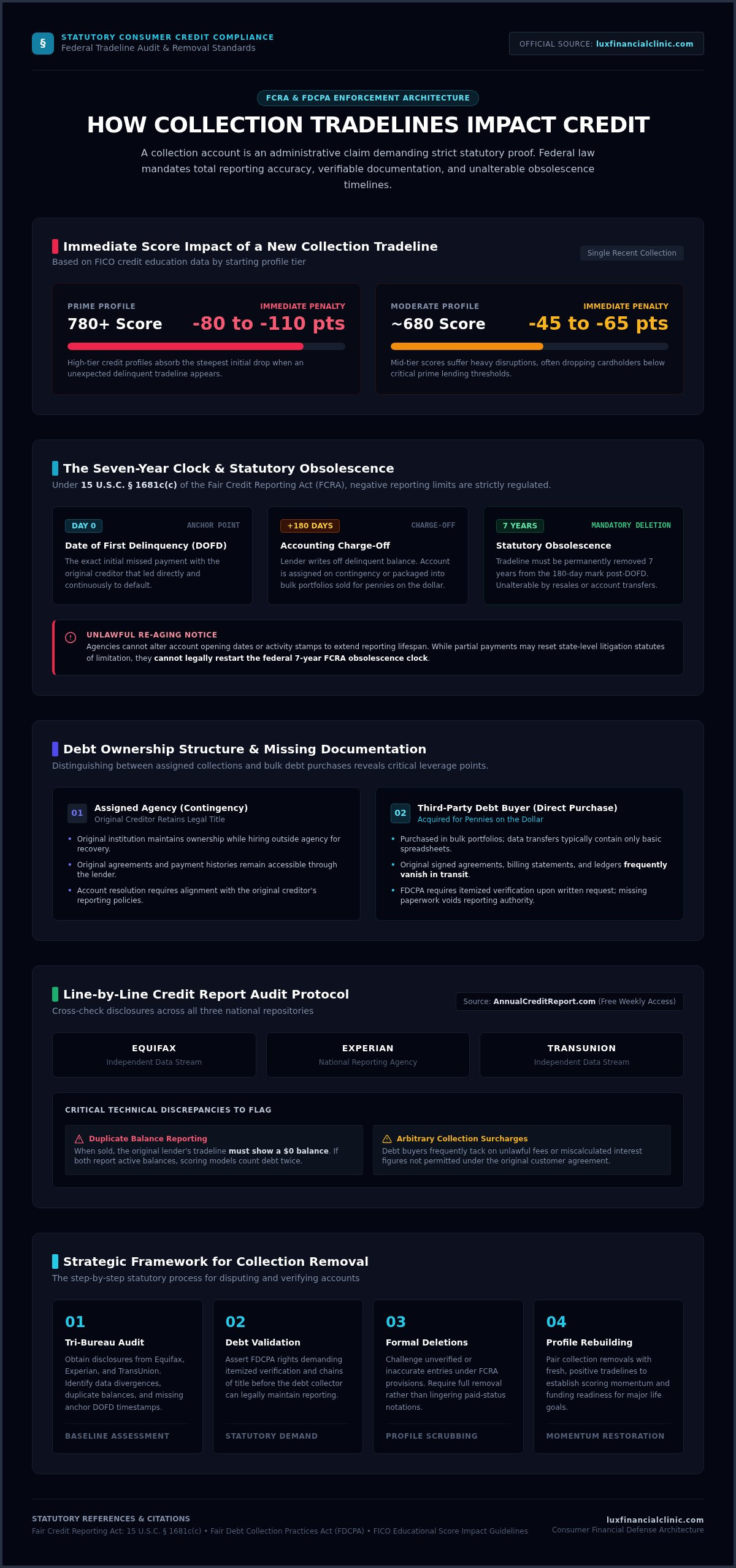
A collection account appears on your file when an original creditor decides a delinquent obligation is unlikely to be recovered internally. After approximately 180 days of non-payment, institutions write off the balance as an accounting charge-off and either assign the file to a contingency agency or package it into a portfolio sold to third-party debt buyers. Learning how to remove collections from credit report entries begins with realizing that an agency's presence on your file represents a reporting tradeline rather than undisputed proof of legal liability.
According to FICO credit education data, a single recent collection tradeline can cause a prime credit score above 780 to plummet by 80 to 110 points. For a consumer around 680, that immediate drop typically ranges between 45 and 65 points. This reporting entry acts as an administrative claim placed by an entity that acquired your data, often for pennies on the dollar. Because third-party collection agencies must adhere to statutory standards under federal lending rules, their authority to report depends entirely on verifiable records.
The Difference Between Original Creditors and Collection Agencies
Debt ownership generally follows one of two paths: assignment or direct purchase. In an assigned arrangement, the original creditor retains account ownership while hiring an outside agency to collect on contingency. Conversely, junk debt buyers purchase charged-off portfolios in bulk. These transactions often transfer little more than basic spreadsheets containing names, Social Security numbers, and stated balances.
Crucial documentation rarely accompanies these portfolio transfers. Original agreements, billing statements, and payment histories frequently vanish during transit. When you evaluate how to remove collections from credit report records, these administrative gaps become critical leverage points. Federal rules under the Fair Debt Collection Practices Act require collectors to validate balances upon written demand, meaning missing paperwork directly challenges their legal right to report the account.
The Seven-Year Clock and the Date of First Delinquency
Under 15 U.S.C. § 1681c(c) of the Fair Credit Reporting Act, the legal reporting window is non-negotiable. Negative collection tradelines must become obsolete seven years from a specific starting point:
- The seven-year timeline runs strictly 180 days after the Date of First Delinquency (DOFD) with the original creditor.
- The DOFD represents the initial missed payment that led directly to the eventual default.
- Portfolio resales, agency transfers, and account assignments cannot alter this timeline under federal law.
Unscrupulous agencies sometimes engage in unlawful re-aging tactics. They alter account opening dates or recent activity stamps to artificially extend the reporting lifespan past the statutory limit. While making a partial payment may reset a state's statute of limitations for lawsuits, it cannot legally restart the federal FCRA reporting obsolescence clock. Pinpointing this anchor date establishes complete clarity over when an entry must be removed.
Auditing Your Credit Reports for Critical Collection Reporting Errors
Before you can determine how to remove collections from credit report profiles, you need an exact baseline. Start by pulling your official consumer disclosures from Equifax, the major national reporting agencies, and TransUnion through AnnualCreditReport.com, where free weekly reports remain permanently available. Reviewing all three files side by side is essential because furnishers rarely transmit identical data streams to each credit repository.
A frequent error pattern emerges during secondary portfolio acquisitions: duplicate balance reporting. When an original creditor sells a charged-off account, their tradeline must update to reflect a zero balance. If both the original lender and the acquiring collection agency report active balances simultaneously, scoring algorithms count that outstanding balance twice, suppressing your profile unfairly.
Identifying Technical Inaccuracies in Account Records
Scrutinize the specific data fields on each collection tradeline with clinical precision. Debt buyers often introduce arbitrary collection surcharges or miscalculated interest figures that violate original account agreements. Under the FTC guidelines for disputing credit errors, every reported balance, fee, and timeline must mirror verifiable history.
- Ensure closed original creditor tradelines reflect a zero balance rather than an active past-due amount.
- Look for inflated collection balances that exceed the original contractual charge-off figure.
- Verify that the Date of First Delinquency matches across all three bureaus without variance.
Uncovering Chain of Custody and Ownership Gaps
When debt portfolios pass between successive debt buyers, the underlying chain of custody frequently fractures. Collectors must hold legitimate legal assignment and required corporate licensing to report an account on your profile. Missing bills of sale, gaps in title transfers, and clerical errors in personal identifying information render a tradeline legally unverifiable.
Pinpointing these structural gaps gives you the precise leverage needed to challenge inaccurate records effectively. If cataloging multiple bureau discrepancies feels overwhelming, scheduling a structured financial diagnostic consultation can help pinpoint reporting inconsistencies and bring total clarity to your credit restoration journey.
Step-by-Step Strategic Framework to Dispute Unverified Collections
Executing an intentional dispute process transforms your credit profile from an anxious burden into a well-managed financial asset. Instead of submitting emotional complaints, you must rely on verifiable paper trails and statutory timelines. Successfully understanding how to remove collections from credit report databases requires coordinating two distinct legal mechanisms: direct debt validation with the collection agency and formal factual disputes with the reporting bureaus.
According to the CFPB Consumer Response Annual Report released in March 2026, credit and consumer reporting issues accounted for 88% of all consumer complaints submitted to the agency, totaling roughly 5.8 million filings. Bureau investigations resolved over 2.1 million complaints with non-monetary relief like deletions in 2025 alone. Securing that outcome requires absolute procedural precision.
Executing the Debt Validation Protocol Under the FDCPA
Under CFPB Regulation F (12 CFR § 1006.34), third-party debt collectors must deliver an itemized validation notice either during initial contact or within five days following it. Your statutory validation window runs for 30 calendar days from the date receipt is assumed, defined as five business days after mailing. Send your validation demand via Certified Mail with Return Receipt Requested.
Demand complete accounting ledgers, including the itemization date, post-charge-off interest, and proof of legal assignment. If the collector receives your written request within this 30-day window, federal law mandates that all collection activities and credit reporting must immediately cease until substantive verification is provided.
Filing Direct Credit Bureau Disputes With Factual Precision
When drafting disputes for Equifax, Experian, and TransUnion, avoid online portals. Electronic portals often contain binding arbitration clauses and compress nuanced arguments into generic two-digit codes. Instead, dispatch physical dispute packets via certified mail following established CFPB credit report dispute procedures.
- Target specific data discrepancies like conflicting balances, invalid status codes, or absent account numbers.
- Include copies of your government-issued identification and utility bills to satisfy stringent FCRA § 611(a)(3) identity filters.
- Cite precise statutory requirements rather than relying on generic internet letter templates that bureaus routinely flag as frivolous.
Managing Investigation Outcomes and Mandated Deletions
Under 15 U.S.C. § 1681i(a)(1), credit reporting bureaus must conclude their reinvestigation within 30 days of receipt, delivering written results within five business days thereafter. If the collection agency fails to verify the tradeline with complete documentation, the bureau must delete the entry entirely. If an agency returns an automated verification without proper records, you retain the legal right to challenge their methodology. You can consult an executive credit strategist for structured multi-bureau dispute support to navigate complex responses effectively.
Resolving Valid Collections: Strategic Settlements and Deletions
When an audit confirms that an account is legally verified and within statutory timeframes, resolving the obligation requires deliberate strategy rather than reflexive payment. Simply paying off an outstanding collection balance rarely restores your credit standing on its own. True mastery of how to remove collections from credit report entries lies in recognizing the vital difference between an account updated to "paid collection" and a tradeline permanently deleted from your file.
A paid collection status confirms past delinquency while updating the outstanding balance to zero. While this satisfies the debt obligation, the negative historical mark remains visible to future underwriters. Total tradeline deletion removes the derogatory record entirely, wiping the slate clean so scoring models and lending evaluators evaluate your profile without that past blemish.
The Reality of Pay-for-Delete Agreements in 2026
Historically, credit bureaus discouraged collection agencies from deleting accurate records in exchange for settlement payments. Today, the operational reality among major national debt buyers has shifted. Prominent buyers, including Midland Credit Management, PRA Group, and Cavalry Portfolio Services, now maintain transparent policies that systematically request complete bureau deletion once an account is satisfied or settled in full.
Always secure written terms before transmitting funds. Demand an official letter on agency letterhead explicitly stating that the agreed payment satisfies the debt and that the agency will instruct Equifax, Experian, and TransUnion to remove the tradeline. Never provide electronic access to your primary bank account or make verbal agreements over the telephone.
Paid Collections Versus Complete Deletion on Lending Underwriting
How an account affects your profile depends heavily on which scoring algorithm a lender utilizes. Modern models such as FICO 9, FICO 10, and VantageScore 4.0 bypass collections showing a zero-dollar balance. Older algorithms still penalize you, however:
- FICO Score 8 continues to factor paid collection tradelines into your score calculation, muting potential score recovery.
- Conforming mortgage underwriting often relies on legacy tri-merge algorithms that treat paid and unpaid collections with similar severity.
- Automotive and Tier-1 personal financing providers frequently view any past-due collection history as elevated underwriting risk.
Achieving total file removal remains the only reliable way to insulate your profile across every scoring framework. If you want a structured plan to eliminate inaccurate marks and restore prime lending eligibility, invest in a dedicated Credit Repair Comprehensive Package to align your credit profile with your long-term goals.
Rebuilding Your Credit Profile After Collection Removal
Deleting an inaccurate collection clears derogatory weight, but an empty space on your report doesn't generate prime scores on its own. True credit restoration requires replacing removed negative records with positive, well-structured primary tradelines. While learning how to remove collections from credit report files resolves historical reporting flaws, intentional portfolio construction defines your future access to capital.
A resilient profile reflects active, positive data. When old collections disappear, your overall file depth temporarily contracts. Strategically adding fresh tradelines and managing statement balances immediately signals creditworthiness to modern scoring models and institutional underwriters alike.
Implementing Positive Trade Lines and Strategic Utilization
Strong credit profiles rely on deliberate account sequencing. Avoid predatory subprime cards that charge excessive maintenance fees while offering negligible limits. Instead, introduce well-structured builder accounts or secured cards from established institutions that report consistently across all three national bureaus.
Balancing your revolving architecture also requires precise utilization management:
- Maintain reported revolving balances strictly below 6% of aggregate limits to capture top-tier scoring points.
- Align payment timing with statement closing dates rather than payment due dates, ensuring bureaus capture minimal statement balances.
- Integrate structured installment tradelines alongside revolving credit cards to satisfy scoring model diversity requirements.
Partnering With a Dedicated Credit Strategist for Lasting Health
Restoring your credit standing rarely happens in a vacuum. Complex discrepancies often span across multiple credit repositories, requiring continuous diagnostic precision rather than isolated dispute efforts. Connecting your credit milestones with tangible lifestyle goals, such as business expansion or future property acquisition, turns credit restoration into an empowering personal transformation.
True financial wellness comes from steady, expert guidance. Schedule a financial diagnostic consultation to restore your credit foundation, optimize your tradeline architecture, and move forward with enduring confidence.
Restoring Your Credit Profile for Future Financial Momentum
Derogatory marks don't have to define your financial horizons or indefinitely delay your lifestyle goals. True success when learning how to remove collections from credit report files relies on clinical auditing, holding third-party agencies accountable to strict federal verification standards, and thoughtfully laying down positive primary tradelines. Transforming your credit profile isn't about rushed shortcuts; it's about executing deliberate, legally grounded adjustments that safeguard your borrowing power across every scoring model.
Navigating multi-bureau discrepancies and complex reporting rules becomes seamless when you have a dedicated specialist by your side. Lux Financial Clinic offers nationwide financial diagnostic consultations and structured dispute protocols to challenge inaccurate collection tradelines, paired with personalized credit-building roadmaps that support your long-term wealth and funding goals. Protect your peace of mind and begin your personalized credit restoration journey with Lux Financial Clinic. A pristine credit foundation is well within your reach.
Frequently Asked Questions
Can paying an old collection account restart the seven-year reporting clock?
No, paying an old collection account cannot restart the federal seven-year reporting clock. Under the Fair Credit Reporting Act, the obsolescence period remains permanently anchored to your Date of First Delinquency with the original creditor. While issuing a payment might reset a state statute of limitations regarding lawsuits, federal law strictly forbids credit bureaus from re-aging the credit reporting window based on payments, settlements, or ownership transfers.
What is the difference between debt validation and a credit bureau dispute?
A debt validation request is sent directly to the third-party collection agency under the Fair Debt Collection Practices Act, demanding documentation of their legal authority to collect. In contrast, a credit bureau dispute is submitted directly to Equifax, Experian, or TransUnion under the Fair Credit Reporting Act, challenging the factual accuracy of tradeline data fields. Both mechanisms play essential roles when evaluating how to remove collections from credit report files.
How quickly can a collection be removed from credit reports once disputed?
Credit reporting bureaus must conclude their reinvestigation within 30 calendar days of receiving your formal dispute package. If you provide supplemental evidence during that period, federal rules grant an additional 15 days. Once an agency fails to verify the account within the statutory window, the bureau must delete the entry and transmit written confirmation within five business days following the resolution.
Do paid medical collections still appear on modern credit reports?
No, paid medical collection accounts are completely excluded from consumer credit reports by Equifax, Experian, and TransUnion. The three nationwide bureaus maintain a standardized policy barring all paid medical debt, as well as any unpaid medical collections with an initial balance under $500. Additionally, eligible unpaid medical debts over $500 face a mandatory 365-day waiting period before appearing on your profile.
What happens if a collection agency verifies an inaccurate collection account?
If a collector verifies an inaccurate tradeline without substantive supporting proof, you can escalate the matter directly. Request a Method of Verification disclosure from the reporting bureau to examine how the furnisher corroborated the data. If the agency verified incorrect data without maintaining original contracts or itemized accounting ledgers, you can file a formal complaint with the Consumer Financial Protection Bureau to enforce compliance.
Is it possible to remove a legitimate, verified collection from a credit report?
Yes, removing a legitimate collection is possible through specific furnisher policies or negotiated goodwill requests. Major debt buyers frequently initiate voluntary bureau deletions once an account is settled or paid in full under standardized operational procedures. Alternatively, you can submit a written goodwill request directly to the original creditor, asking for an administrative deletion after satisfying the balance, though furnishers aren't legally required to grant deletions for verified records.
Will removing a collection automatically raise your credit score immediately?
Removing a collection account typically eliminates substantial derogatory weight, but individual score reactions depend on your overall profile architecture. When reviewing how to remove collections from credit report entries, modern scoring algorithms like FICO 9 or VantageScore reward file deletions quickly. However, older models like FICO 8 assess the entire profile, meaning overall utilization, age of accounts, and the presence of remaining negative marks determine the exact velocity of your score recovery.

