
Resolving a charged-off account is fundamentally an audit of regulatory reporting accuracy, not an emotional plea for leniency. If you've faced declined mortgage applications or stressful collection notices, you probably wonder whether you can legitimately remove charge offs from credit report records before the standard seven-year reporting window closes. It's completely understandable to feel anxious when a past delinquency threatens your major life goals, especially when there's widespread confusion around whether simply paying the balance repairs your profile immediately.
The truth is that credit bureaus are legally bound to reflect strictly accurate, fully verifiable information. In this guide, you'll discover the federal statutory framework, structured three-bureau dispute protocols, and strategic steps required to identify and address reporting errors across major credit reporting agencies like Equifax and TransUnion with Lux Financial Clinic. We'll walk through a clear, dignified roadmap designed to help you master your consumer rights, correct documentation flaws, and restore your financial standing with calm confidence.
Key Takeaways
- Understand that a charge-off is an internal accounting declaration by a lender after roughly 180 days of non-payment, not an erasure of the underlying balance.
- Discover how federal consumer protection statutes give you the right to challenge unverified, outdated, or conflicting data across all major reporting agencies.
- Learn a structured, multi-bureau audit protocol to address reporting inaccuracies and legally remove charge offs from credit report files when details fail verification standards.
- Clarify the critical differences between paid, settled, and unpaid statuses so you understand exactly how future lenders view your profile.
- Establish a reliable rebuilding roadmap that combines structured tradeline management with disciplined utilization kept strictly below ten percent.
Understanding Charge-Offs: What They Mean for Your Credit Profile
A charge-off is fundamentally an internal bookkeeping declaration, not a legal forgiveness of what you owe. When a lender writes off an account, they classify the unpaid balance as an uncollectible loss on their balance sheet. Gaining clarity on Understanding Charge-Offs helps demystify how these entries function behind the scenes. While the original creditor moves the asset into a non-performing category, your underlying legal obligation to repay remains intact. Understanding this distinction is essential before you attempt to remove charge offs from credit report records through formal dispute channels.
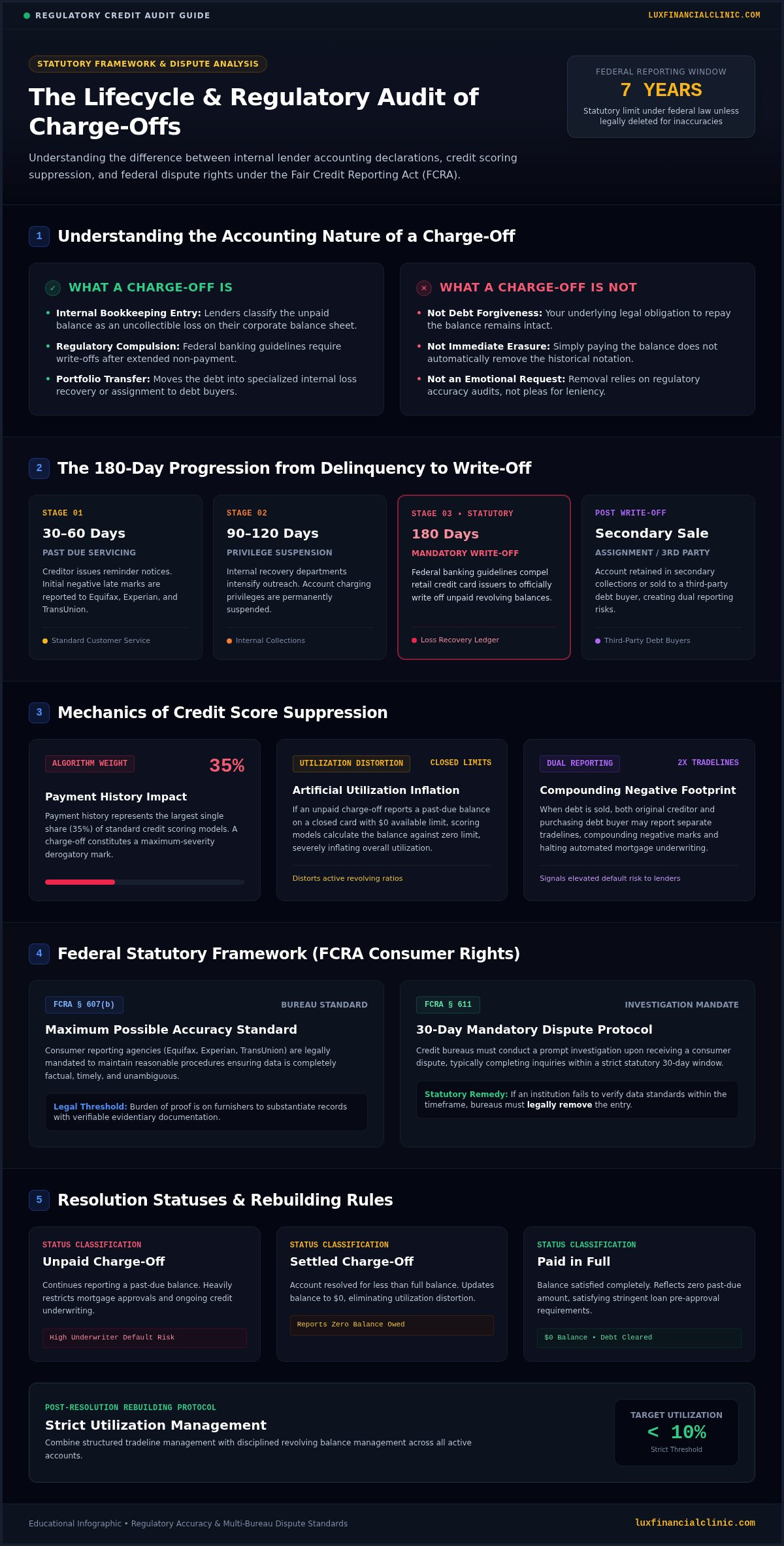
The progression toward a write-off follows a rigid, regulatory timeline that unfolds over several months of missed obligations:
- 30 to 60 days past due: The creditor issues reminder notices and adds initial late marks to your consumer files.
- 90 to 120 days past due: Internal recovery departments intensify their outreach while account charging privileges are permanently suspended.
- 180 days past due: Federal banking guidelines require retail credit card issuers to write off unpaid revolving balances, shifting the account from standard servicing to specialized loss recovery.
Once written off, the original institution either retains the account within a secondary collections department or formally sells the underlying debt assignment to a third-party debt buyer. If sold, both the original lender and the purchasing collection agency can report separate tradelines. This creates a compounding negative footprint that confuses many consumers who want to remove charge offs from credit report profiles.
The Anatomy of a Charge-Off: From Delinquency to Write-Off
The transition from a standard past-due bill to a written-off loss represents a shift in institutional custody. Between 30 and 120 days of non-payment, frontline customer service teams manage your account. At the statutory 180-day mark, federal regulations compel major banking entities to officially clear delinquent consumer assets from active ledgers. The account then transfers to internal recovery units or outside collection agencies tasked with aggressive asset reclamation.
Why Charge-Offs Heavily Suppress Credit Scores
A charged-off account inflicts severe, multifaceted damage across primary scoring algorithms. Because payment history accounts for 35 percent of a standard credit score, severe delinquencies heavily suppress overall ratings. If an unpaid charge-off continues reporting a past-due balance on a closed revolving credit card, scoring models often factor that balance into your credit utilization calculation. This drastically inflates your utilization percentage even if you hold low balances on other active accounts. When prospective mortgage underwriters run automated reviews, unresolved charge-offs signal elevated default risk, frequently halting loan approvals until the reporting details are methodically verified and resolved.
Legal Rights Under Federal Law: Can Charge-Offs Be Removed?
Consumer reporting agencies often suggest that accurate entries cannot be modified under any circumstances before statutory expiration. Federal consumer statutes tell a far more nuanced story. Under the Fair Credit Reporting Act (FCRA), the mandate governing Experian, Equifax, and TransUnion is not merely to publish adverse data, but to ensure maximum possible accuracy. When you examine how charge-offs affect your credit profile, the law demands that every underlying detail meet strict evidentiary thresholds. If a furnisher cannot substantiate an entry with verifiable documentation upon request, the bureaus must legally remove charge offs from credit report files regardless of account age.
Federal standards place distinct burdens of proof on both reporting agencies and original creditors:
- Maximum possible accuracy: Under Section 607(b), consumer reporting agencies must follow reasonable procedures to ensure that recorded items are completely factual, timely, and unambiguous.
- Duty to conduct investigations: Section 611 requires bureaus to conduct a prompt investigation upon receiving a consumer dispute, typically completing their inquiry within 30 days.
- Mandatory deletion of unverified data: If an institution fails to provide complete verification records within the statutory response window, the reporting agency is legally obligated to modify or delete the tradeline immediately.
For individuals seeking structured clarity when navigating complex reporting discrepancies, an objective Financial Diagnostic Consultation can help uncover underlying technical non-compliance across your bureau profiles.
The Fair Credit Reporting Act and Data Furnisher Obligations
Section 623 establishes explicit duties for entities reporting account information. Banks and collections departments cannot report data they know or have reasonable cause to believe contains errors. When a formal inquiry challenges the accuracy of a balance or payment status, the furnisher must review all relevant documentation. When records are missing, incomplete, or corrupted during institutional portfolio transfers, the law leaves no room for ambiguous approximations: the item must be promptly corrected or permanently purged.
The Seven-Year Statutory Reporting Window Explained
Federal statute limits adverse charge-off reporting to seven years from the date of first delinquency. This critical date reflects the initial missed payment that directly led to the default, never the date the account was charged off or subsequently assigned to collections. Transferring or selling the obligation cannot restart this clock. If a collection agency alters the original delinquency date, they commit an unlawful act known as re-aging, which provides robust legal grounds to challenge and remove charge offs from credit report documentation.
Strategic Steps to Audit and Dispute Inaccurate Charge-Off Entries
Remediating damaged credit requires an analytical, paper-based strategy rather than hasty online clicks. Rather than accepting high-interest consolidation loans that add new debt, consumers can take deliberate action to audit their files directly. The Fair Credit Reporting Act establishes a clear administrative process to dispute inaccurate charge-off entries across all three nationwide repositories. If you want to legally remove charge offs from credit report histories, you must approach the effort with the precision of a compliance auditor.
Executing a successful dispute demands a repeatable, five-phase protocol:
- Phase 1: Retrieve complete consumer disclosures. Obtain full credit files from Experian, Equifax, and TransUnion to review the raw data points reported by each institution.
- Phase 2: Perform a forensic side-by-side audit. Compare every data field across all three files, pinpointing mismatched dates, payment profiles, and balance calculations.
- Phase 3: Assemble objective documentary evidence. Collect historical statements, formal settlement receipts, cancellation agreements, or identification records that disprove the furnisher's claims.
- Phase 4: Construct structured formal written submissions. Package your findings into clear dispute packets that cite precise regulatory requirements and include supporting exhibits.
- Phase 5: Track verification timelines via certified mail. Send disputes using USPS Certified Mail with Return Receipt Requested, establishing an indisputable physical paper trail that locks in statutory response windows.
Bypassing standard web forms is critical. Online dispute portals often require consumers to select oversimplified drop-down categories, which can limit your legal rights and reduce detailed evidentiary narratives to arbitrary computer codes.
Identifying Critical Data Discrepancies Across Credit Bureaus
Credit bureaus rarely hold identical records. Look closely at account numbers, original delinquency dates, and historical payment grids. If an original creditor sold the underlying debt assignment to a collection agency, that original creditor must update their trade balance to zero. Showing an active balance on both the original charge-off and the new collection account is a blatant double-counting violation that distorts debt calculations.
Constructing Formal, Documented Dispute Packages
Written correspondence creates structural accountability. Your dispute package should calmly lay out each identified factual flaw, referencing specific attached account statements or billing disclosures as proof. When your written submission establishes clear evidentiary deficiencies, furnishers face an undeniable choice: substantiate the data with verified proof or delete the unverified entry entirely.
Collaborating With a Professional Dispute Strategist
Navigating multi-layered institutional bureaucracy can feel exhausting. Partnering with a dedicated strategist through a professional 3 bureau credit dispute service provides seasoned oversight for complex investigations. A qualified specialist systematically audits response findings, identifies technical reporting defects, and ensures credit agencies honor federal accuracy standards, protecting your peace of mind while working to remove charge offs from credit report records.
Paid, Settled, or Unpaid: Navigating Balance Resolutions
One common misconception is that paying off a charged-off account automatically erases the negative mark. In reality, fulfilling an outstanding obligation merely changes the status notation from unpaid to "paid charge-off" or "settled charge-off." The underlying historical record remains on file for the statutory seven-year reporting window unless verifiable reporting inaccuracies exist. Understanding how these variations display is critical when auditing your files to remove charge offs from credit report records.
Modern credit scoring models evaluate resolved charge-offs differently depending on the specific algorithm used:
- Unpaid charge-offs: Represent active, unresolved liabilities that continue to depress risk models and signal ongoing default exposure during manual underwriting reviews.
- Paid in full charge-offs: Update the reported balance to zero, which eliminates the negative impact on your overall revolving utilization ratio.
- Settled charge-offs: Indicate the creditor accepted an amount less than the contractual balance to satisfy the debt, closing the account with a zero-dollar balance.
While an older scoring model might not award immediate points simply for updating an account to paid, having a verified zero balance stops the account from worsening your debt-to-limit ratios. If you suspect your credit disclosures contain conflicting balance figures or unresolved accounting flaws, you can schedule a Financial Diagnostic Consultation with a dedicated specialist to assess your bureau files.
Status Comparison: Unpaid vs. Paid in Full vs. Settled
An unpaid charge-off presents a continuing roadblock during automated lending evaluations. Many mortgage and prime auto underwriters require open charge-off balances to be addressed before issuing final loan clearances. Paying in full or settling for an agreed amount closes the outstanding liability. Between the two, conventional underwriters view a zero-balance settlement nearly the same as paid in full, provided the tradeline no longer reports an active past-due balance.
Preventing Double Counting: Original Creditor vs. Collection Agency
Federal reporting guidelines establish clear rules when an original creditor transfers or sells a delinquent account to a third party. The moment an institution sells the debt assignment, it no longer owns the receivable. As a result, the original lender must immediately update their reported balance to zero dollars. If an original credit card issuer and an outside collection agency both report active balances simultaneously, they are artificially inflating your total debt load. This duplicate reporting violates federal accuracy mandates, providing clear leverage to challenge the entry and remove charge offs from credit report documentation across all three bureaus.
Rebuilding Financial Stability: Moving Forward With Confidence
True credit restoration requires more than addressing past delinquencies; it demands establishing an intentional, forward-looking financial foundation. While you work to address inaccuracies and remove charge offs from credit report records, cultivating healthy balance sheet habits ensures lasting credibility. Rebuilding your profile is an act of long-term wellness. When approached methodically, each deliberate step shifts your profile from recovery toward genuine financial strength.
Sustained credit health rests upon several practical daily disciplines:
- Keep revolving utilization strictly below ten percent: While standard guidance suggests thirty percent, maintaining balances under single digits signals exceptional fiscal control to automated scoring algorithms.
- Pace future credit inquiries: Resist the urge to submit multiple financing applications. Excessive hard inquiries suggest urgent liquidity needs and depress scores temporarily.
- Maintain impeccable payment consistency: Automate minimum payments across every open tradeline to ensure an unblemished record of on-time fulfillment moving forward.
By pairing administrative auditing with disciplined account management, you establish a resilient credit profile that supports major lifestyle milestones, from competitive business financing to prime homeownership terms.
Establishing Positive Trade Lines and Credit Architecture
Reconstructing your credit architecture starts with adding dependable, low-risk tradelines that report consistently. Opening a well-structured secured card backed by a cash deposit or initiating a credit-builder installment certificate creates fresh, active data. Confirm that your chosen financial institution reports monthly payment performance to all three major bureaus: Experian, Equifax, and TransUnion. Over time, these positive payment entries steadily dilute the scoring weight of older negative records, establishing a clear pattern of reliability.
Partnering With Lux Financial Clinic for Holistic Credit Restoration
Navigating the credit landscape doesn't have to be an isolating or stressful endeavor. At Lux Financial Clinic, our advisors reject high-pressure tactics in favor of a calm, boutique consultative experience that respects your intelligence. Through a personalized diagnostic assessment, our strategists design a customized Credit Repair - Comprehensive/Build Package tailored to your unique objectives. Rather than offering unrealistic shortcuts, we provide structured 3-bureau dispute protocols designed around federal consumer protection standards to legally address errors and help remove charge offs from credit report files, guiding you toward lasting personal independence.
Restoring Your Financial Authority and Long-Term Clarity
Addressing adverse credit entries is an objective regulatory audit, not an emotional trial. When you understand your statutory rights, you realize that inaccurate, conflicting, or unverified records have no legal standing on your consumer disclosures. By conducting a methodical audit and practicing disciplined balance management, you regain full control of your fiscal narrative. Reclaiming your peace of mind as you work to remove charge offs from credit report records is simply the first milestone in your broader journey toward stability.
You don't have to manage complex institutional reporting standards alone. At Lux Financial Clinic, we provide a boutique, dignified advisory experience focused on long-term personal empowerment. Our structured 3-bureau dispute protocols align with federal consumer reporting standards, while our comprehensive credit restoration packages pair you with dedicated strategist guidance every step of the way. Schedule a confidential consultation with Lux Financial Clinic today to begin your tailored path toward sustained financial wellness.
Frequently Asked Questions
Can accurate charge-offs be removed from a credit report legally before seven years?
Completely accurate and verifiable charge-offs are legally permitted to remain for seven years under the Fair Credit Reporting Act. However, bureaus must remove charge offs from credit report records if the furnisher cannot verify every underlying technical detail during a formal audit. Creditors sometimes agree to voluntary goodwill deletions for consumers with strong prior histories, but legitimate removal prior to seven years strictly requires identifying factual reporting deficiencies or lack of verification.
What is the difference between an account charge-off and a collection account?
A charge-off is an internal accounting declaration made by the original creditor declaring an account delinquent, while a collection account is created when that debt is placed with or sold to a third-party agency. The charge-off reflects the lender writing off the balance as bad debt after roughly 180 days. A collection represents an outside entity actively seeking repayment, which often results in two separate adverse marks on your file.
Does paying an old charge-off restart the seven-year credit reporting clock?
Paying an outstanding charge-off does not restart the statutory seven-year credit reporting clock. Under federal law, the seven-year obsolescence period is anchored strictly to the date of first delinquency preceding the write-off. While making a payment or acknowledging an old debt might reset the separate state statute of limitations for legal collection lawsuits, it can never extend how long an adverse tradeline remains visible on your consumer credit reports.
Will paying off a charged-off account instantly boost my credit score?
Fulfilling an unpaid charge-off rarely triggers an immediate credit score surge on older scoring models, though newer algorithms treat paid derogatory items more favorably. The primary credit benefit comes from updating the reported balance to zero, which immediately prevents the delinquent balance from distorting your overall revolving utilization ratio. It also satisfies underwriting prerequisites for mortgages and vehicle loans, clearing a major hurdle toward new financing approvals.
What happens if an original creditor and a collection agency both report a balance?
An original creditor cannot legally report an active past-due balance once they have sold the underlying account to a collection agency. If both entities display an active balance simultaneously, they are artificially inflating your debt utilization through duplicate liabilities. You can challenge this blatant data conflict to correct the reporting discrepancy or completely remove charge offs from credit report profiles when furnishers fail to resolve the duplicate records properly.
How can I dispute inaccurate charge-off information with the credit bureaus?
You dispute inaccurate charge-offs by sending structured, written audit requests directly to Experian, Equifax, and TransUnion via certified mail. Avoid generic online portals that compress your claim into basic drop-down codes. Instead, draft detailed dispute correspondence that identifies specific factual discrepancies, such as incorrect balance figures or misstated delinquency dates, and attach supporting documentation like account statements or billing disclosures to prove your position.
How long does a credit bureau investigation take after filing a dispute?
Consumer reporting agencies generally must conclude their investigations within 30 days of receiving your formal dispute package under Section 611 of the FCRA. If you provide supplementary documentation during the ongoing inquiry, the bureau may extend the statutory window by up to 15 days. If the furnisher fails to verify the accuracy of the disputed tradeline within this timeframe, the bureau must promptly modify or permanently delete the entry.


