
A credit check doesn’t automatically lower your score. Understanding hard vs. soft inquiries starts with the key distinction: a hard inquiry may affect your credit score after you apply for credit; a soft inquiry doesn’t. Both types may remain on your credit report for up to two years.
It’s understandable to feel cautious when a lender reviews your credit, especially while you’re comparing loan options. For certain loans, rate-shopping inquiries may be treated as one inquiry when they occur within a short window, though the window varies by scoring model.
This article explains what triggers each type of inquiry, who can see it, and how long it may appear on your report. You’ll also learn how rate shopping for mortgages, auto loans, and private student loans is treated, so you can make credit decisions with greater clarity.
Key Takeaways
- Recognize common hard inquiry triggers, such as applying for a new credit card, mortgage, auto loan, or personal loan.
- Know that checking your own credit is commonly a soft inquiry, which doesn’t affect your score.
- Plan loan rate shopping thoughtfully: scoring models may group multiple inquiries for the same loan type within a defined window.
- Understand that hard inquiries can be visible to others reviewing your credit report, while soft inquiries are visible only to you.
How long does a soft pull stay on your credit report?
A soft inquiry can remain on a U.S. credit report for up to two years without affecting your credit score. Checking your own report through a monitoring service commonly counts as a soft inquiry, so reviewing your file doesn’t have the same score impact as applying for credit.
Hard inquiries can also remain on credit reports for up to two years. Their reporting period and scoring effect are different: most credit scoring models stop counting a hard inquiry after 12 months. A hard pull may lower a score by a few points, but its effect depends on the broader credit profile. An inquiry’s continued appearance doesn’t mean it continues affecting your score.
For example, a credit card application may trigger a hard inquiry, while a prequalified card offer may involve a soft inquiry. A landlord’s screening may also involve a soft inquiry. These checks can appear on your report, but soft inquiries aren’t visible to others who purchase it. Check the inquiry type and date to understand what appears in your credit history.
If you find an unauthorized or inaccurate hard inquiry, contact the company associated with it and dispute it with the credit bureau reporting it. Explain why the inquiry is incorrect, and keep a record of your dispute and any response.
Before applying, ask the lender whether it plans to make a hard or soft inquiry and when the check will happen. Application disclosures may also explain the credit check. This distinction matters when comparing a soft-pull prequalification with a formal credit card or loan application, which may trigger a hard inquiry.
What Is a Hard Credit Inquiry?
A hard credit inquiry occurs when a lender reviews your credit report after you apply for credit. The lender uses information in your credit history to assess your application. Unlike a soft pull, a hard check is tied to a request for new credit, not simply a review of existing information.
Common triggers include applications for credit cards, mortgages, auto loans, and personal loans. For example, submitting a full auto loan application can prompt the lender to request a hard credit check. A lender may also review your report when you request a new credit line. The inquiry records that an application prompted a review, but it doesn’t show whether you made payments on time.
Soft inquiries serve different purposes. A lender may review an existing account when considering a credit-line increase, while a company may check eligibility before sending a prequalified loan or credit card offer. An employer’s background screening can also include a soft inquiry. These are reviews, not applications for new credit, so they don’t affect your credit score.
Employers, landlords, and insurers may use soft inquiries during screening. Hard inquiries can be visible to others who purchase your credit report, while soft inquiries are visible only to you. A utility company’s access depends on the type of report review: a hard inquiry may be visible to report purchasers, but a soft inquiry isn’t.
Checking your own credit report doesn’t create a hard inquiry. Credit monitoring services commonly use a soft pull, so reviewing your credit history through monitoring won’t lower your score. For example, checking your report before applying for a credit card lets you review your file without submitting a new credit application.
Rate-shopping treatment for loan inquiries
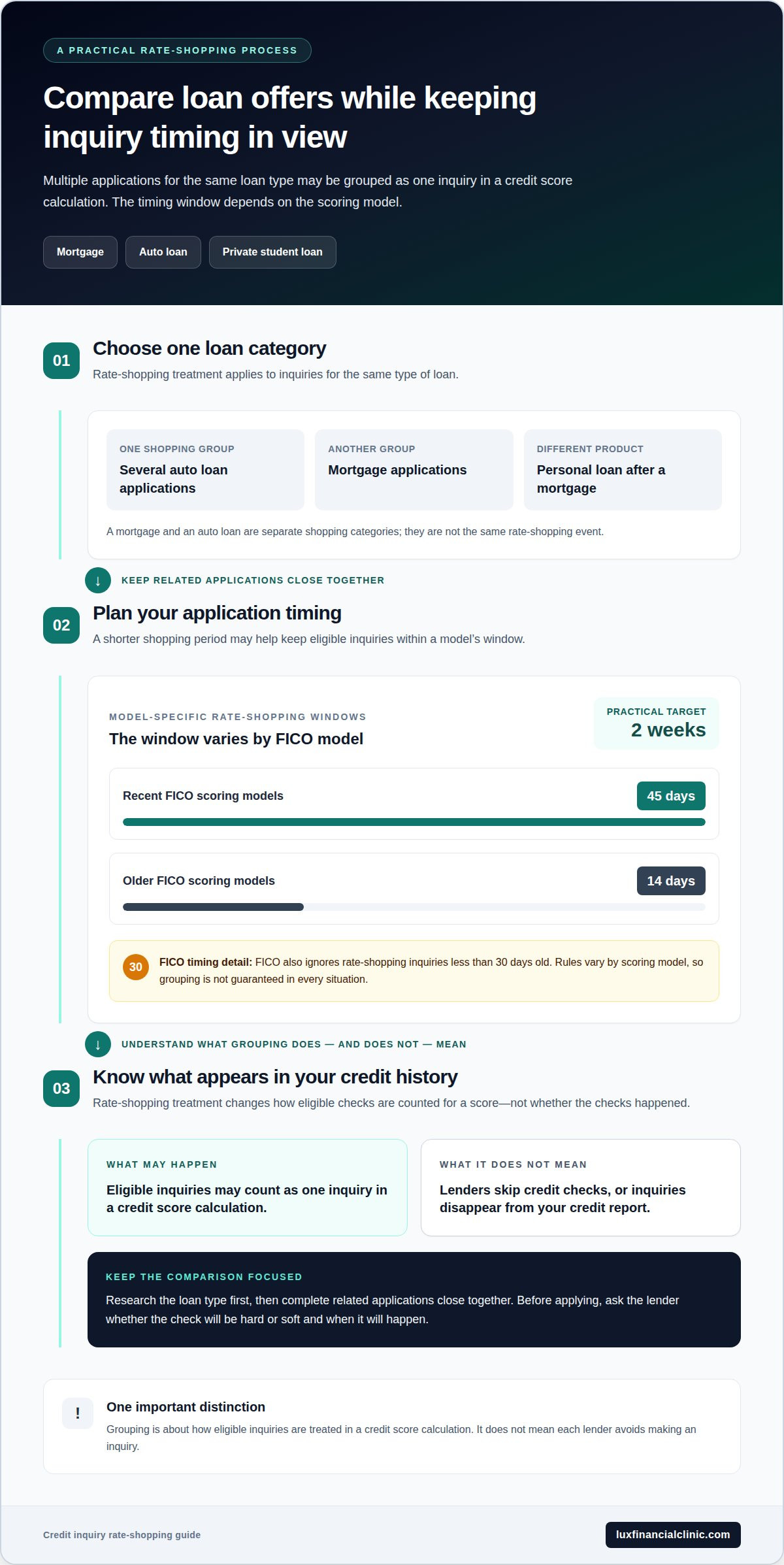
Applying to several lenders for the same loan can generate multiple hard inquiries. Credit scoring models may group rate-shopping checks, helping you compare offers without treating every application as a separate request for new credit.
Loan Rate-Shopping Windows
A rate-shopping window is a set period in which inquiries for the same loan type may count as one for scoring. Recent FICO scoring models use a 45-day window, while older FICO models use 14 days. FICO also ignores rate-shopping inquiries less than 30 days old. These rules make timing important when comparing mortgage, auto loan, or private student loan offers.
If possible, research and apply within two weeks. This shorter period may help credit scoring models treat checks as a single inquiry, though the window varies by model. Keep applications focused on the same type of loan: a mortgage and an auto loan are separate shopping categories.
How Loan Inquiries Are Treated
Rate-shopping treatment means eligible inquiries count as one inquiry in a credit score calculation, rather than as separate applications. It doesn’t mean each lender skips a credit check or that the inquiries disappear from your credit report. Knowing the difference helps you understand what may affect your score as you compare loan terms.
For example, several auto loan applications within a qualifying window may be grouped for scoring. Applying for a mortgage and then a personal loan isn’t the same rate-shopping event because the applications involve different credit products.
To keep comparisons organized, choose the loan type first, then complete related applications close together. For a mortgage, auto loan, or private student loan, a two-week shopping period is a practical target. Checking your own credit beforehand can help you review your file, but it doesn’t replace asking a lender whether an application will trigger a hard inquiry.
Differences between soft and hard pulls
Understanding hard vs. soft inquiries clarifies why two credit checks can appear on a report but have different effects. A hard inquiry follows an application for credit and may be visible to businesses reviewing your report. A soft inquiry can appear in your file, but only you can see it when you review your credit.
That visibility difference matters when you’re preparing for a financial decision. For example, a lender may see a hard inquiry linked to a recent credit card application. A soft inquiry from monitoring or a prequalified offer isn’t visible to that lender when it purchases your report. Both checks leave a record, but they reflect different kinds of credit activity.
Soft inquiries don’t affect your credit score. Hard inquiries may affect it because scoring models consider how recently and how often you’ve applied for credit. The impact depends on your overall credit profile, so the same hard inquiry won’t have the same effect on everyone.
Use the inquiry type to interpret what you find instead of treating every entry as a warning. A soft inquiry from an account review or prescreened offer doesn’t indicate a new application. A hard inquiry should generally relate to an application you recognize. If an entry looks unauthorized or inaccurate, contact the company associated with it and dispute it with the bureau reporting it.
For a full-file review, understanding hard vs soft inquiries also means distinguishing inquiry records from inaccurate negative items. Both types can remain on a report for up to two years, but hard inquiries generally stop counting toward most credit scores after 12 months. If your file includes inaccurate negative items beyond inquiries, explore credit repair support as a separate way to address those report concerns.
Lux Financial Clinic
Lux Financial Clinic can help you address credit report concerns beyond the difference between inquiry types. If your report also contains inaccurate negative items, its Credit Repair - Basic/Repair Package and Credit Repair - Comprehensive/Build Package use structured dispute protocols to address collections, charge-offs, late payments, and other negative items.
Credit repair may help when you’re reviewing broader report accuracy, but it isn’t necessary just because a legitimate inquiry appears. Understanding which checks affect your score can help you decide whether you need support with report concerns or simply clearer information about your credit activity.
For a thoughtful review of credit report concerns, contact Lux Financial Clinic.
Choose your next financial step with clarity
Understanding hard vs. soft inquiries can help you approach future credit applications more intentionally. Before applying, consider how the decision fits your broader goals and whether you need new credit now. If an inquiry raises questions, focus on the accuracy of your credit file and the next practical step instead of treating every credit check as a setback.
For concerns beyond inquiries, Lux Financial Clinic offers Credit Repair - Basic/Repair Package and Credit Repair - Comprehensive/Build Package. The clinic also offers Business Funding Consulting for business funding needs. These services address different concerns, so the right next step depends on the issue you’re working to resolve.
If you’d like support reviewing your financial concerns and considering a suitable path forward, contact Lux Financial Clinic. A thoughtful next step can bring greater clarity to your financial decisions.
Frequently Asked Questions
What Is a Soft Inquiry?
A soft inquiry is a credit report review that isn’t tied to an application for new credit. It can occur when you review your own credit, a current creditor checks an account, or a company screens you for a prequalified offer. Soft inquiries don’t affect your credit score. They can still appear in your credit file, giving you a record of who reviewed it.
How can you minimize soft and hard pulls?
You can limit hard pulls by applying deliberately rather than submitting several unrelated applications. Before applying, ask whether the lender will perform a hard inquiry. For a mortgage, auto loan, or private student loan, keep rate-shopping applications within a short period, such as two weeks. Soft pulls don’t affect your score, so focus on why a check appears instead of trying to avoid every soft inquiry.
Soft pull vs hard pull: what’s the difference?
A soft pull is generally linked to account reviews, prescreening, or your own credit review; a hard pull follows an application for credit. The practical differences are whether the check can affect your score and who can see it. A soft inquiry doesn’t affect your score and is visible only to you. A hard inquiry may affect your score and be visible to others who purchase your report.
What Does a Soft Credit Check Show?
A soft credit check gives the organization conducting it access to credit report information relevant to its review. For example, a current creditor reviewing an account or a company screening someone for a prequalified offer can use a soft inquiry. The inquiry itself doesn’t indicate that a credit application was approved. Approval is a separate decision based on the organization’s review.
What is the difference between a hard inquiry and a soft inquiry on a credit report?
Both types can be recorded on a credit report, but they aren’t equally visible. You can see soft inquiries when reviewing your own report, while others purchasing your report can see hard inquiries. A report entry can remain even after it stops influencing a score. For most scoring models, hard inquiries stop counting after 12 months, though they can remain on reports up to two years.
Which actions trigger a hard credit inquiry?
Applying for new credit commonly triggers a hard inquiry. Examples include applying for a credit card, mortgage, auto loan, or personal loan. After an application, a lender may use the inquiry and your report to assess whether to approve the request. By contrast, a current creditor’s review of an existing account is commonly a soft inquiry, not an application for new credit.


