
Mortgage shopping doesn’t have to mean a separate credit-score hit for every lender. In the United States, multiple mortgage lender credit checks made within a 45-day window are recorded on your credit report as a single inquiry. Applying for a mortgage after credit repair still calls for thoughtful timing, since inquiries can be visible to other lenders and may have a small negative effect on your scores.
It’s understandable to feel cautious after working to restore your credit. The next step is to understand how lenders view your credit profile now, and how everyday choices such as carrying card balances or opening new accounts can shape it. This guide explains how mortgage shopping affects credit, why debt levels and new accounts matter, and how long credit repair may take. You’ll also learn what to consider before moving from credit repair toward a mortgage application, so you can approach the process with greater clarity and confidence.
Key Takeaways
- Manage card balances with mortgage readiness in mind: the article recommends keeping utilization below 30%, with 10% as an ideal target.
- Mortgage shopping within a 45-day window groups multiple lender credit checks as a single inquiry on your report.
- Pause unnecessary credit applications and new accounts while preparing for a mortgage, since inquiries and account-opening activity can affect scores.
- Credit repair may take months or longer depending on the issues involved; Lux Financial Clinic’s Credit Repair - Basic/Repair Package can support work on inaccurate negative items.
How debt levels and credit utilization affect scores
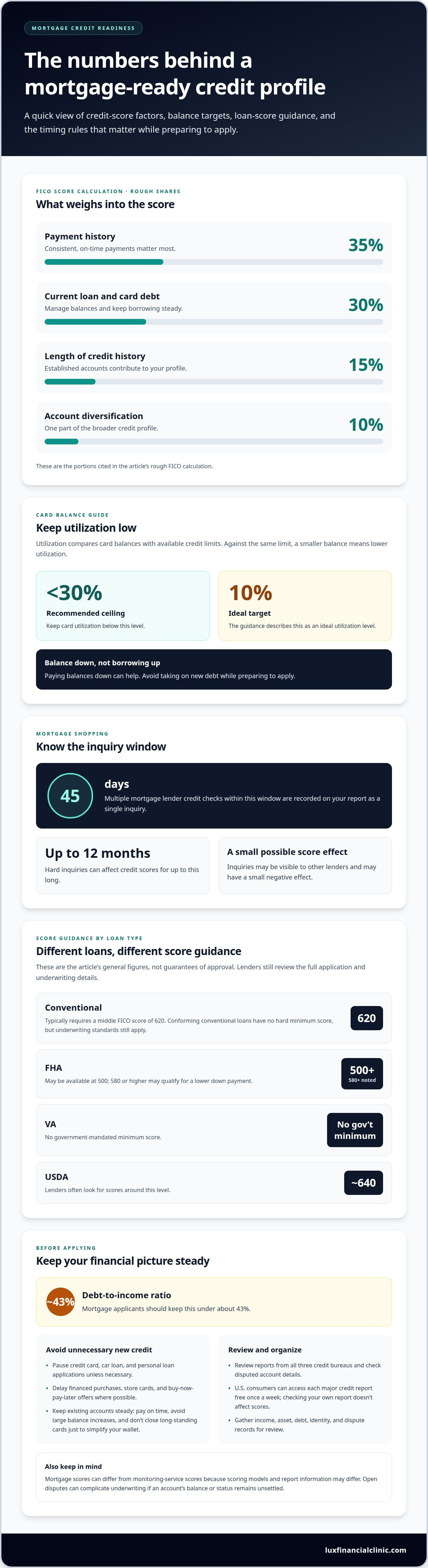
Credit card balances can influence mortgage readiness because utilization compares your balances with available limits. Keep utilization below 30%, with 10% as the ideal target described in the guidance. For example, carrying a smaller balance against the same limit produces lower utilization. Paying balances down can help, but avoid taking on new debt while preparing to apply.
FICO’s rough score calculation gives payment history the largest share, about 35%. Current loan and credit card debt accounts for 30%, while credit history length accounts for 15%. Account diversification makes up 10%. These portions show why consistent payments, manageable balances, and established accounts each contribute differently to a credit profile.
Mortgage score requirements vary by loan type. Conventional mortgages typically require a middle FICO score of 620, although conforming conventional loans have no hard minimum score and still require borrowers to meet underwriting standards. VA loans have no government-mandated minimum. FHA loans may be available at 500; a score of 580 or higher may qualify for a lower down payment. USDA lenders often look for scores around 640.
Mortgage credit scores can differ from scores shown by monitoring services because scoring models and report information may differ. Lenders typically pull reports from all three credit bureaus. Multiple mortgage lender checks within a 45-day window count as one inquiry on a report, though inquiries can be visible to other lenders and may have a small negative effect.
Gather documents that show your income, assets, debts, identity, and the results of credit-report disputes. Organize pay and tax records, bank statements, debt details, and dispute correspondence so your financial information is easy to review.
To confirm corrections across all three bureaus, review each report and compare the disputed account’s status and details. U.S. consumers can access each major credit report for free once a week, and checking your own report doesn’t affect your scores.
Open disputes can complicate underwriting if an account’s balance or status remains unsettled. Before applying, review reports, keep payments current, reduce balances, and avoid unnecessary borrowing; mortgage applicants should keep debt-to-income ratios under about 43%.
Avoiding other credit applications during the mortgage process
Once you begin preparing for a mortgage, avoid applying for credit cards, car loans, or personal loans unless necessary. An application can generate a credit inquiry and may lower your scores. A new loan also adds a payment that can change your monthly debt picture. For example, financing a car before buying a home may affect your credit profile and the amount of your budget available for housing.
Timing matters because hard inquiries can affect credit scores for up to 12 months. A single application may seem minor, but several applications can signal new borrowing activity while a mortgage lender reviews your finances. Keep existing accounts steady instead: make payments on time, avoid large balance increases, and don’t close long-standing cards simply to simplify your wallet.
Before accepting a store card or financing offer, consider whether the purchase can wait. A checkout discount, furniture promotion, or “buy now, pay later” offer may create new credit activity or obligations. Keep major purchases on hold during the mortgage process, and use available cash only after accounting for funds needed for the home transaction.
If an unexpected expense makes borrowing necessary, understand the potential impact before applying. A new inquiry may affect your score, while a new monthly payment can change the debts considered during underwriting. Keep records of necessary financial changes and be ready to explain them. Don’t move money or take on obligations without considering how they fit your mortgage budget.
A useful preparation step is to make a short “no new credit” plan with household members. Agree to delay applications, co-signing, and financed purchases until the mortgage process ends. If a lender requests updated financial information, respond accurately and disclose new accounts rather than leaving them unexplained. For support addressing credit-report concerns before mortgage shopping, explore credit repair support as part of your preparation.
Effects of opening too many new accounts
Each new account can change several parts of a credit profile at once. Account-opening behavior may account for up to 10% of a score’s calculation. Applying for a card, car loan, or personal loan can add an inquiry, while the new account may also change average account age and total available credit. Those effects can matter during mortgage preparation.
For example, opening a retail card to finance furniture before buying a home creates additional credit activity and a new balance. If the payment increases your monthly obligations, it can also change the debt picture lenders review. The concern isn’t simply having another account; it’s how the inquiry, balance, payment, and timing fit together.
New credit can change a recently repaired profile from the one you reviewed during preparation. Paying down a card may reduce its balance, for example, but opening another card soon afterward adds new activity. A lender may review updated credit information during the mortgage process, so consistent account use helps keep your financial picture steady.
Adding accounts to broaden your credit mix involves a trade-off. A mix of revolving credit and installment loans can be part of a credit profile, but opening an account solely to change that mix can create inquiries and new obligations. Avoid unnecessary applications instead of chasing a quick score change. Existing accounts with timely payments build useful history without new borrowing.
Before accepting financing, consider whether the purchase can wait until the mortgage process is complete. Weigh the potential payment and balance against your budget, and decline offers that aren’t essential. If an application is necessary, keep its paperwork and account details together. Accurate records can help explain changes if the lender reviews your credit again.
For a smoother transition from credit repair to home financing, focus on consistency: maintain existing accounts, avoid opening several accounts close together, and limit new obligations. This helps reduce avoidable changes while your mortgage application is under review.
How long credit repair can take
Credit repair timelines depend on the type of issue and whether information is inaccurate. A dispute generally takes 30 days to investigate; the period may extend to 45 days if you provide additional information during the investigation. Each unresolved error can require another dispute round, so several items may take longer than one correction.
Resolving multiple disputes may take 3-6 months in total, while repairing a score can take 3-6 months to a few years. The timeframe depends on the severity of the credit damage and the actions involved, such as correcting errors or paying down balances. A correction can address inaccurate reporting, but it doesn’t erase accurate negative history.
Some negative information stays on reports for years. Most negative information, including late payments, generally falls off after 7 years. Collections generally drop off 7 years after the first delinquency. According to the Federal Trade Commission, a Chapter 7 bankruptcy may remain on a credit report for 10 years; a Chapter 13 bankruptcy is likely to affect a report for seven years.
How long should you wait to apply for a mortgage after credit repair? The guidance recommends completing credit repairs 30-60 days before applying. Use that time to review updated reports for corrections, keep payments current, and avoid changes that could complicate the profile lenders see. Multiple dispute rounds or older negative information can mean the full recovery process takes longer than this preparation window.
Timing your application around completed corrections can help you present a clearer credit picture. Keep dispute records and updated reports together, and track which items changed and when. That creates an organized record if a lender asks about a removed or corrected entry. A credit repair professional can help structure this work; explore credit repair support for guidance addressing inaccurate negative items.
Lux Financial Clinic: Credit Repair - Basic/Repair Package
Lux Financial Clinic offers its Credit Repair - Basic/Repair Package for people addressing inaccurate negative information as they prepare for a mortgage. Its structured dispute protocols focus on items such as collections, charge-offs, and late payments. This service may help if you’ve identified inaccurate entries and want organized support with the correction process before applying.
Credit repair addresses credit-report issues; it doesn’t provide mortgage lending or guarantee a particular score or approval. If you’re reviewing your reports or addressing inaccurate items, Lux Financial Clinic offers credit repair support, including its Comprehensive/Build Package for broader credit-building guidance.
To discuss your next step toward clearer credit, contact Lux Financial Clinic about its credit repair services.
Move Forward With a Clear Credit Plan
Applying for a mortgage after credit repair is not just a matter of choosing a date. It’s an opportunity to align your financial picture with the home you want. Before moving forward, decide what needs to feel stable: your monthly budget, documented income, or confidence in the accuracy of your credit file. A deliberate plan can keep your purchase decision connected to your longer-term financial wellbeing.
Use this point to identify the remaining questions that could affect your readiness, then address them one at a time rather than rushing into a commitment. The appropriate timing depends on your credit history, current obligations, and mortgage goals. If structured support with credit restoration would help you plan your next move, contact Lux Financial Clinic. You can continue toward homeownership with a thoughtful approach and a clearer sense of what comes next.
Frequently Asked Questions
Does shopping around for a mortgage hurt my credit?
Mortgage shopping within a 45-day window records multiple lender credit checks as one inquiry on your report. The inquiry can still have a small negative effect, and other lenders may see it when reviewing your credit. Keep comparisons focused on mortgage applications during that window, and avoid mixing in unrelated credit card or auto loan applications that create separate inquiries.
How Long Does it Take to Repair Credit?
Credit repair can take from 3-6 months to a few years, depending on the credit damage and what needs attention. A dispute investigation generally takes 30 days, or 45 days if you provide additional information during the investigation. For example, correcting one inaccurate entry may take less time than resolving multiple disputes while also building a record of consistent payments.
Is it true that your credit clears after 7 years?
No. Most negative information, including late payments, generally falls off a U.S. credit report after 7 years, but that doesn’t mean every credit issue disappears then. Collections generally fall off 7 years after the first delinquency. According to the Federal Trade Commission, a Chapter 7 bankruptcy may remain on a credit report for 10 years.
Is it worth paying someone to fix your credit?
Credit repair support can help organize disputes over inaccurate negative entries, but paying for help doesn’t guarantee a particular score or mortgage approval. Lux Financial Clinic offers its Credit Repair - Basic/Repair Package and Credit Repair - Comprehensive/Build Package. Compare the support each provides with the work you need, especially if you’re comfortable reviewing reports and disputing errors yourself.
What happens when a mortgage lender checks my credit?
A mortgage lender typically reviews credit reports from all three national credit bureaus and considers credit information during its loan assessment. The check creates an inquiry that may be visible to other lenders and can have a small negative effect on your scores. For example, a lender may see mortgage inquiries alongside your reported balances, payment record, and account history.
What credit score do I need for a mortgage after credit repair?
The score threshold depends on the mortgage type. Conventional mortgages typically require a middle FICO score of 620, while conforming conventional loans have no hard minimum score and still require underwriting approval. FHA loans may be available at 500, with a score of 580 or higher potentially qualifying for a lower down payment. USDA lenders often look for scores around 640.


