
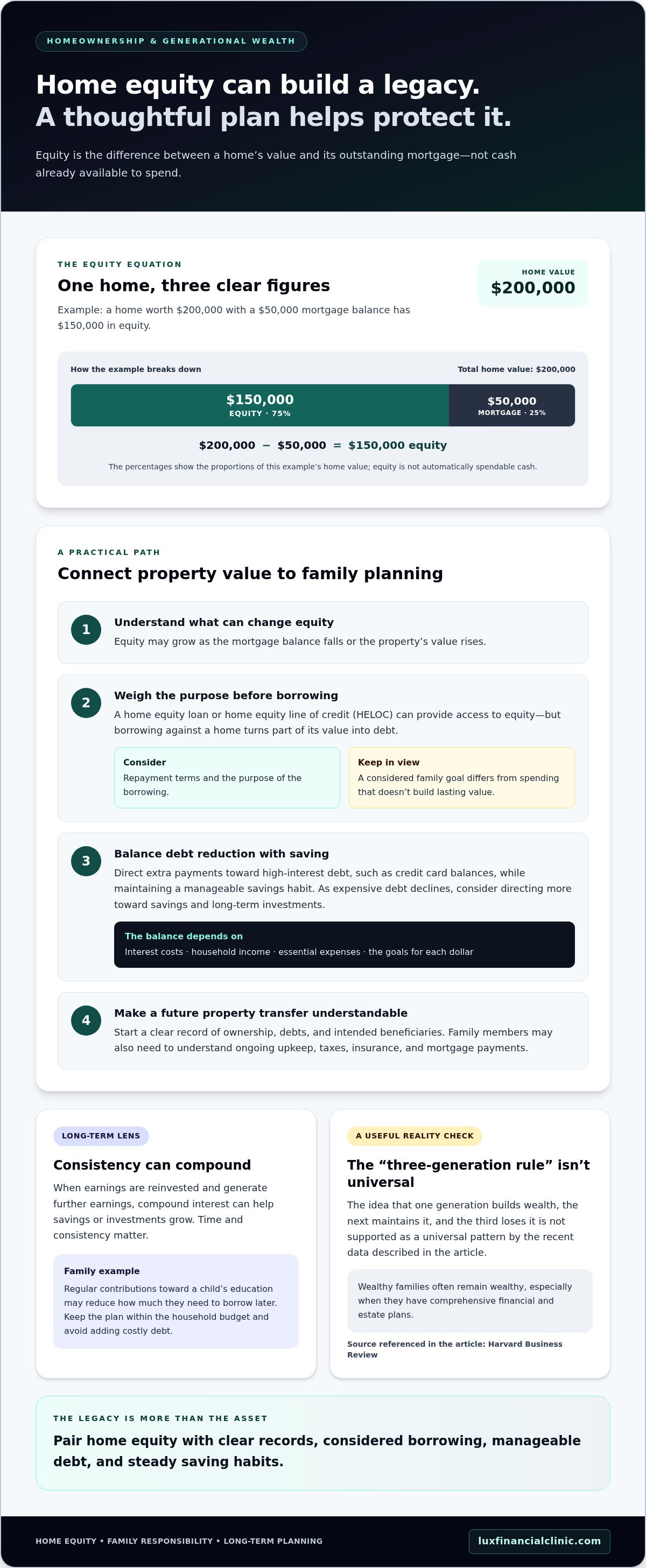
A home can be more than a place to live: as its value grows and its mortgage balance falls, it can build equity that may benefit the next generation. Building generational wealth with good credit means pairing assets such as home equity with responsible money habits, including timely payments and careful borrowing. For example, a home worth $200,000 with a mortgage balance of $50,000 has $150,000 in equity.
It’s easy to think of generational wealth as money or property passed down through a family. But the habits that preserve those assets matter just as much, from managing debt to teaching younger family members how to make informed financial decisions.
This article explains how credit can affect borrowing terms, why payment history matters, and how home equity may fit into a long-term family plan. You’ll also learn how responsible financial routines and credit builder loans can support progress. Building lasting wealth takes steady decisions, not one financial move.
Key Takeaways
- Understand how home equity can become a family asset, and why borrowing against it should fit a thoughtful long-term plan.
- Build habits that help younger family members manage money and care for assets responsibly.
- Learn how payment history, credit utilization, and other credit factors can shape borrowing terms.
- Use consistent bill payments and manageable balances to support a stronger credit history over time.
- Explore how a credit builder loan works and what to consider before adding a new payment obligation.
1. Homeownership, equity, and intergenerational wealth
Generational wealth can include cash, investments, businesses, and real estate transferred between family members. A home may contribute to that legacy when its value exceeds the remaining mortgage balance. For example, a home worth $200,000 with a $50,000 mortgage balance has $150,000 in equity. That figure represents the difference between the home’s value and its outstanding mortgage, not cash already available to spend.
Equity may grow as a mortgage balance falls or a property’s value rises. Homeowners may access it through a home equity loan or a home equity line of credit, known as a HELOC. Borrowing against a home turns part of its value into debt, so consider the repayment terms and purpose. Using equity for a considered family goal differs from borrowing for spending that doesn’t build lasting value.
The three-generation rule suggests that one generation builds wealth, the next maintains it, and the third loses it. Harvard Business Review says recent data doesn’t support this as a universal pattern. Wealthy families often remain wealthy, especially when they have comprehensive financial and estate plans.
How can families balance paying down debt with saving and investing for the next generation? Direct extra payments toward high-interest debt, such as credit card balances, while maintaining a manageable savings habit. As expensive debt declines, consider directing more money toward savings and long-term investments. The right balance depends on interest costs, household income, essential expenses, and the goals for each dollar.
Compound interest can help savings or investments grow when earnings are reinvested and generate further earnings. Time and consistency matter because growth builds on earlier growth. For example, regularly setting aside money for a child’s education can reduce how much they may need to borrow later. Make sure the contribution plan fits the household budget and doesn’t add costly debt.
Real estate can pass to future generations, but a transfer works best when family members understand the responsibilities involved. Property brings ongoing costs and decisions about upkeep, taxes, insurance, and mortgage payments. Start by listing the property’s ownership, debts, and intended beneficiaries. A clear record gives relatives a shared starting point for discussing its purpose and future management.
Practical strategies connect property ownership with everyday financial habits. Review mortgage progress, prioritize high-interest balances, and set a regular amount for savings or investing. Families considering a property purchase can use Real Estate Brokerage Consulting to think through the decision. The aim is not simply to leave an asset, but to help future generations understand its value and responsibilities.
2. Teaching responsible money decisions
Family conversations can turn money from a private mystery into a shared skill. Choose a regular moment, such as a monthly family meal, to discuss one practical topic. For example, explain how household income is divided among bills, saving, and planned purchases. Keep the conversation age-appropriate, and invite questions without judging mistakes. Children learn that financial decisions involve priorities, trade-offs, and follow-through.
Use specific examples rather than abstract warnings. If a child wants a new game, help them compare its cost with their available spending money. Discuss whether to buy it now, save for it, or choose a less expensive option. This exercise teaches decision-making without placing adult financial responsibilities on children. It also shows that saving is a deliberate choice, not simply money left over.
According to U.S. Bank, teaching children and grandchildren financial literacy helps them manage inherited assets responsibly. Start with everyday skills: identify coins and bills, compare prices, read a simple account statement, and set a savings goal. As children grow, introduce budgeting, responsible borrowing, and the difference between needs and wants. Connect each lesson to a real family decision, such as planning a school-supply purchase.
A clear routine makes saving easier to understand. Set an agreed amount aside for a specific goal, then let children track progress on paper or in a simple chart. Saving $42.00 every month for a year totals $504.00. Families can use this example to show how regular contributions add up over time. The amount should fit the household budget, so the lesson models sustainable choices rather than pressure.
Discuss family goals with care and privacy. Adults can explain that an emergency reserve, education costs, and future housing needs all draw on limited resources. Children don’t need access to sensitive account details to learn the principles. Instead, share a decision, explain the factors behind it, and invite them to suggest reasonable alternatives. This builds financial literacy while respecting appropriate boundaries.
Make lessons practical by assigning age-appropriate responsibilities. A younger child might compare grocery prices, while an older teen plans a small event within a set budget. Afterward, review what the family spent, what worked, and what could change next time. April is Youth Financial Literacy Month, a timely prompt to begin or refresh these conversations.
Families seeking a clearer view of their financial habits and priorities may find a Financial Diagnostic Consultation useful. It can help organize current concerns into practical next steps, while family conversations reinforce those decisions at home. Consistent examples, open discussion, and age-appropriate practice give children tools to handle future choices with greater understanding.
3. Credit scores and borrowing terms
A credit score can be a major factor in the loan rates and terms available in the United States. Lenders may consider credit information alongside income, existing debts, and the loan request when assessing an application. Stronger credit can support access to borrowing for assets, while expensive terms can leave less money for savings. Credit is one part of a financial picture, not a measure of a person’s worth.
Payment history makes up 35 percent of a credit score. Credit utilization, or how much available revolving credit is being used, is another significant factor. Credit history length, credit mix, and new inquiries or accounts also influence scores. A practical starting point is to review credit reports, check account details, and make a plan to address errors or high balances before applying.
What are the rules for adding an authorized user or co-signer to a credit account? An authorized user can use another person’s card, but the primary account holder remains responsible for managing the account. A co-signer shares responsibility for repaying the debt; the lender sets the application requirements and account terms. Before agreeing, both people should understand payment expectations and how account activity may be reported.
For example, a parent might add a child as an authorized user to introduce responsible card use. The parent should set clear limits, monitor charges, and pay the bill on time. Under 18, a person can become an authorized user on a parent’s credit card. Issuer policies and credit reporting practices affect whether account activity helps establish the authorized user’s credit history.
What are the risks of using credit to invest in real estate or a business? Borrowed money still has to be repaid if rent, sales, or investment returns fall short. A vacancy, unexpected repair, or slow business period can strain household cash flow and put other financial goals at risk. Before borrowing, compare expected income with repayment obligations and consider how the debt could affect assets intended for inheritance.
Lowering debt can help improve a person’s credit score and reduce interest costs that compete with saving. List balances, rates, and minimum payments, then prioritize high-interest debt while making required payments on time. This can strengthen your financial base, especially before borrowing for a major asset or business.
Credit habits also shape the options available to future generations. A well-managed account may help a family member begin building credit, but shared access requires trust and clear responsibilities. Discuss who pays, how charges are approved, and what happens if circumstances change. These conversations complement an estate plan by clarifying financial expectations alongside the transfer of assets.
4. Paying bills on time and building credit
Consistent bill payments can create a dependable foundation for credit and household planning. Start by listing every recurring bill, its due date, and the account used for payment. A simple calendar can help prevent missed due dates when work, school, or family schedules change.
Automatic payments can help keep bills on schedule and avoid late fees. Set them for recurring bills only after confirming that the linked account can cover each withdrawal. For bills with changing amounts, such as a credit card balance, set reminders to review them before payment. A calendar alert several days before the due date gives you time to check the bill and account balance.
Credit accounts need regular attention, not just an automatic payment system. Pay at least the required amount by its due date, and review statements for unfamiliar charges or errors. If income arrives on a regular schedule, align reminders with payday while leaving enough for essentials. This routine connects income to obligations clearly, rather than relying on memory or last-minute decisions.
Students can build positive credit habits through careful card use. Keep balances low and pay on time, avoiding purchases that can’t be repaid from available funds. A student who charges a small recurring expense can review the statement, confirm the charge, and pay it promptly. Consistent, on-time student loan payments can also help build a positive credit history.
Use a practical monthly review to keep payment habits organized:
- Match each bill to its due date and payment account.
- Review upcoming withdrawals against available funds.
- Check statements for unexpected charges or mistakes.
- Adjust reminders when income dates or bill schedules change.
This review can reveal a cash-flow problem before it leads to a missed payment. If several bills are due close together, note the timing and plan available funds around those obligations. Avoid taking on a new payment to cover another bill, since added debt can make future payments harder to manage.
Reliable routines can become part of a family’s financial legacy. Parents can show the next generation how a calendar, statement review, and timely payments work together. For example, a young adult managing a first student card can practice checking the balance before making a purchase. These habits support financial success by making everyday responsibilities clear and repeatable.
Over time, paying bills as agreed can contribute to a positive credit history, while careful account reviews help identify problems early. Families can discuss the routine without sharing private account details: explain how they track due dates, plan payments, and keep an eye on balances. This practical example gives the next generation a method to carry forward as its own financial responsibilities grow.
5. Credit builder loans
A credit builder loan is designed to help establish a record of installment payments. Instead of receiving the borrowed funds upfront, the borrower typically makes scheduled payments while the lender holds the loan proceeds. After repayment, the funds are released according to the loan agreement. This creates both a payment obligation and a savings outcome, so consider each carefully.
Before applying, review the payment amount, repayment schedule, fees, and how the lender reports account activity. Confirm that the monthly payment fits comfortably alongside housing, food, and other essential expenses. A loan supports a steady financial plan only when its payments are manageable and made as agreed. Don’t take on a new obligation just to add an account to your credit file.
Consider how the loan fits your broader goals. If you already have installment debt, another payment may strain your income without adding meaningful value. If your credit history is limited, a credit builder loan may provide a structured way to practice consistent repayment. Track due dates, set reminders, and review account statements to spot payment errors or unexpected charges.
Credit builder loans don’t create wealth on their own. Their potential value lies in the discipline of regular payments and the possibility of building credit history. Good credit may support better borrowing terms, while savings released at the end can help fund another priority. Directing those funds toward an emergency reserve or education goal may be more useful than immediately taking on fresh debt.
Keep the loan connected to your household budget. Compare the scheduled payment with dependable income after essential bills, then decide whether the commitment leaves room for saving. If income changes, review your budget early and contact the lender about account procedures. Don’t miss payments because the loan’s eventual savings benefit feels far away.
A credit builder loan is different from life insurance or an inheritance. Life insurance can provide a benefit to named beneficiaries under the policy terms, while a credit builder loan is a borrowing arrangement that may release funds after repayment. Families can include both in a wider plan, but each serves a distinct purpose. A loan isn’t a substitute for protection or an estate plan.
For a practical decision, compare the loan’s total repayment obligation with its intended benefit. Consider whether each payment will remain manageable, whether the account activity is reported, and what you’ll do with the funds once released. A clear plan helps prevent a credit-building tool from becoming an avoidable burden. The goal is to build lasting habits and assets that can be passed on, not simply to open another account.
Lux Financial Clinic: Credit Repair - Basic/Repair Package
Lux Financial Clinic offers its Credit Repair - Basic/Repair Package to people seeking help addressing inaccurate negative items on their credit reports. Its structured dispute protocols focus on items such as collections, charge-offs, and late payments. Reviewing those entries is a useful next step if you’ve found information that appears incorrect and want to understand its possible effect on your credit profile.
Credit repair is different from paying bills on time or using a credit builder loan. It focuses on disputing inaccurate information on credit reports, while consistent payments and careful borrowing support positive habits over time. No service can guarantee a particular credit score outcome, so keep building habits that serve your longer-term financial goals.
If you’re ready to discuss credit report concerns and possible next steps, contact Lux Financial Clinic.
Choose Your Next Financial Step
Progress becomes more manageable when you choose one practical step and give it consistent attention. Decide what needs focus now, whether that’s understanding your credit profile, strengthening your financial routines, or clarifying how business goals fit your household plan. Building generational wealth with good credit takes time and steady choices that can adapt as family needs change.
Lux Financial Clinic offers Credit Repair - Basic/Repair Package and Credit Repair - Comprehensive/Build Package for people seeking credit repair support. Its Business Funding Consulting may also suit entrepreneurs working through business funding questions. The right starting point depends on the financial concern you want to address, so focus first on the issue affecting your next decision.
A clear conversation can help turn that concern into an organized next step. Contact Lux Financial Clinic today to discuss your goals and explore a suitable direction. Steady progress starts with a choice you can carry forward, and that choice can help create a more thoughtful foundation for the generations ahead.
Frequently Asked Questions
What Is Generational Wealth?
Generational wealth includes money, property, businesses, and knowledge passed from one generation to another. It can mean a family home, savings, or practical financial skills that help relatives manage assets. For example, a parent might pass on a property and explain its upkeep costs and ownership documents. This combination of resources and understanding can help future family members make informed decisions about what they inherit.
How does good credit help build generational wealth?
Good credit can support access to more favorable borrowing terms, helping families preserve cash for other priorities. For example, someone preparing to buy a home can review their credit profile and budget before applying, then compare expected loan payments with household expenses. Building generational wealth with good credit also means treating borrowing as one tool in a broader plan, not as wealth in itself.
What credit score is considered good in the United States?
There isn’t one universal score that every lender labels “good.” Credit scoring models and lender requirements differ, and loan type, income, debts, and application details also affect decisions. Rather than relying on a single label, review the score and report relevant to your intended application. If you’re planning a major purchase, focus on accurate account information and consistent credit habits before applying.
How can I improve my credit score and maintain it over time?
Start by reviewing your credit reports and identifying inaccurate information, balances, or accounts you don’t recognize. Then choose a routine you can sustain, such as reviewing account activity on the same day each month. Avoid applying for several new accounts at once if you’re preparing for a major financial decision. Keep a written record of disputes, payments, and account changes to track progress over time.
How do mortgage rates and credit scores affect the cost of buying a home?
A credit score can be a major factor in the rates and terms offered on a loan. The interest rate affects borrowing costs over time, while the loan balance and repayment period also shape total payments. For example, compare proposed monthly payments with your budget, not just the home’s asking price. Include ongoing ownership costs in that review before deciding what you can comfortably afford.


