
What if paying a past-due account doesn’t erase the late payment from your credit report? If you’re asking how long do late payments stay on credit report, the general answer is up to seven years from the original delinquency date, usually the first missed payment. That timeline can feel discouraging, especially when you’re working toward future borrowing, but the entry’s visibility and its effect on your credit score aren’t the same thing.
It’s understandable to want a clear end date and to know whether bringing an account current changes the record. Payment may resolve the amount owed, but an accurate late payment generally remains until its reporting period ends. Its influence on a score may lessen over time, particularly as you establish a steady record of on-time payments.
This guide explains how the seven-year window is determined, how to review your reports for errors, and what steps may help strengthen your credit profile. You’ll also learn the difference between correcting inaccurate information and trying to remove an accurate entry, so you can approach your next steps with greater clarity and a measured plan.
Key Takeaways
- For a clear answer to “how long do late payments stay on credit report,” learn what the general seven-year window means and which date matters.
- See how a payment due date, delinquency reporting, and the date on your report can help you review the timeline.
- Understand why paying a past-due balance can update account status without automatically removing accurate payment history.
- Use a simple review process to compare report details with your account records and identify information that may be inaccurate.
- Explore practical ways to organize payments and build steadier habits, then consider a personalized credit-building roadmap.
How long do late payments stay on a credit report? The clear answer
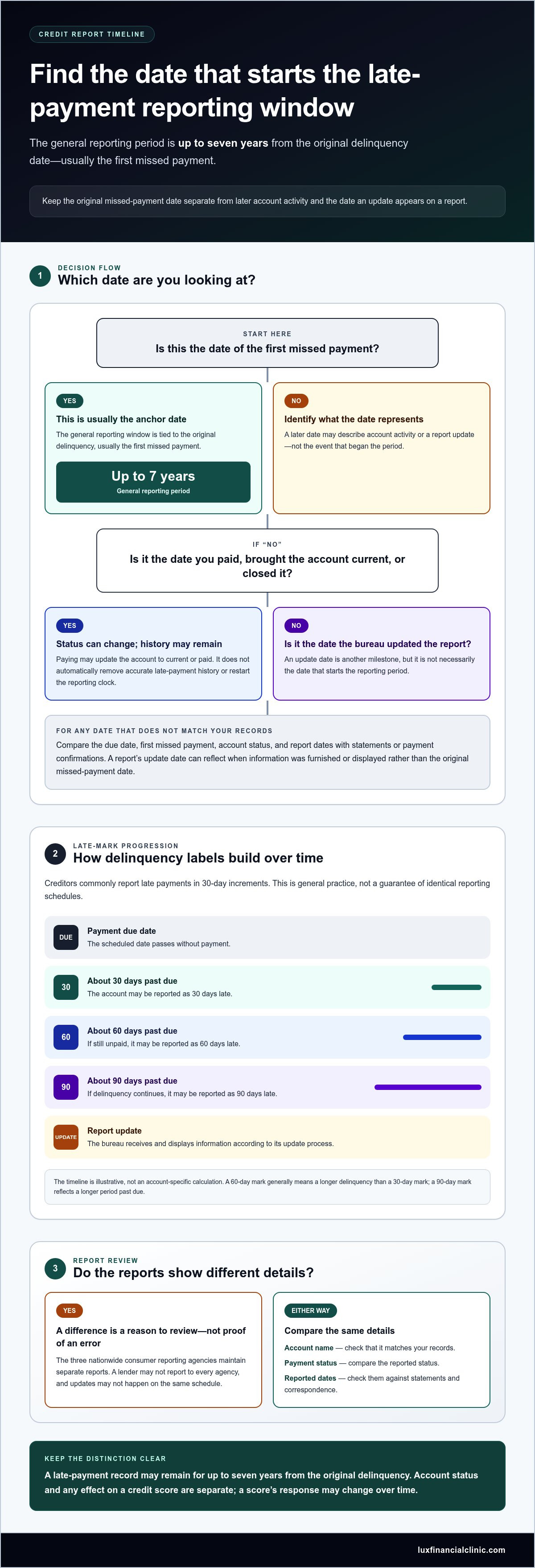
A late-payment record may generally remain on a credit report for up to seven years, based on the original delinquency date, usually the first missed payment. The Consumer Financial Protection Bureau (CFPB) describes seven years as the general reporting limit for most negative payment-history information. This is a reporting timeframe, not a promise that every account or report will display identical dates or details.
That distinction matters. A credit report is a record of account information, while a credit score is calculated from information in a report using a scoring model. A late-payment entry’s potential reporting period and its effect on a score are separate questions. The record may still appear even as its influence on a score changes over time. For a broader overview of understanding credit reports, it helps to remember that reports collect account history rather than present a single score or lending decision.
What does “up to seven years” mean for a late payment?
“Up to seven years” describes a general maximum reporting period, not an exact removal date that can be calculated from when you paid or closed the account. A late-payment entry is part of the account’s payment history, showing that a payment was reported late. It is different from a separate collection account, which can involve its own reporting details. The key date is the original delinquency, not the date the account was brought current.
For a practical record, note the payment due date, the first missed payment, any date the account was brought current, and the dates or status shown on your report. These milestones help you distinguish the event that began the reporting period from later account activity. Keep statements or payment confirmations nearby so you can compare the report’s timeline with your own records.
Does every credit report show the same late-payment history?
Not necessarily. The three nationwide consumer reporting agencies maintain separate reports, and the information displayed can differ. A lender may not report to every agency, and reporting or updating may not happen on the same schedule. A difference between reports isn’t automatically proof of an error, but it is a reason to review each entry and its dates rather than assume one report represents them all.
When checking, compare the account name, payment status, and reported dates across the reports you obtain. If one shows a late payment that another doesn’t, record the difference and look for account statements or correspondence that clarify what happened. The goal is not to expect identical files, but to understand what each report says and whether the information is accurate.
So, how long do late payments stay on credit report? The general answer is up to seven years from the original delinquency, while the account’s current status and any score impact are separate matters. Treat the timeframe as a guide, then use the dates in your account records and on each report to understand your own history.
When does the seven-year late-payment reporting period begin?
The timeline can look confusing because an account has several relevant dates. Start with the payment’s due date, then note when it became delinquent and how the creditor reported that status. The date an update appears on a credit report is another milestone, but it isn’t necessarily the date that starts the reporting period. Under the general rule described by the CFPB, the period is tied to the original delinquency, usually the first missed payment. The precise calculation should be checked against current FCRA and bureau guidance when reviewing a specific account.
Creditors commonly report late payments in 30-day increments, such as 30, 60, or 90 days past due. That’s general practice, not a guarantee that every creditor reports at the same moment or that every bureau displays an update on the same day. Keep the due date and account records separate from the report’s update date when you assess the timeline.
How do 30-, 60-, and 90-day late marks differ?
These labels describe how far past due the account was reported. A 60-day mark generally indicates a more prolonged delinquency than a 30-day mark, while a 90-day mark reflects a longer period past due. The timeline below is an illustration only, not an account-specific calculation.
Illustrative timeline:
- Payment due date: The scheduled date passes without payment.
- About 30 days past due: The account may be reported as 30 days late.
- About 60 days past due: If still unpaid, it may be reported as 60 days late.
- About 90 days past due: If the delinquency continues, it may be reported as 90 days late.
- Report update: The bureau receives and displays information according to its update process.
Use your billing statement or payment history to identify the missed payment, then compare it with the account’s reported status and dates. A report date can reflect when information was furnished or updated, rather than the original missed-payment date. If the dates don’t seem to align, save the relevant statements and correspondence for a closer review.
Can paying or closing the account restart the reporting clock?
No. Paying the overdue amount can change the account’s status, such as showing that it’s current or paid, but it doesn’t automatically erase accurate late-payment history. Closing the account doesn’t by itself remove that history or restart the reporting period. For a specific account, compare the original delinquency date with the dates shown on each report and current official guidance.
Understanding which date marks the missed payment, and which date simply reflects a later update, can make the answer to how long do late payments stay on credit report easier to assess for your own records. If you find potentially inaccurate dates or status details, structured credit report review support can help focus attention on reporting accuracy rather than promises to remove accurate history.
What a late-payment mark means for your credit, and what paying does not change
Paying a past-due amount doesn’t automatically remove accurate late-payment history from your credit report. It can resolve the overdue balance and change how the account is currently reported, but it doesn’t rewrite what happened earlier. That distinction helps answer a common concern behind “how long do late payments stay on credit report”: paying and report retention are related to the same account, but they’re not the same process.
Think of the information in three parts:
- Current account status: Whether the account is past due, current, paid, or closed.
- Payment history: The record of whether earlier payments were made on time.
- Credit-score effect: How a scoring model weighs the information in your file at a particular time.
These details can change on different schedules. An account may be brought current while its earlier late mark remains visible. A score may also respond differently as the account history ages or as other information in your credit file changes. So an entry staying on a report doesn’t mean its score effect remains fixed, and a paid balance doesn’t mean the entry has disappeared.
Does an older late payment affect a score in the same way forever?
Not necessarily. The influence of a late payment can change over time, but there’s no single score response or recovery schedule that applies to everyone. Credit-scoring models differ, and people’s credit files differ too. A lender may also use a particular model for its decision. An entry’s age may affect its scoring influence, but it doesn’t determine whether the entry is still within its reporting period.
For that reason, it’s better to avoid relying on a predicted point change or a promised date for recovery. The rest of your credit history and the scoring model being used matter. A later series of on-time payments may contribute to a stronger overall record, but it can’t guarantee a particular score or lending outcome.
What changes when an overdue account is brought current?
Bringing an account current may update its present status or balance, while leaving accurate past payment history intact. After making a payment, review a later report update and compare the account’s status and balance with your receipt or account statement. If the payment is reflected but the historical late mark remains, that alone doesn’t establish that the report is wrong.
If the current status, balance, or payment history appears inconsistent with your records, gather statements, payment confirmations, and relevant correspondence. Focus any correction request on specific facts you believe are inaccurate. Paying an overdue amount can be a constructive step toward stabilizing an account, but payment alone doesn’t guarantee faster score recovery or removal of accurate history.
How to check and challenge a late payment on your credit report
A careful review can help you distinguish an inaccurate entry from a late payment that’s being reported correctly. If you’re wondering how long do late payments stay on credit report, first make sure you’re looking at the right account and the right dates. A focused comparison of all three reports and your own records gives you a clearer basis for deciding whether to dispute anything.
Use this four-step review:
- Obtain your reports. Review reports from each of the three nationwide consumer reporting agencies. Don’t assume one agency’s file shows everything reported elsewhere.
- Locate the entry. Note the creditor, account details, month marked late, reported status, and any dates associated with the entry.
- Compare your records. Check account statements, payment confirmations, and relevant letters or messages. Confirm the account belongs to you and compare the payment date with the reported month and status.
- Decide whether there’s a factual issue. Identify exactly what appears inaccurate, incomplete, duplicated, or unfamiliar. If the entry matches your records, it may not be appropriate to dispute it simply because it’s unwelcome.
What should you compare before disputing a late payment?
Look at the creditor’s name, account information, reported month, and payment status, then compare each detail with your own documentation. Check all three reports because an entry on one doesn’t establish what appears on the others. Keep dated copies of the reports, statements, payment confirmations, and communications together. That organized record can make it easier to describe a specific discrepancy clearly.
For broader context on reviewing and addressing information across bureaus, the three-bureau credit dispute guide outlines the dispute process. Use it alongside your records, not as a substitute for checking the actual entry and supporting facts.
When is a dispute appropriate, and when is it not?
A dispute may be appropriate if an account isn’t yours, a payment is marked late despite records showing it was made on time, the reported status is incomplete, or the same information appears duplicated. State the precise detail you believe is wrong and include relevant supporting records. A general request to remove a negative mark gives less clarity than explaining which fact is inaccurate and why.
Accurate negative history isn’t removable simply because it’s stressful or inconvenient, and no dispute can promise a particular result or score change. If you’d like structured help reviewing potentially inaccurate negative items, explore credit repair support focused on reporting accuracy.
What to do after a late payment: build steadier credit
A late payment can be a reason to reset your routine, not a reason to give up on progress. The entry may remain on your report, but the habits you establish now can help support a stronger credit profile over time. Start with steps that make upcoming payments easier to manage, then decide whether you’d benefit from a more structured review of your credit picture.
How can you reduce the chance of another missed payment?
Choose a system you can maintain, rather than relying on memory alone. Add due dates to a calendar, set account alerts, and create a regular time to review upcoming bills. If you use automatic payments, confirm that the payment amount and funding account are appropriate and that the account will have funds available. Autopay can support a routine, but it doesn’t replace checking that payments are processed as expected.
If you anticipate difficulty making a payment, contact the creditor promptly to discuss your account and possible options. Reaching out early gives you a chance to understand the next steps before the situation changes. Keep notes on the conversation and save any follow-up communication with your account records.
A simple monthly routine can make these habits easier to sustain:
- Review upcoming due dates and choose reminders that fit your schedule.
- Check automatic payment settings and the account used to fund them.
- After payments are made, review statements for anything that needs attention.
- If a payment may be late, contact the creditor and keep a record of the discussion.
Consistent future payment behavior can support progress, but it doesn’t erase accurate past history. If you’re still asking how long do late payments stay on credit report, remember that reporting duration and the work of building steadier habits are separate concerns. You can make constructive changes now without expecting them to rewrite an accurate record.
When can personalized credit guidance help?
Guidance may be useful when you’ve reviewed your reports but want help organizing the findings into clear next steps. A financial diagnostic consultation can provide a structured conversation about your report details and longer-term goals. Beforehand, gather the reports you’ve reviewed, notes about any discrepancies, and questions you want to address. The financial diagnostic consultation guide explains how to prepare and what to expect.
Lux Financial Clinic’s structured credit repair focuses on disputing inaccurate negative items, including late payments, across the three major credit bureaus. The goal is accuracy, not guaranteed removal of information that’s being reported correctly. For readers seeking broader guidance, the Comprehensive/Build package includes a personalized credit-building roadmap and dedicated strategist support to help organize a considered path forward.
If a more structured review feels useful, you can explore credit support and consider what guidance may fit your next steps. A measured plan, grounded in accurate information and practical habits, can help you move forward with greater clarity.
Choose a thoughtful next step for your credit
A past late payment doesn’t have to define the direction of your finances. Use what you’ve learned to make your next move deliberate: keep a clear record of your accounts, follow a payment routine that suits your circumstances, and seek correction when you find a factual error. Knowing how long do late payments stay on credit report can bring clarity, but your ongoing choices can help shape the path ahead.
If you’d value tailored guidance, Lux Financial Clinic can help you assess your credit picture and consider practical priorities. Its approach centers on accuracy and informed planning, not promises to remove correctly reported history or guarantee a particular score. A clear plan can make the work feel more manageable, one considered step at a time.
Explore personalized credit support and decide whether structured guidance fits your goals. Progress may take patience, but each steady, informed choice is a meaningful way to move forward.
Frequently Asked Questions
Does closing an account remove a late payment from my credit report?
No. Closing an account doesn’t automatically remove accurate payment history, and the account may remain on your report with its payment record, subject to applicable reporting limits. If a closed account still appears, check whether its status and dates are correct. For example, compare the closure date with account statements and any final payment confirmation. If you find a specific factual error, dispute that detail; closure alone isn’t grounds to expect deletion.
Can I add a statement explaining why I paid late?
You may be able to add a brief consumer statement to a credit report, depending on the bureau’s process. It can offer context, such as explaining that a payment delay followed a billing issue, but it won’t change the account data itself or guarantee a different score or lending decision. Keep the statement factual and concise. Before adding one, check that the report accurately reflects the account history.
Is checking my own credit report a hard inquiry?
No. Checking your own credit report is generally treated as a soft inquiry and doesn’t lower your credit score. Reviewing it can help you spot an unfamiliar account, a date that doesn’t match your records, or an incorrect status. Use official report-access channels and save dated copies for reference. Reports from different bureaus may contain different information, so review each one rather than relying on a single file.
Can a late payment on a co-signed loan appear on my credit report?
It can. A co-signer may be responsible for the loan, and the lender may report account history connected to that obligation. Whether a specific late payment appears depends on the account and reporting practices. If you co-signed, review your loan documents and credit reports, even if another borrower manages the payments. Compare any reported late status with payment records before deciding whether there’s a factual error to address.
Are late rent or utility payments reported to the major credit bureaus?
Reporting varies by provider and account arrangement. A late rent or utility bill may not appear like a credit-card or loan payment, while an unpaid balance or third-party reporting could result in a separate entry. Check your reports and account notices to see what information is actually being furnished. If you find an entry, identify who reported it and compare the amount, dates, and account details with your records.
Can I dispute a late payment if I disagree with the lender’s decision?
You can dispute a factual error, such as a payment recorded for the wrong month or an account you don’t recognize. Disagreeing with a lender’s decision or regretting a missed payment doesn’t by itself make accurate reporting incorrect. Before submitting a dispute, gather evidence tied to the specific issue, such as a dated payment confirmation or statement. Keep copies of what you send and the records supporting your explanation.
Will a late payment affect every credit score I see?
Not necessarily in the same way. Scoring models may weigh information differently, and lenders can use different models when reviewing applications. The account entry may appear on a report even when score results vary. Treat a score you see online as a snapshot, not a prediction of every lender’s decision. Focus on accurate report details and consistent payment habits rather than expecting one universal point change.


