
A settled debt may correctly appear as “settled” rather than “paid in full,” but an inaccurate balance or account detail deserves attention. Contact the credit bureau reporting the error and follow its dispute process; negative marks generally remain for 7 years from the date of first delinquency. Knowing how to rebuild credit after debt settlement also means pairing accurate reports with careful, consistent credit use.
Seeing settled accounts on your credit report can feel discouraging, especially when you’re ready to move forward. A clear plan can help. This guide explains how to review your reports, dispute errors, make on-time payments, use credit carefully, and weigh whether to keep older accounts open. It also covers what can affect your rebuilding timeline and how steady habits support progress over time.
Key Takeaways
- Review all three credit reports for settled-account details, including whether the balance is $0 or marked as settled, and dispute inaccurate information with the bureau reporting it.
- Build a steady payment record by paying every credit-card bill on time and keeping balances below 30% of available credit.
- Before closing an older account with a positive payment history, consider how it may support your credit profile.
- Credit recovery takes time: meaningful improvement after debt relief typically takes six to 12 months or longer.
- A secured card that reports to all three credit bureaus can help establish consistent payment activity when used carefully.
1. What should I do if I find an error on my credit report?
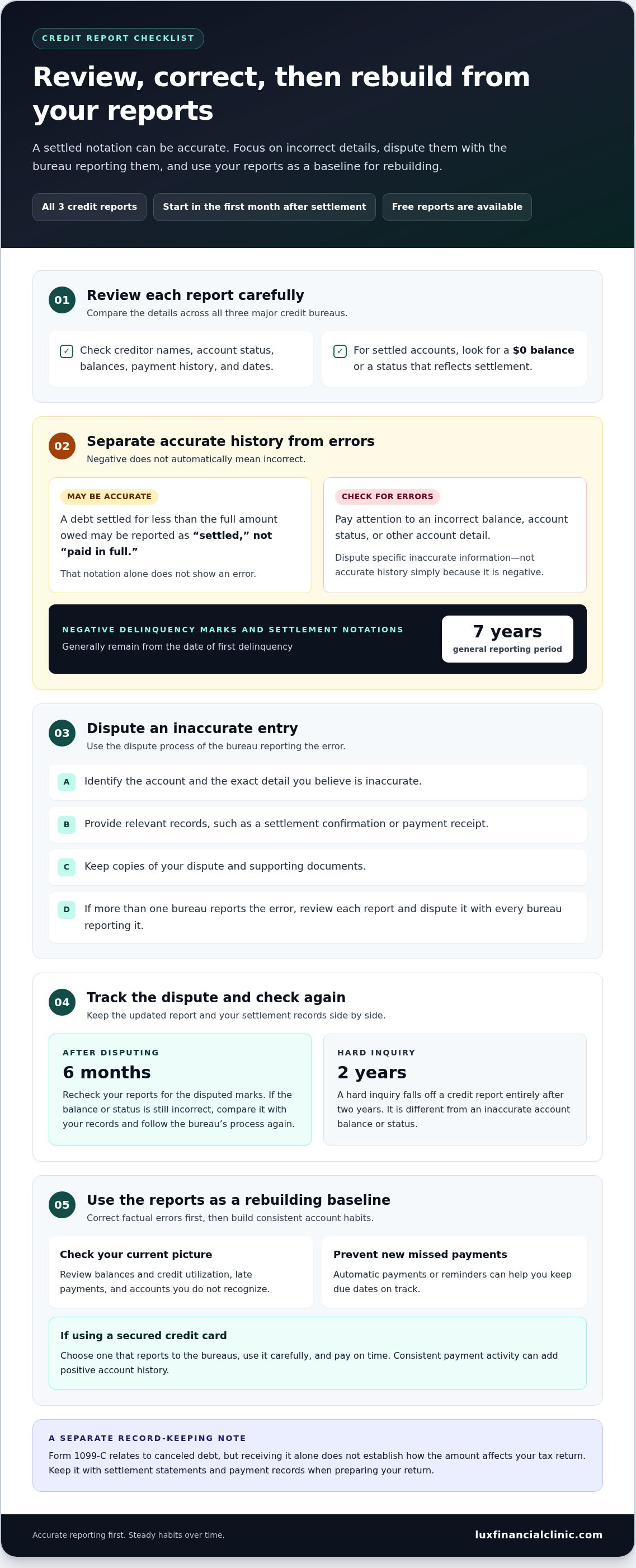
Start with the reports from all three major credit bureaus during the first month after completing settlement. You’re entitled to free credit reports, and reviewing each one can reveal differences between bureau records. Compare creditor names, account status, balances, payment history, and dates. Check settled accounts for a $0 balance or a “settled” status, then note any entry that appears inaccurate.
A debt settled for less than the full amount owed may appear as “settled,” not “paid in full.” That notation alone doesn’t show an error. Negative delinquency marks and settlement notations generally remain for 7 years from the date of first delinquency. Check that the account’s balance is $0 or that its status reflects settlement; don’t dispute accurate information simply because it’s negative.
If you find an error, contact the credit bureau reporting it and follow its dispute process. Identify the account and the specific detail you believe is inaccurate, then provide relevant records, such as a settlement confirmation or payment receipt. Keep copies of your dispute and supporting documents. If the account appears on reports from more than one bureau, review each report separately and dispute the error with every bureau reporting it.
After submitting a dispute, track its progress and recheck your reports 6 months after disputing inaccurate marks. If an account still shows an incorrect balance or status, compare the updated entry with your settlement records and follow the bureau’s process again. A hard inquiry, by contrast, falls off a credit report entirely after two years. Avoid treating every negative entry as a reporting error; distinguish inaccurate information from accurate history that remains on file.
Can settled debt lead to a tax bill, and how does IRS Form 1099-C apply? It can raise a tax question: Form 1099-C relates to canceled debt, but receiving the form alone doesn’t establish how the amount affects your tax return. The details of the cancellation and your tax circumstances matter, so keep the form alongside settlement statements and payment records when preparing your return.
Once you’ve reviewed your reports, use them as a baseline for rebuilding. Check balances and credit utilization, and look for late payments or accounts you don’t recognize. A settled-account notation and an incorrect balance call for different responses. Automatic payments or reminders can help prevent new missed payments. A secured credit card, managed carefully and reported to the bureaus, can add positive account history. Correct factual errors first, then build a record of consistent account management.
2. Secured credit cards and on-time payments
A secured credit card can add current payment activity to your credit history after debt settlement. You provide a deposit, which typically determines the card’s credit limit. Use the card for a planned purchase, then pay the statement balance in full each month. Its value comes from consistent payments, not from carrying a balance or spending more. Choose a card that reports payment activity to the credit bureaus so that history can appear on your reports.
Payment history is a major part of credit scoring. It accounts for approximately 35% of the widely used FICO scoring framework. A late payment can work against the record you’re trying to build, so make each payment by its due date. If you’re using a secured card alongside other accounts, include every minimum payment in your monthly plan. One missed due date can undermine the consistency that timely payments are meant to establish.
Set up a routine before your first statement arrives. Add the due date to your calendar, turn on account alerts, and consider setting up automatic payment for at least the minimum. This can reduce the chance of overlooking a bill, but review your account regularly to confirm the payment went through. When possible, pay the remaining statement balance in full. That keeps the account current without letting a revolving balance grow.
Keep spending manageable. For example, use the secured card for one recurring charge you can comfortably cover, such as a phone bill. Check the balance before the statement closes, then pay it in full. The goal is to show regular use and reliable repayment, not to use as much of the credit limit as possible. Make sure each purchase will still be affordable when the statement is due.
Consistency takes time to show up in credit reports. After debt consolidation, people may see a more significant score increase after three to six months of consistent, on-time payments. That timing relates to debt consolidation, so don’t treat it as a guaranteed schedule for every account or situation. Review reports for the new payment history as it appears, and continue the same routine. Each on-time payment adds another current record; a missed payment can affect the credit history you’re building. Keep the process simple: charge deliberately, track the due date, and pay on time every month.
3. Expected credit score recovery timelines
Credit score recovery after debt settlement usually happens in stages, not on one fixed date. You may see small changes within a month or two as payments are reported to the credit bureaus. Meaningful improvement after debt relief typically takes six to 12 months or longer. These periods describe possible progress, not a promise of a particular score or schedule. A useful first step is to record your current score and review it alongside the reports, so you can distinguish a short-term change from a sustained pattern.
Your rebuilding timeline depends on what your credit history shows after settlement. Existing late payments and settled-account notations can remain, while new on-time payments add more recent activity. A report with unresolved errors gives you a different starting point from one with accurate records and consistent payments. Correct errors, keep accounts current, and avoid credit you can’t manage. These steps address different parts of your profile, so score changes may not happen all at once.
Severity also matters. Recovery after serious events such as bankruptcy or foreclosure can take 12-24 months. That estimate concerns those severe issues, not a guaranteed timetable for debt settlement alone. The effect of settlement depends on the rest of your credit history, including payment patterns, outstanding balances, and the accuracy of reported information. Don’t judge progress from one number alone. Review whether new accounts are paid as agreed and whether reported balances reflect your actual accounts.
To track recovery with more clarity, keep a simple record of your starting point, report changes, and payment activity. When a creditor reports a new payment, allow time for the information to appear before assessing its effect. If a score shifts, look for the underlying change rather than reacting by opening another account. A hard inquiry can affect a score for 12 months and gradually fades during that time. Limiting applications helps keep your credit activity organized while you establish positive history.
Rebuilding is a process of adding reliable information while older negative history remains. Focus on the actions you control: pay on time, keep balances manageable, and check that reports accurately reflect account activity. A month or two may bring an early signal; six to 12 months or longer is a more realistic window for meaningful improvement after debt relief. Keep your records organized and compare trends over time. That steady review can show whether your habits are helping, even before the full recovery becomes visible in your credit score.
4. Keeping older accounts open
An older account with a good payment history can support your credit profile, so weigh its value before closing it. Keeping it open may preserve available credit and a longer record of account management. Closing it can reduce your total credit limit, potentially raising utilization if your balances stay the same. Consider the account’s history, fees, balance, and whether you can manage it responsibly.
How do on-time payments and account age affect credit rebuilding after settlement? On-time payments add positive recent activity, while an older account with a good payment history can help maintain an established credit record. Neither removes accurate settlement information, but together they can strengthen the overall pattern in your reports.
Before closing a card, compare its credit limit with your total balances. For example, using $1,000 of combined $5,000 credit limits equals 20% utilization. If you close a card and lose part of that available limit, the same balance could take up a larger share of your remaining credit. Keeping balances below 30% of available credit helps limit utilization, but paying the statement in full can keep debt from carrying forward.
Review the account terms and your spending habits before deciding. An account with a positive payment history may be worth keeping if you can avoid new charges and manage any annual fee. If an older card encourages spending you can’t repay, preserving its age shouldn’t take priority over avoiding new debt. You could remove it from everyday purchases while keeping it active, then monitor statements and due dates each month.
Make a considered decision rather than closing several accounts at once. List each account’s age, credit limit, balance, payment record, and fees. Comparing them can show which account provides useful available credit and which creates costs or payment risks. If you keep an account open, use reminders or automatic payments to avoid missing a due date. Review your credit reports after making account changes to see how balances and account status are reported.
Account age is only one part of rebuilding. A newer account with reliable monthly payments can add positive current activity, while an older account with missed payments may offer less support than one managed consistently. Keep older accounts open when their history is positive and their terms fit your budget. Combine that decision with low balances and on-time payments, and review your overall credit use before making another change.
5. Using secured cards or small loans to rebuild credit
A secured credit card can help build positive payment history when the issuer reports account activity to all three credit bureaus. You provide a refundable deposit, which usually sets the credit line. For example, a $300 deposit may establish a $300 limit. Most secured cards have a minimum deposit of $200, so choose an amount that fits your budget without reducing funds needed for regular expenses.
Keep the balance below 30% of available credit. A $200 utility bill would use the entire limit on a secured card with a $200 credit line. A $100 cellphone bill on that same limit would use 50%. These examples show why a recurring charge should fit the available limit. Consider starting with one modest purchase, then pay the full statement balance each month.
Timing and reporting matter. Consider a secured card 1-2 months after program completion, and confirm that it reports to all three credit bureaus. Use it for one recurring charge and pay the full balance before the statement closing date each month. Paying in full every month after opening helps establish payment history without interest costs. The deposit usually returns when you close the account with a $0 balance or the issuer upgrades it to an unsecured card.
A small loan can be another credit-building tool, but taking on debt solely to add an account may not suit your budget. Consider a credit-builder loan after 6-12 months of rebuilding, once the secured card is established and payments feel manageable. Before accepting a loan, review its payment schedule and confirm that it reports to all three credit bureaus. Include each payment in your monthly budget so the new account doesn’t create a missed-payment risk.
Start with one manageable account rather than opening several cards or loans at once. Each application can cause a small, temporary dip in your credit score, so avoid applying repeatedly while building a reliable record. Track the due date, set a payment reminder, and review statements for unexpected charges. A secured card or small loan is useful only if you can make payments as agreed. Let it build positive history over time, and keep balances low instead of borrowing more to chase a quick score change.
Lux Financial Clinic: Credit Repair - Basic/Repair Package
Lux Financial Clinic’s Credit Repair - Basic/Repair Package can help if your reports contain inaccurate negative items, such as collections, charge-offs, or late payments. Its structured dispute protocols focus on reviewing and challenging inaccurate information, not removing accurate settlement history or promising a particular score. If you’ve reviewed your reports and want support addressing errors, this can be a practical next step while you continue managing payments and balances carefully.
If you need broader support as you rebuild, Lux Financial Clinic’s Credit Repair - Comprehensive/Build Package is another option. Choose support based on the work you need, and keep copies of your reports and relevant account records for the review process. Contact Lux Financial Clinic to discuss credit repair support for your situation.
Choose a Steady Next Step
Your financial reset can focus on the priorities that matter now, whether that means correcting credit records or preparing for future goals. Learning how to rebuild credit after debt settlement is an opportunity to set a sustainable direction, guided by your current needs rather than pressure to change everything at once.
For help addressing inaccurate negative items, Lux Financial Clinic offers the Credit Repair - Basic/Repair Package. The Credit Repair - Comprehensive/Build Package provides another credit repair option. If business financing is your next priority, Lux Financial Clinic also offers Business Funding Consulting. Each service addresses a different need, so choose the support that fits your next steps.
Take the next step at a pace that feels considered and clear. Contact Lux Financial Clinic today to discuss credit repair support. You can move forward with intention, one practical decision at a time.
Frequently Asked Questions
What should I do if I find an error on my credit report?
Contact the credit bureau displaying the error and use its dispute process. Describe the specific detail that’s inaccurate, such as a payment marked late despite a receipt showing it was paid on time. Include relevant records and keep copies of what you submit. If the same mistake appears on reports from multiple bureaus, dispute it separately with each bureau reporting it.
How does debt settlement affect your credit score and credit report?
Debt settlement means negotiating with creditors to repay less than the total amount owed. The settled account can appear as “settled” rather than “paid in full,” and related negative payment history can affect your credit profile. Check that the account reflects its settled status and a $0 balance. Then focus on adding accurate, current account activity through payments you can manage consistently.
How long does settled debt stay on a credit report?
Negative delinquency marks and settled notations generally remain on a U.S. credit report for 7 years from the date of first delinquency. That date matters more than the date you check your report or complete settlement. Review the account’s reported dates for accuracy, and distinguish correct history from errors. Accurate negative information isn’t removed simply because the debt has been settled.
What steps should you take to rebuild credit after debt settlement?
To understand how to rebuild credit after debt settlement, start with accurate reports and a payment routine you can maintain. Review account details, keep current obligations up to date, and avoid applying for credit without a clear need. If you use a card, set a reminder before its due date and keep spending within your budget. Consistent habits create a clearer record of how you manage accounts now.
How can you get a secured credit card after debt settlement, and what fees should you compare?
Look for a secured card that reports payment activity to all three credit bureaus, and review its deposit requirements before applying. Compare the annual fee, late-payment fee, returned-payment fee, and interest rate. Read how the issuer handles your deposit if you close the account or qualify for an upgrade. Choose a card whose terms and monthly payment fit your budget.
How do credit-builder loans help rebuild credit, and what do they cost?
A credit-builder loan can add a new payment record as you make scheduled payments, provided the lender reports the account to the credit bureaus. Before agreeing, compare the interest, fees, payment schedule, and total amount you’ll repay. Check what happens if you pay late and when you can access any funds held during the loan. Borrow only if the payments fit your budget.
How much of your credit limit should you use to improve your credit score?
Aim to use less than 30% of your available credit. Calculate utilization by dividing card balances by total credit limits, then multiply by 100. For instance, if balances rise while limits stay unchanged, utilization rises too. Check balances before statements close, since reported balances can differ from what you owe after making a payment. Keep purchases manageable rather than spending to reach a target.
How can you check credit reports and dispute errors after debt settlement?
Review all three credit reports, since an account’s status or balance can differ between bureaus. Consumers are entitled to free reports from the major bureaus. Compare the settled account’s balance, status, and dates with your settlement records. For an error, contact the bureau showing it, follow its dispute instructions, and save the records you submit. Recheck reports 6 months after disputing inaccurate marks.


