
According to the 2025 Federal Reserve Small Business Credit Survey, only 42% of financing applicants received the full amount they sought. That’s a reminder that credit readiness for business funding involves more than a single score. Lenders may consider personal credit, business finances, cash flow, and how clearly you present your application.
If you’re unsure which credit profile a lender may review, or worry that past credit challenges could close the door, you’re not alone. It can also be hard to know which records to gather and what to address first. These concerns are understandable, but they don’t have to define your next step.
This guide explains how personal credit, business financials, and application preparation work together. You’ll learn how to assess your current position, organize key information, and identify priorities before funding conversations begin. The goal isn’t to promise approval or a particular outcome. It’s to help you approach the process with greater clarity and a coordinated plan.
Key Takeaways
- Credit readiness for business funding is a coordinated profile, not a single score. Lenders may consider personal credit, business credit, cash flow, and supporting records.
- Understand what each part of your financial profile can tell a lender, then identify gaps that need attention.
- Match the funding option to its purpose, repayment structure, and flexibility before deciding which path to pursue.
- Prepare in a deliberate order: define your funding need, review credit information, organize records, assess cash flow, and compare options.
- Financial diagnostic consultations and business funding consulting can help clarify priorities and organize next steps.
What Credit Readiness for Business Funding Really Means
Credit readiness means being prepared to present a clear, credible picture of your business and its finances when exploring funding. It doesn’t promise a lender will approve an application, and it isn’t measured by one number alone. The goal is to understand your current position, organize relevant information, and identify questions to address before funding conversations begin.
Credit readiness: A clear, organized view of the financial information a lender may consider, paired with a practical understanding of your funding purpose and next steps.
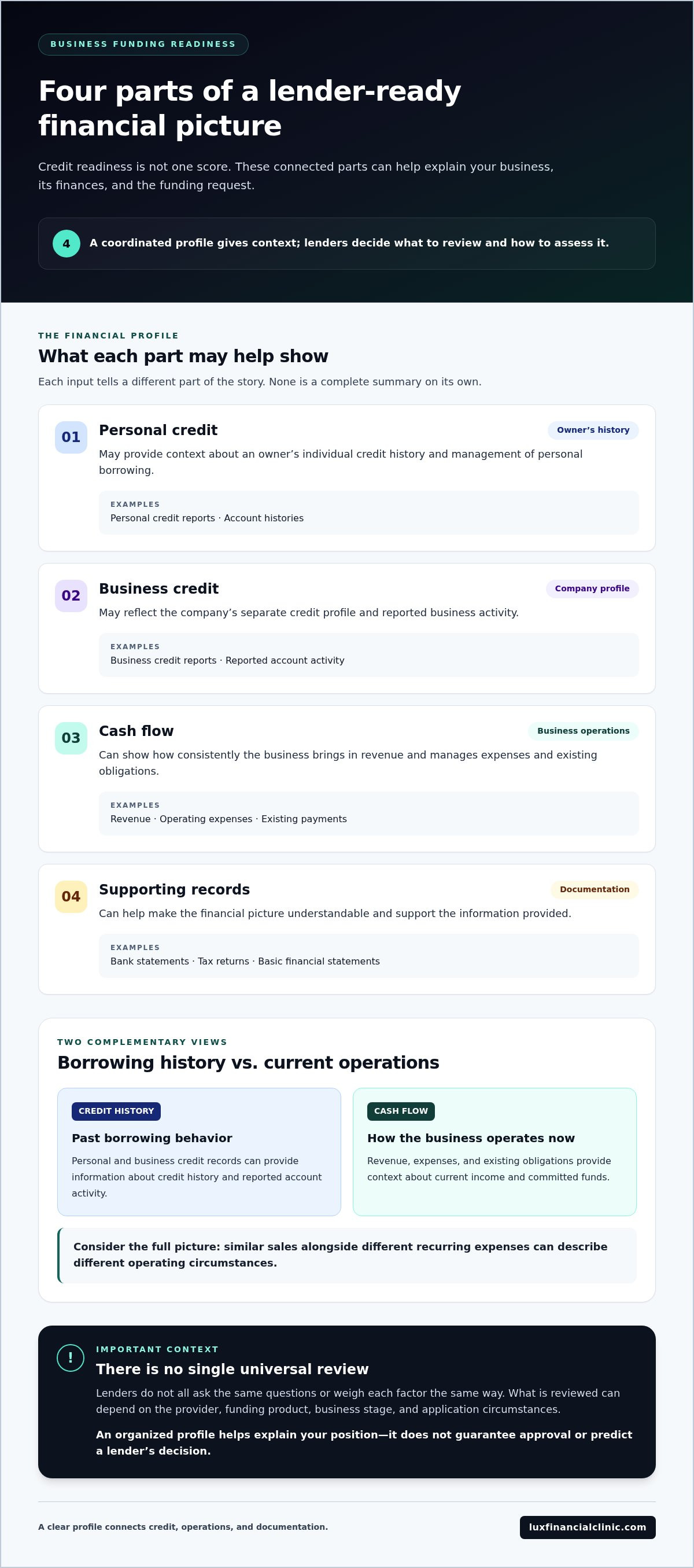
Four dimensions work together: personal credit can provide context about an owner’s credit history, business credit can reflect the company’s credit profile, cash flow can show how the business manages money coming in and going out, and supporting records can explain revenue, obligations, and the funding request. A Credit Score is one part of that wider picture, not a complete summary of business readiness.
Which parts of your financial profile may matter?
Depending on the application, a lender may review personal credit, business credit, revenue, cash flow, existing obligations, and records that support the information provided. These details can help the lender understand how the business operates, what it owes, and how a funding request fits its financial circumstances. Lenders don’t all ask the same questions or weigh each factor in the same way.
The review can also vary by funding product, business stage, and application circumstances. A newer business, for example, may have a shorter operating record than an established company. That can affect what information is available to review, but it doesn’t determine the outcome. Start by understanding your own profile rather than assuming one universal requirement applies.
Why credit readiness is not a funding guarantee
Preparation is within your control; an approval decision is not. Lenders set their own criteria, evaluate applications, and decide whether an offer fits their requirements. Even a well-organized profile may receive a different assessment depending on the lender and funding option. Credit readiness for business funding helps you prepare for that evaluation, not predict or guarantee its result.
Preparation can help you spot missing or unclear information, explain your funding purpose, and approach conversations with a better understanding of your financial position. Credit challenges are information to understand, not a reason for shame. An organized profile supports informed discussions, while the lender remains responsible for its decision.
How Personal Credit, Business Credit, and Cash Flow Fit Together
A funding profile brings together different kinds of information. Credit records describe borrowing history, while operating figures and supporting documents help explain how the business functions today. Together, these details may help a lender understand your request. The information reviewed, and how it’s assessed, varies by provider and funding product.
| Information | What it may help a lender assess | Examples |
|---|---|---|
| Personal credit | An owner’s individual credit history and management of personal borrowing | Personal credit reports and account histories |
| Business credit | The company’s separate credit profile and reported business activity | Business credit reports and reported account activity |
| Cash flow | How consistently the business brings in revenue and manages expenses and obligations | Revenue, operating expenses, and existing payments |
| Supporting records | Whether the financial picture is understandable and supported by documentation | Bank statements, tax returns, and basic financial statements |
Personal credit and business credit serve different roles
Personal credit reflects an individual’s borrowing history. Some lenders may consider it alongside other information about the owner and company when reviewing a business funding application. Business credit is a separate profile that may develop through business activity and the reporting of relevant accounts. Credit reporting organizations maintain consumer or business credit information, but not every lender checks every report. The records and criteria used depend on the provider, product, and application.
Cash flow and records show how the business operates
Revenue provides context about money coming into the business. Expenses and existing obligations show what funds are already committed. Consider these details together: steady sales alongside substantial recurring expenses may present a different operating picture from similar sales with fewer ongoing commitments. A lender may use this information to understand how the business manages its finances and how a funding request fits its circumstances.
Credit history describes past borrowing behavior; cash flow provides evidence of the business’s current capacity to manage income, expenses, and potential repayment obligations.
Bank statements, tax returns, and basic financial statements are common records that may support this picture. The documents requested and the period reviewed depend on the funding provider and product. For an overview of one category of small-business financing, the U.S. Small Business Administration outlines its SBA Loan Programs.
Business funding consulting can help you clarify relevant information and organize next steps for a funding profile.
Compare Funding Paths Before You Decide You Are Ready
Funding readiness includes choosing a type of financing that fits your purpose, timing, and likely repayment source. A defined purchase may call for a different structure than recurring working-capital needs. Comparing options before applying helps you focus on the obligations your business would take on, not just the amount of capital available.
| Funding path | Potential use and structure | Information a provider may request |
|---|---|---|
| Term loan | A defined purchase or project, with funds generally provided as a lump sum and repaid on a schedule. | Funding purpose, business financial records, revenue, and existing obligations. |
| Business line of credit | Recurring or changing working-capital needs. A revolving line generally allows a business to draw funds as needed, subject to its terms. | Cash-flow information, bank statements, and details about the business’s financial position. |
| Equipment financing | A specific equipment purchase, with repayment structured around the financing agreement. | Purchase details and financial records relevant to the request. |
Match the funding type to the business purpose
Start with the need, not the product name. Is the funding for a defined project with a clear cost, or to manage recurring timing gaps between expenses and incoming revenue? Write down the amount you need, how you’ll use it, when you need it, and the expected repayment source. These details help you compare options against your business plan rather than choosing based on access alone.
A term loan and a revolving line generally work differently. One is commonly structured around a set advance and repayment schedule, while the other may allow repeated draws within its terms. Actual structures vary, so review each offer’s conditions carefully.
Compare obligations, documentation, and uncertainty
Look beyond the payment amount. Consider the repayment schedule, fees, whether collateral is required, and whether a personal guarantee applies. Each can affect your business’s overall obligations and cash flow. A provider may request records that support the funding purpose and financial picture, but requirements depend on the product and provider. Consider how repayment would fit alongside existing expenses, even if revenue changes.
Comparing options can bring clarity, but it doesn’t ensure approval or favorable terms. Credit readiness for business funding means understanding the trade-offs and preparing to assess them. Before moving forward, consider whether the expected business benefit justifies the full commitment and whether repayment remains manageable under more than one realistic cash-flow scenario.
Build a Practical Credit-Readiness Plan Before Applying
A calm, sequenced review can make funding preparation more manageable. Work through these steps before starting an application, adjusting the depth of your review to the funding purpose and the information available to your business.
- Define the funding purpose. Write down what the funds will support, the amount you’re considering, when you need them, and how the business expects to repay them. A specific request is easier to explain and compare.
- Review personal and business credit information. Look at the reports and records available to you. Check for unfamiliar accounts, incorrect balances, or other details that don’t appear accurate.
- Organize financial records. Gather recent tax returns, business bank statements, and basic financial summaries. Keep a current account of business obligations so you can explain recurring payments and commitments.
- Assess cash flow. Review revenue alongside expenses and obligations. Consider how a new payment could fit if income varies, rather than relying on your strongest month.
- Compare funding options. Once your need and financial picture are clearer, compare repayment structure, fees, flexibility, and other requirements that may apply.
Review credit information and prioritize accurate corrections
Check the personal and business credit information available to you for unfamiliar entries or details that may be inaccurate. If you find a documented error, use the appropriate channels to dispute it and keep copies of relevant records and communications. This is different from seeking to remove accurate information. Reviewing your reports can help you understand what they show, but it can’t promise a particular change or funding result.
For a closer look at the process, read our article on three-bureau credit dispute services.
Prepare financial records and a clear funding request
Provider requirements vary, so treat this as a starting checklist rather than a universal submission list. Organize records that explain the business’s finances and support your request:
- Recent business tax returns and bank statements
- Basic financial statements or a concise financial summary
- A list of current business obligations and recurring payments
- A short explanation of the funding purpose, requested amount, timing, and expected repayment source
If you’re self-employed, consistent tax records can help you present your business income clearly. Reviewing self-employed tax preparation guidance may help you organize that information. Keep your request grounded in actual business needs, with a concise description of recent performance and how the funds fit your plan.
For structured support with assessing readiness and organizing next steps, explore business funding consulting with Lux Financial Clinic.
How Lux Financial Clinic Supports Business Funding Readiness
Preparing to discuss funding can raise practical questions: Which opportunity fits the business’s purpose? What financial information should you organize first? Lux Financial Clinic’s business funding consulting offers structured guidance as you consider funding opportunities, loans, and credit lines, along with lender introductions. The focus is on clarifying your position and possible next steps, not promising lender approval or particular terms.
Connect credit restoration with funding preparation
Credit review and funding preparation can move forward as coordinated but distinct areas of work. Reviewing credit information may help identify details that appear inaccurate and need attention through appropriate dispute channels. Lux Financial Clinic’s credit repair support can help address those concerns and may include a personalized credit-building roadmap. Accurate information can’t be promised for removal, and credit improvement doesn’t guarantee a lender’s decision or specific funding terms.
This distinction helps keep expectations grounded. Credit readiness for business funding involves more than credit history, so credit-related priorities can be considered alongside business finances and the purpose of a funding request. Each area can inform your preparation without guaranteeing an outcome.
Turn readiness findings into deliberate next steps
A financial diagnostic consultation can help bring your questions into focus. Use the discussion to separate credit concerns from documentation gaps, clarify your funding goal, and identify which steps deserve attention first. You may need to review an item on a credit report, organize current financial records, or refine how you plan to use the funds.
Lux provides guidance as you evaluate funding opportunities and prepare for lender conversations. The clinic supports your planning; it doesn’t act as a lender or loan originator, and the lender makes its own independent decision. A considered plan can still be valuable when the right next step is to organize records or address a credit question before applying.
For a more tailored view of your priorities, explore Lux Financial Clinic’s business funding consulting and financial diagnostic consultation. A conversation can help you organize readiness questions and map out next steps at a pace that feels appropriate for your business.
Take Your Next Funding Step With Greater Clarity
Preparing for funding is about more than reviewing a credit score. A clear view of personal and business credit, cash flow, and supporting records can help you understand your starting point. Defining the purpose, amount, and repayment plan for a request can also make comparisons between funding options more intentional.
That’s the value of credit readiness for business funding: it helps you organize what you can control and approach lender conversations with greater confidence, without assuming a particular decision or set of terms. If credit questions or documentation gaps remain, address them as part of a broader plan.
Lux Financial Clinic offers business funding consulting for loans and credit lines, along with lender introductions. A financial diagnostic consultation and personalized credit-building roadmap can help clarify priorities and shape practical next steps.
Explore business funding consulting and take a thoughtful next step. A measured plan can help you move forward with purpose, one clear decision at a time.
Frequently Asked Questions
Does credit readiness for business funding require a specific credit score?
No single score defines readiness for every business funding option. Lenders set their own criteria, and the information they assess can vary by product, business stage, and application circumstances. Personal credit may be one factor alongside business credit, revenue, cash flow, and supporting records. Review your overall financial profile rather than relying on a score alone, and don’t assume one number predicts a lender’s decision.
Can I get business funding if my personal credit needs work?
It may still be worthwhile to understand your options, but approval depends on the lender’s criteria and your complete application. Some funding paths may weigh business finances and other details differently, while others may place greater attention on personal credit. Review your credit information for accuracy, organize your financial records, and consider how the request fits your business’s cash flow. Credit challenges don’t define your business, but they can be relevant to a funding review.
Do lenders check personal credit for a business loan?
Some lenders may review an owner’s personal credit as part of a business loan application, but practices vary by provider, product, business stage, and application details. A lender may also consider business credit, revenue, cash flow, existing obligations, and supporting documents. Don’t assume every lender checks the same credit information or applies identical criteria. Reviewing your personal and business credit records before applying can help you understand what may need attention.
What documents should I prepare before applying for business funding?
Start with recent business tax returns, bank statements, basic financial statements or summaries, and a clear record of existing business obligations. Prepare a concise explanation of how much you’re seeking, how you plan to use the funds, and the expected repayment source. These items can help you describe your request and finances clearly. Requirements differ by funding provider and product, so use this as a starting point and organize any additional records requested.
How long does it take to become ready for business funding?
There’s no standard timeline because readiness depends on what needs attention. Organizing statements and clarifying your funding purpose may be manageable quickly, while resolving inaccurate credit information or building a fuller financial record may take longer. Begin by identifying what’s already in order and what remains unclear. You can prepare for funding conversations while addressing open questions, but preparation or a particular timeline doesn’t guarantee approval.
Does improving my credit guarantee business funding approval?
No. Improving credit or correcting inaccurate information can contribute to a clearer financial profile, but a lender makes its own decision using its criteria and the application as a whole. Funding terms and approval can also depend on business finances, the requested product, and other circumstances. Focus on accurate records, organized documentation, and a funding request that fits your business plan. These steps support informed conversations, not a guaranteed outcome.
Can a business line of credit help with ongoing cash-flow needs?
A business line of credit may help manage recurring or short-term cash-flow needs, depending on its terms and your business circumstances. It generally works differently from a term loan because a business may draw funds as needed, subject to the agreement. Before relying on one, review repayment terms, fees, and other obligations, then consider how repayments would fit alongside expenses and existing commitments. A line of credit isn’t a substitute for understanding persistent cash-flow challenges.


