
What if a business loan application depends on more than your credit score? If you’re asking how to qualify for business loans, it’s natural to focus on credit, revenue, and time in business. Lenders may also consider cash flow, current debt payments, the purpose of the funds, and the quality of your financial records. A challenge in one area doesn’t automatically tell the whole story.
This guide explains what lenders commonly evaluate, how to prepare a clearer application, and how to compare financing routes with your business’s needs in mind. You’ll also learn how to approach personal credit concerns without assuming they rule out every option.
Start by understanding your financial position, then match your funding goal to a realistic financing option. The sections below cover common qualification factors, records a lender may request, and practical steps to take before applying. Requirements vary by lender and loan program, so use the guidance as a preparation framework rather than a universal checklist.
Key Takeaways
- Learn how to qualify for business loans by looking beyond one credit score to repayment ability and business stability.
- Compare financing routes by how the funds can be used, how repayment works, and what lenders may consider.
- Prepare for an application by defining your funding need and gathering financial records a lender may request.
- Decide whether you’re ready to explore financing, need to organize documents, or would benefit from more preparation.
- Use business funding consulting or a financial diagnostic consultation to clarify goals and map practical next steps, without treating either as a loan approval route.
How to Qualify for a Business Loan: Start With the Lender’s Basic Requirements
Before comparing financing options, consider qualification from the lender’s perspective. A lender assesses whether your business appears able to repay the requested financing, how much risk the application presents, and whether the request fits the loan program’s rules. If you’re researching how to qualify for business loans, think of it as presenting a clear, credible picture of your business, not passing one universal test.
In brief: Business loan qualification commonly depends on credit history, cash flow, time in business, existing obligations, and how well the requested amount and purpose fit the financing option.
What does it mean to qualify for a business loan?
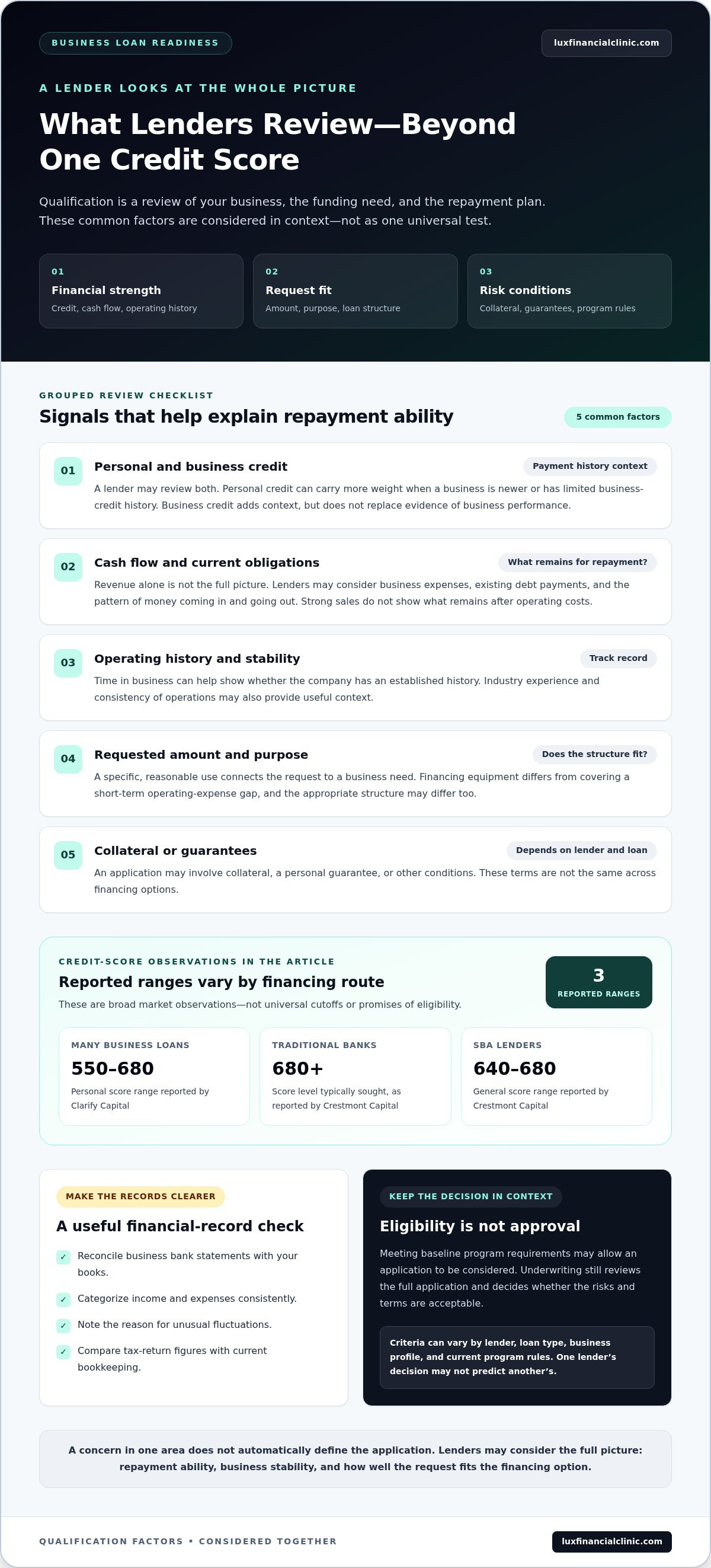
Qualification involves reviewing the applicant, the business, the financing need, and the repayment plan. Some programs set baseline eligibility requirements, such as rules about the business or intended use of funds. Meeting those requirements may allow an application to be considered, but it doesn’t mean the loan is approved.
During underwriting, a lender reviews the full application and decides whether the risks and terms are acceptable. There’s no single credit-score or revenue threshold for every business loan. Criteria can vary by lender, loan type, business profile, and current program rules, so one lender’s decision may not predict another’s.
Which basic factors do lenders commonly review?
Each application is considered in context. Lenders may look at:
- Personal and business credit: Credit history can offer clues about how financial obligations have been managed. A newer or smaller business may have limited business-credit history, so a lender may also consider the owner’s personal credit. Business credit adds context, but it doesn’t replace evidence of business performance.
- Operating history and stability: Time in business can help a lender assess whether the company has an established track record. Industry experience and consistency of operations may also provide context.
- Cash flow and current obligations: Revenue alone doesn’t show what remains available to repay a loan. Lenders may consider business expenses, existing debt payments, and the pattern of money coming in and going out.
- Requested amount and purpose: A specific, reasonable use of funds connects the request to the business’s needs. Financing equipment differs from covering a short-term gap in operating expenses, and the appropriate structure may differ too.
- Collateral or guarantees: Depending on the lender and loan, an application may involve collateral, a personal guarantee, or other conditions. These terms aren’t the same across financing options.
For a broader overview of types of business loans and qualification factors, including secured and unsecured lending, consider how each structure relates to your intended use. A clear request and organized financial picture can make it easier to assess fit, but neither preparation nor baseline eligibility guarantees a lending decision.
How Lenders Assess Credit, Cash Flow, and Business Stability
A lender often considers several financial signals together. Credit history can show how obligations have been managed, while business records help show whether the company can handle additional payments. No single item tells the whole story, and a concern in one area doesn’t automatically define the strength of the application.
How personal and business credit can affect an application
Depending on the application, a lender may review both personal and business credit. Personal credit can carry more weight when a business is newer or has limited credit history of its own. Business credit adds context about the company’s borrowing and payment history, but it doesn’t replace a review of revenue, expenses, and repayment capacity.
Credit-score expectations vary. Clarify Capital reported in July 2026 that many business loans look for personal scores in the 550-to-680 range; Crestmont Capital reported in April 2026 that traditional banks typically seek 680 or higher, while SBA lenders generally look for 640 to 680. These are broad market observations, not universal cutoffs or promises of eligibility. Before applying, review your credit reports for inaccurate information and identify what may be affecting your profile. A guide to credit readiness for business funding can help you approach that review. Credit restoration can address inaccurate negative items, but it isn’t a way to guarantee a particular score.
Why cash flow and financial records matter
Creditworthiness describes how financial obligations have been handled. Repayment ability depends on documented cash coming in, business expenses, existing debt payments, and what remains to meet a new obligation. Lenders may consider whether revenue is consistent or seasonal, whether expenses are rising, and how current payments fit into the business’s cash flow. Strong sales alone don’t show what remains after operating costs.
Accurate bookkeeping makes this picture easier to understand. Reconcile business bank statements with your books, categorize income and expenses consistently, and note the reason for unusual fluctuations. For example, a temporary revenue dip tied to seasonality may need a different explanation than a pattern of declining sales. Clear records help you explain what happened rather than leaving gaps for a lender to interpret.
Tax returns may also support the financial history in an application. Compare return figures with current bookkeeping and address inconsistencies before applying. If you’re organizing return records, this small-business tax preparation guide offers related context. For SBA-backed financing, review the current SBA loan eligibility requirements, since program criteria can differ and change.
Understanding how to qualify for business loans means looking at credit alongside the cash flow and records that support repayment. If you’d value help clarifying financing goals and organizing questions, business funding consulting can help you consider funding opportunities and plan next steps. It doesn’t determine a lender’s decision or guarantee approval.
Which Business Loan Type Fits Your Qualification Profile?
Start with the need the financing must meet. A one-time equipment purchase or planned expansion may call for a different structure than recurring cash-flow needs. Before comparing qualification criteria, consider how much funding you need, when you need it, how you’ll use it, and what repayment schedule your business could reasonably support.
How financing purpose can guide loan selection
A term loan provides a lump sum that’s repaid on a schedule, which may suit a defined purchase or project. A business line of credit provides access to funds up to a limit. The business can typically draw funds as needs arise and repay what it uses under the agreement. That flexibility can help with changing working-capital needs, but it isn’t automatically a better fit.
SBA-backed options include programs such as 7(a) loans, 504 loans, and microloans. Their intended uses, structures, and requirements differ, and specific terms depend on the program and participating lender. A microloan may be worth exploring for a smaller financing need, while a 504 loan is generally associated with fixed-asset projects. These are starting points for comparison, not endorsements or assurances of eligibility.
How to weigh qualification fit against repayment obligations
Compare more than the amount offered. Review the repayment schedule, permitted use of funds, potential collateral or guarantee requirements, and documentation involved. A product that seems suitable at first may not align with your expected cash flow or the timing of the expense. Estimate payments under realistic revenue assumptions, including slower periods, rather than relying only on an optimistic sales forecast.
Use this high-level comparison to organize your questions. Lender criteria and program details vary and can change, so review current requirements for the particular option you’re considering.
| Financing type | Typical use | Repayment structure | General qualification considerations |
|---|---|---|---|
| Term loan | A defined purchase, project, or expansion | Lump sum repaid on an agreed schedule | Cash flow, credit history, time in business, and the project’s financial rationale may be reviewed. |
| Business line of credit | Variable working-capital needs or short-term gaps | Draw funds as needed, then repay under the account terms | Revenue patterns, existing obligations, and the ability to manage changing balances may matter. |
| SBA-backed financing | Eligible business purposes under a specific SBA program | Terms depend on the program and lender | Program rules, lender underwriting, business finances, and use of funds all factor into review. |
| Microloan | A relatively modest financing need | Installment repayment under the loan agreement | Requirements and permitted uses depend on the program and its intermediary. |
Learning how to qualify for business loans includes matching the financing structure to the purpose and repayment timeline, not simply choosing the option that seems easiest to access. Business funding consulting can help you clarify financing goals and organize questions as you compare routes; the lender makes the lending decision.
How to Prepare a Business Loan Application Step by Step
A well-prepared application helps a lender follow the reasoning behind your funding request. Use this sequence to organize details, identify gaps, and present information consistently. The exact forms and documents vary by lender and loan program, so treat this as a preparation framework rather than a universal checklist.
- Define the funding need. Identify what the funds will support, how much you need, and when you’ll need it. Break the request into clear uses, such as equipment, inventory, or working capital, and connect each expense to a business goal.
- Set a realistic repayment plan. Review expected income, recurring expenses, current debt payments, and seasonal changes. Consider whether the business could manage payments if revenue is lower than forecast, not only under your best-case projection.
- Review your financial and credit records. Check personal and business credit reports for errors, then compare bookkeeping, bank statements, and tax records for discrepancies. Correct mistakes where possible and prepare a straightforward explanation for material differences.
- Gather supporting documents. A lender may request financial and ownership information, depending on the application. Organize the materials before completing forms so you can use consistent figures and dates.
- Complete and review the application. Check that names, ownership details, requested amount, intended use, and financial figures match across the application and supporting records. Keep a copy of what you submit and note follow-up requests, deadlines, and questions.
What documents may a business loan application require?
Possible records include business and personal tax returns, profit-and-loss statements, balance sheets, cash flow information, business and personal bank statements, and a schedule of existing debts. Depending on the request, you may also need business formation documents, ownership details, relevant licenses, or a business plan explaining the purpose and expected impact of the funding.
Requirements differ by lender and program, so review the current document list before submitting. Organized return records make it easier to compare reported income with other financial documents; a small-business tax preparation guide offers useful context for keeping tax information in order.
What should you do before submitting the application?
Do a final review with fresh eyes. Confirm that the amount requested aligns with documented costs and that your repayment plan reflects realistic business conditions. If a figure differs across records, don’t conceal it. Resolve a correctable error or add a clear explanation supported by available documents.
For SBA-backed financing, review current program rules and documentation requirements, since details can change. A financial diagnostic consultation can help you assess your financial position as a planning step, while business funding consulting can help organize financing questions and clarify goals. Neither determines a lender’s decision. If you’d like structured help preparing your funding questions, explore business funding consulting.
Build a Business Loan Readiness Plan With Financial Guidance
Not every business needs to apply immediately. A readiness plan can help you see what’s already in place, what needs attention, and which next step is practical. Use these three categories as a planning guide, not as a lender’s approval criteria:
- Ready to explore: Your funding goal is clear, records are organized, and cash flow gives you a reasonable basis to assess repayment. Begin comparing options and current program requirements.
- Document cleanup needed: You have a defined need, but records are incomplete, inconsistent, or difficult to follow. Organize financial statements, reconcile bookkeeping, and clarify discrepancies before preparing an application.
- Longer-term preparation needed: Your funding purpose, cash-flow picture, or credit information needs further review. Set priorities and revisit your position as your records and business circumstances develop.
This process is a planning tool, not a verdict on your business. Understanding how to qualify for business loans can begin with a clear view of your finances and a manageable plan for improving the information you’ll present.
What if your business is not ready to apply yet?
Start with actions you can maintain: gather current records in one place, review cash flow regularly, and track changes in revenue, expenses, and existing obligations. Set a recurring date to update your records, then note questions or gaps that need attention. This creates a useful financial history instead of a last-minute scramble.
Review personal and business credit reports as part of that preparation. If you find inaccurate negative information, document the specific item and follow an appropriate dispute process. A three-bureau credit dispute services guide may help you understand the process when report inaccuracies are relevant. Credit restoration addresses inaccurate negative items; it doesn’t promise a particular score or loan outcome.
How financial consulting can support funding readiness
Funding guidance can turn a broad goal, such as expanding operations or managing a working-capital need, into focused questions about amount, timing, and financing fit. Lux Financial Clinic’s business funding consulting helps clients consider loans, credit lines, and funding opportunities, with an emphasis on clarifying goals and preparation. A financial diagnostic consultation can help assess your financial position and identify priorities for a personalized roadmap.
These services support planning and preparation, while a lender makes the approval decision. Your next useful step may be to organize records, understand your credit profile, or compare financing structures against realistic cash flow. Focus first on the readiness gap that matters most, then revisit your plan as your business develops.
Explore funding guidance and plan your next steps.
Take Your Next Step Toward Funding Readiness
You don’t need to solve every financing question at once. Choose one practical next step, such as clarifying what the funds would make possible or setting aside time to review your business records. A steady, informed approach can help you move forward, whether you’re preparing to explore financing now or building readiness over time.
Lux Financial Clinic’s business funding consulting can help you consider funding opportunities and organize your questions. A financial diagnostic consultation offers a way to assess priorities and shape a personalized financial plan. Small-business tax preparation can also support business filing needs as you bring your records into clearer order. These services provide guidance and preparation, not a promise of loan approval.
If you’re ready to take a thoughtful next step, explore funding guidance and plan your next steps. Understanding how to qualify for business loans is part of making deliberate financial decisions. Begin with one clear action, then build from there.
Frequently Asked Questions
What credit score do you need to qualify for a business loan?
There’s no universal minimum score for every business loan. Clarify Capital’s July 2026 overview describes common personal credit expectations in the 550-to-680 range. Crestmont Capital reported in April 2026 that traditional banks typically look for 680 or higher, SBA lenders generally seek 640 to 680, and some alternative lenders may accept scores around 500 to 550. These are general ranges, not guarantees. Lender criteria and the rest of your application matter.
Can I qualify for a business loan with a new business?
It may be possible, although a newer business has less operating history for a lender to assess. The lender may consider the owner’s credit and financial position, business plan, projected cash flow, relevant experience, and available assets. Prepare a clear explanation of how the business will generate revenue and repay the requested funds. Eligibility depends on the financing option and lender, so review current startup criteria before applying.
How much revenue do you need to qualify for a business loan?
There isn’t one revenue threshold for all business loans. A lender may assess whether income is consistent and whether enough remains after expenses and current debt payments to support the proposed repayment. For example, a seasonal business can explain how revenue changes throughout the year and show how it plans for slower months. Review the lender’s requirements for the specific loan, and don’t treat gross sales as the same as available cash.
Do business loans require a personal guarantee?
Some business loans may require an owner to personally guarantee repayment, while others may not. A guarantee can make the owner personally responsible if the business doesn’t meet its loan obligations, so understand who is signing and what the agreement covers. Requirements can depend on the lender, loan structure, and business profile. Review the guarantee language alongside the repayment terms before accepting an offer, and clarify any responsibilities you don’t understand.
Can I get a business loan with bad personal credit?
Possibly, but a lower personal score can narrow financing choices or lead a lender to examine other parts of the application more closely. Some alternative lenders may consider scores around 500 to 550, according to Crestmont Capital’s April 2026 overview, though that doesn’t mean every applicant in that range will qualify. Check your credit reports for errors. If a review identifies inaccurate negative items, credit restoration may address those inaccuracies, but it can’t promise loan approval or a specific score.
What documents do I need to apply for a business loan?
Common requests include recent business and personal tax returns, profit-and-loss statements, balance sheets, bank statements, and details of existing debts. A lender may also ask for identification, ownership information, formation documents, licenses relevant to the business, or a plan describing how the funds will be used. Keep copies organized by category and date. The exact checklist depends on the lender and financing program, so follow the current application instructions.
How long does it take to qualify for a business loan?
There’s no standard timeframe for qualifying. Getting your records in order may take longer if documents are missing or financial details need explanation. After you apply, the lender’s review can vary by loan type and application complexity. An initial eligibility check isn’t the same as full underwriting or a final decision. To avoid preventable delays, submit complete information, respond promptly to document requests, and ask about the lender’s expected review process before beginning.


