
What if credit repair for home buyers is less about chasing a score and more about preparing a clear, accurate financial picture? If you’re concerned that an item on your credit report could affect a home purchase, it can be hard to tell what needs attention and what may simply take time.
Credit reports matter in a mortgage review, but they’re only one part of your financial profile. Disputing potentially inaccurate information may help correct a report. Credit repair can’t erase accurate negative history or promise a particular score, mortgage eligibility, or loan approval.
This guide explains how credit reports fit into mortgage readiness and how to compare self-guided steps with counseling and structured dispute support. You’ll learn which report issues may warrant a closer look, what support can realistically do, and how to organize your next steps before applying. The goal isn’t a shortcut. It’s a clearer, more considered approach to preparing for a mortgage.
Key Takeaways
- Review your credit reports from all three major bureaus and note details that may need attention.
- Compare self-guided review, credit counseling, and professional dispute support by the time, involvement, and guidance each requires.
- With credit repair for home buyers, focus on potentially inaccurate information rather than expecting accurate negative history to disappear.
- Keep organized records of disputes, maintain steady account habits, and plan follow-up before submitting a mortgage application.
- Compare Lux Financial Clinic’s basic and comprehensive options. The comprehensive package includes a personalized credit-building roadmap and dedicated strategist support.
Credit Repair for Home Buyers: What It Can, and Cannot, Do
A credit concern can make a home purchase feel uncertain. Is a negative item affecting your plans, or does it accurately reflect a past event? Credit repair for home buyers is best understood as a careful review of report accuracy, not a quick fix for mortgage approval. It can help identify information that may be inaccurate, incomplete, or unverifiable and support a dispute for review.
That distinction matters. Accurate negative information isn’t removed simply because it’s inconvenient or may affect a mortgage application. A dispute makes sense when there’s a specific reason to question how an item is reported, such as a payment marked late despite records showing it was made on time. Even if a report is corrected, that doesn’t promise a particular score or lending outcome.
How credit reports fit into mortgage readiness
A credit report is a record of accounts and payment history. A credit score is a number calculated from information in a report using a scoring model. Lenders may review credit alongside income, debts, assets, and other application details, so a report or score alone doesn’t show your full mortgage picture.
Criteria and scoring models can vary by lender and loan program. The same credit history may therefore be considered under different underwriting approaches. A credit review helps you understand what’s recorded; a lender evaluates how your full application fits the program you’re pursuing. Credit repair is one part of preparation, not a substitute for underwriting.
What credit repair can reasonably address
Look for specific inconsistencies in negative items. A collection may show an amount or account detail that doesn’t match your records. A late payment may appear for a month when you paid on time. Incomplete information or details that can’t be verified may also warrant attention. Gather relevant statements, payment confirmations, or correspondence so you can explain the concern and support it with evidence.
By contrast, if a late payment or collection accurately reflects your account history, disputing it solely because it may affect a mortgage application doesn’t make the information inaccurate. Credit repair can’t guarantee that a dispute will change a report, remove an item, or alter a lender’s decision. For a general introduction to common practices and background, see Credit Repair. Use it as an overview, not a substitute for advice about your circumstances.
Legitimate credit repair reviews credit reports and disputes information with a factual basis, without promising removals, score changes, or mortgage approval. This keeps the focus on what can be checked and documented. It also gives you a clearer starting point, whether you review reports independently or use structured dispute support.
How to Review Your Credit Before a Home Purchase
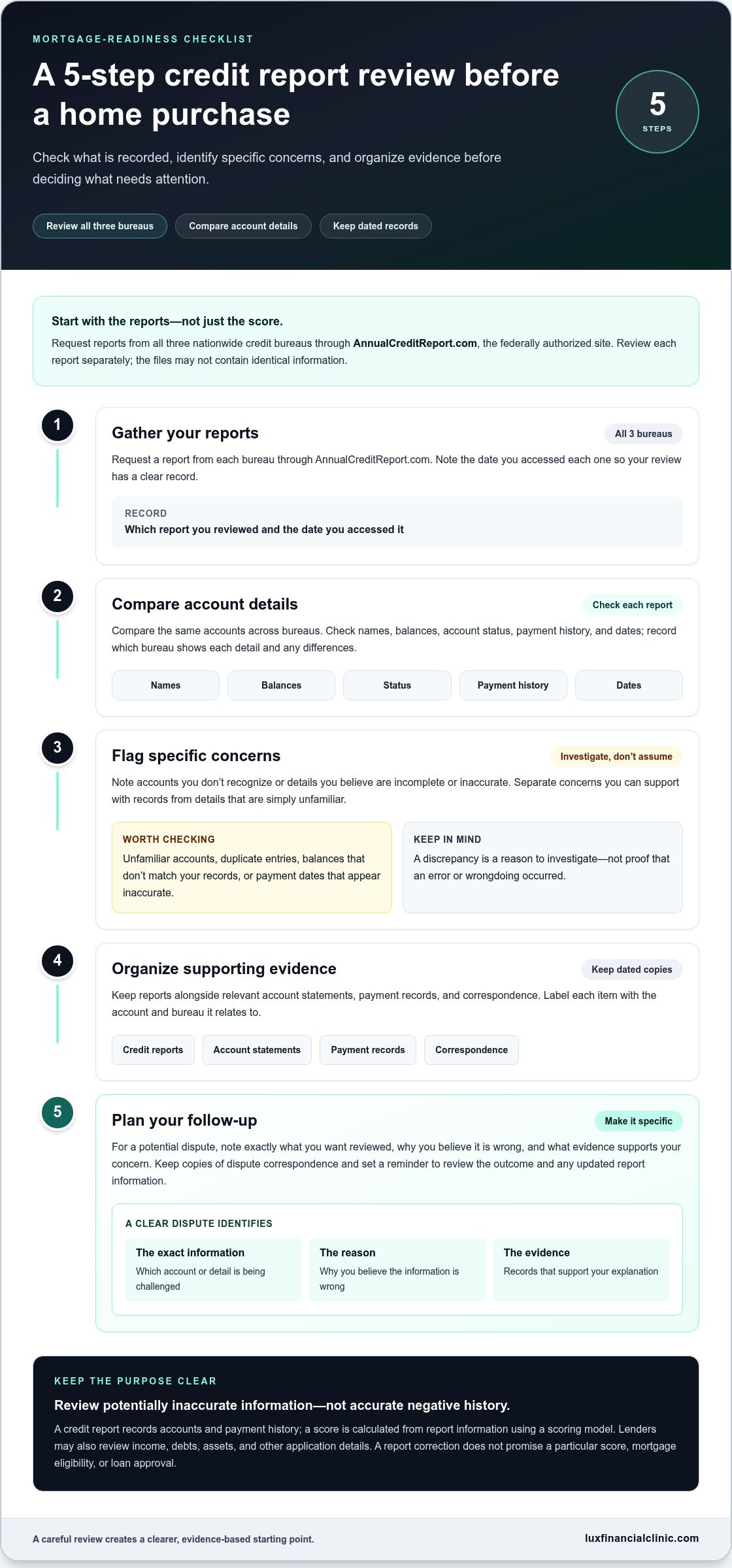
A useful credit review goes beyond checking a score. Compare the underlying account details across your reports and keep a record of what you find before deciding whether an entry needs attention. For credit repair for home buyers, an organized review helps distinguish a genuine reporting concern from a detail that simply needs clarification.
Start at AnnualCreditReport.com, the federally authorized site for requesting reports from all three nationwide credit bureaus. Review each report separately. The files may not contain identical information, so checking only one could leave you unaware of an entry or discrepancy reported elsewhere.
Which report details deserve a closer look?
Look for unfamiliar accounts, duplicate entries, balances that don’t match your records, and payment dates that appear inaccurate. Compare the same account across bureaus instead of assuming every report is identical. A discrepancy is a reason to investigate, not proof that an error or wrongdoing occurred.
- Gather your reports. Request reports from all three bureaus through AnnualCreditReport.com and note the date you accessed each one.
- Compare account details. Check names, balances, account status, payment history, and dates. Record which bureau shows each detail, including any differences.
- Flag specific concerns. Mark information you don’t recognize or believe is incomplete or inaccurate. Separate concerns you can support with records from details that are simply unfamiliar.
- Organize evidence. Keep dated copies of the reports alongside relevant account statements, payment records, and correspondence. Label each item with the account and bureau it relates to.
- Plan your follow-up. Note what you want reviewed, why you believe it’s wrong, and what evidence supports your concern. Keep copies of dispute correspondence and set a reminder to review the outcome and any updated report information.
How to organize a potential dispute
A clear dispute identifies the exact information being challenged and explains why, rather than making a broad request to remove negative entries. For example, identify the account and payment month in question, then include records that support your explanation. A three-bureau credit dispute service guide can help explain how bureau-specific review works.
Accurate information calls for thoughtful planning; inaccurate or incomplete information calls for a specific, evidence-supported review. If the details are difficult to sort, Lux Financial Clinic provides structured support reviewing potentially inaccurate negative items across the three major bureaus. Learn about structured credit dispute support as one part of your preparation.
Credit Repair Options for Home Buyers: A Practical Comparison
There isn’t one right level of support for every buyer. Your choice may depend on how many report entries concern you, how comfortable you are handling paperwork, and whether you want broader guidance with your finances. This comparison outlines what each approach is designed to do and where its limits begin.
| Approach | Primary purpose | Buyer involvement | Typical focus | Realistic limits |
|---|---|---|---|---|
| Self-guided report review | Help you inspect reports and identify specific information to question. | You gather records, prepare any disputes, track correspondence, and plan follow-up. | Report accuracy and personal documentation. | It takes time and organization; it can’t change accurate history or lender criteria. |
| Credit counseling | Offer guidance on managing finances, debt, and repayment habits. | You discuss your situation and take responsibility for agreed financial steps. | Budgeting, debt management, and sustainable account habits. | It isn’t the same as disputing report errors, and it can’t ensure a mortgage decision. |
| Professional credit dispute support | Provide structured assistance reviewing and disputing potentially inaccurate negative items. | You share relevant account details and records and stay engaged with the process. | Potential inaccuracies across credit reports. | A dispute may not change a report; it can’t promise a score or approval. |
When self-guided review may be a reasonable starting point
If you have time to organize your reports and only a few specific concerns, handling the review yourself may be manageable. Keep copies of the information you’re questioning, the records that support your position, and any correspondence you send or receive. You remain responsible for tracking responses and deciding what to do next. A self-guided dispute addresses a factual concern, not accurate history or a lender’s underwriting standards.
What structured professional dispute support adds
Structured support can bring a consistent process to reviewing potentially inaccurate negative items, including collections, charge-offs, late payments, or hard inquiries. Lux Financial Clinic offers a basic repair package focused on credit repair and a comprehensive build package that also includes a personalized credit-building roadmap and dedicated strategist support. Neither option replaces a lender’s review or guarantees a particular result.
Dispute support focuses on report accuracy. It doesn’t negotiate debt settlements or issue mortgages. If you want a broader view of your financial situation, a financial diagnostic consultation guide can help you think through that planning process.
Choose an approach based on the work you can manage and the guidance you need, not on a promised score or approval. For buyers considering structured help with report disputes, Lux Financial Clinic’s credit repair support can be one part of a deliberate mortgage-readiness plan.
A Mortgage-Ready Credit Plan: Steps to Take Before Applying
Preparing for a mortgage is easier when you separate what you can review from what requires a lender’s guidance. Credit repair for home buyers can fit into a broader plan, alongside steady account habits, careful recordkeeping, and a conversation about your application timeline. No single correction or action guarantees eligibility.
Use this flexible sequence to organize your next steps:
- Review your credit reports. Check the information across the bureaus and note details that may be inaccurate or incomplete.
- Address verified errors. If you dispute an item, identify the specific information, explain the concern, and keep copies of supporting records and correspondence.
- Maintain steady account habits. Pay obligations on time, monitor account information, and avoid major financial changes without understanding how they may affect your application.
- Discuss timing with your lender. Ask how your planned application date, any open disputes, and your financial circumstances fit the lender’s process.
Record when you submitted a dispute and any response you receive. A report correction may not appear immediately, so review an updated report before assuming the information has changed. Organized notes can also help you explain an item’s status during a mortgage conversation.
What to coordinate with a mortgage professional
Discuss application timing and underwriting questions directly with your lender. Requirements and document requests can differ by loan program, and the lender can explain how its process applies to your situation. Ask how to handle an unresolved report concern before applying instead of relying on a general score threshold or assuming a particular action will secure approval.
How to keep credit habits steady while preparing
Consistency matters. Continue paying obligations on time and review account information for unexpected changes. Balances and other debt obligations may be part of the lender’s broader financial review, so avoid taking on new credit or making a major financial change without first discussing it with your lender. That includes changes that may seem routine, such as financing a large purchase.
If you’re self-employed or building a business while preparing to buy, the credit repair guide for women entrepreneurs may offer relevant planning context.
For help reviewing potentially inaccurate negative items as part of your preparation, explore Lux Financial Clinic’s credit repair support. It can be one component of a considered plan alongside lender guidance and consistent financial habits.
How Lux Financial Clinic Supports Credit Repair for Home Buyers
If you’ve identified negative items that may be inaccurate, the next step is to approach the review in an organized way. Lux Financial Clinic provides structured credit dispute services for potentially inaccurate negative items across the three major credit bureaus. The service focuses on credit-file accuracy, giving you a defined process for addressing concerns while you continue planning with your mortgage lender.
What a client can expect from the service
The process centers on reviewing potentially inaccurate items and disputing concerns based on the information and circumstances available. Relevant account details and supporting records help inform that work. Items may include collections, charge-offs, late payments, or hard inquiries. A dispute service doesn’t make a lender’s decision or provide a mortgage product; it supports one part of your preparation.
Lux Financial Clinic offers two package levels with different scopes of support:
- Basic repair package: Provides structured credit repair support focused on report disputes.
- Comprehensive build package: Includes dispute support, a personalized credit-building roadmap, and dedicated strategist support.
The difference is whether you want focused dispute assistance or also want a personalized roadmap and strategist support as part of your credit-building work. Neither option can guarantee that a bureau will change an item or that a lender will view an application in a particular way. Your records, the accuracy of the information, and the lender’s review all remain relevant.
Choosing a next step with clarity
Consider what you need most right now. If your primary concern is a specific negative entry you believe may be inaccurate, structured dispute support may be relevant. If you also want a broader plan to guide credit-building habits, the comprehensive package includes a personalized roadmap and dedicated strategist support. If the information is accurate, a dispute isn’t a substitute for addressing it through appropriate financial habits or planning.
For credit repair for home buyers, the service is one part of readiness, not a shortcut around mortgage underwriting. Keep your lender informed about your application timing and follow its guidance on your financial profile. Credit-file work may support a more organized review, but it can’t guarantee item removals, score changes, mortgage eligibility, or loan approval.
If structured help with potentially inaccurate report items fits your needs, explore credit repair support and consider which package scope fits your preparation. Start by understanding what’s on your reports, what evidence you have, and what kind of support would help you move forward with greater clarity.
Choose Your Next Step with Confidence
A home purchase is a major decision, and preparing your credit deserves the same care as reviewing any other part of your finances. Set a manageable next step: organize one concern, note what you still need to understand, or clarify your application timeline with your lender. You don’t need to resolve every question at once to move forward thoughtfully.
If you’d value structured help reviewing potentially inaccurate items across major credit bureaus, Lux Financial Clinic offers dispute support. The comprehensive option includes a personalized credit-building roadmap and dedicated strategist support. This work can support your preparation, while your lender remains responsible for evaluating your mortgage application. No service can promise a particular score, item removal, or approval.
Explore credit repair support to see whether a structured approach fits your needs. Credit repair for home buyers is most useful as part of a realistic plan guided by accurate information and steady decisions.
Frequently Asked Questions
Is there a minimum credit score to buy a house?
There isn’t one score that applies to every mortgage. FHA’s stated minimum is 580 for a 3.5% down payment; scores from 500 to 579 require a 10% down payment under FHA guidelines. Conventional loans are often associated with a 620 benchmark, though Fannie Mae removed its 620 minimum for loans assessed through Desktop Underwriter in November 2025. Lenders may apply stricter standards, so ask about the specific program you’re considering.
Can credit repair remove accurate negative information from my credit report?
No. A negative entry isn’t disputable simply because it affects your home-buying plans. Credit repair focuses on information that may be inaccurate, incomplete, or unverifiable. For example, if a reported late payment conflicts with your payment records, you can raise that specific issue for review. If the entry accurately reflects your account history, a dispute isn’t a way to erase it. Review the details and supporting records before deciding how to proceed.
How long before applying for a mortgage should I start reviewing my credit?
Start as early as you can, since there’s no universal lead time for every buyer or lender. An early review gives you time to understand your reports, gather records, and discuss concerns before an application is underway. If you’re already close to applying, don’t assume it’s too late to ask questions. Tell your lender about your timing and any unresolved issues so you can understand the next steps.
Does paying a collection account automatically improve a credit score?
No. Paying a collection doesn’t automatically produce a score increase or remove its history from a report. The effect can depend on how the account is reported and on the scoring model used. Before making a payment, review whether the collection details are accurate and ask your lender how it may view the account in your application. Keep documentation of any payment and later account communications for your records.
Can I apply for a mortgage while a credit report dispute is open?
Possibly, but an open dispute may raise questions during the lender’s review, and the lender’s process can vary. Before submitting an application, tell the mortgage professional which account is disputed, what information you challenged, and whether you’ve received a response. Ask whether the dispute status affects the timing or documentation for your specific loan process. Don’t withdraw or change a dispute solely to meet an assumed requirement without first understanding the implications.
What documents should I gather before reviewing credit for a home purchase?
Gather copies of your credit reports, account statements, payment confirmations, collection notices, and letters or emails related to the accounts you’re reviewing. For each concern, note the account name, relevant dates, reported balance, and bureau showing the information. If a payment date appears wrong, a bank record or account statement from that period may help explain the discrepancy. Keep the documents together so details are easy to find.
Does credit repair guarantee mortgage approval?
No. Credit repair for home buyers can help address potentially inaccurate report information, but it can’t guarantee that an entry will change, that a score will rise, or that a lender will approve an application. Mortgage decisions involve a broader review of your finances and the lender’s program requirements. Treat dispute support as one possible preparation step, and rely on your lender for guidance about its application review and decision.


