
What if the safest way to fix a bad credit score isn’t paying someone to erase it, but first checking whether the information behind it is accurate? If you’re looking for ways to fix a bad credit score, conflicting claims can make it hard to know where to begin, especially when a low score feels connected to important future goals. Many regions restrict upfront-fee credit-repair services, so promises of a quick score increase deserve particular scrutiny.
You still have practical steps available. Review your credit reports, dispute information you believe is inaccurate, and build steady habits that support stronger credit over time. At Lux Financial Clinic, this guide explains what credit repair can and can’t accomplish, which claims to treat as warning signs, and how to protect your personal information. You’ll also find a realistic path forward, including how structured dispute support can help review potentially inaccurate items without promising to remove accurate negative information or guarantee a score increase.
Key Takeaways
- Understand how credit reports differ from credit scores, and why accurate report information matters when you plan to fix bad credit score Georgia.
- Learn to distinguish potentially inaccurate, incomplete, or outdated entries from accurate negative information that may take time to age.
- Follow a practical sequence to review reports from all three bureaus, address possible errors, and maintain habits that support stronger credit.
- Recognize misleading repair claims and understand how structured dispute support can organize a complex review without promising a score result.
What Does It Mean to Fix a Bad Credit Score in Georgia?
To fix a bad credit score in Georgia, start by separating report corrections from long-term credit building. Credit repair focuses on identifying and addressing information on a credit report that is inaccurate, incomplete, or otherwise questionable. It doesn’t erase accurate negative history. Separately, habits such as paying bills on time and managing balances can support healthier credit over time.
A credit report records account and payment history; a credit score is a number calculated from information in a report. Correcting an error and building a stronger record are related, but they are not the same task. A dispute may correct inaccurate information, while consistent financial behavior can shape the information reported going forward.
Credit report versus credit score: what is being repaired?
Credit reports generally contain details about accounts, payment history, balances, and inquiries. A score applies a scoring model to report information to estimate credit risk. Models can weigh information differently, so the same report data may produce different scores. Reports from the three major credit bureaus can also differ, as can scores calculated using different models. For a broad overview of understanding credit scores, see how scores are calculated and used.
When reviewing a report, check specific details: Is the account yours? Is its payment status correct? Do you recognize the balance and inquiries? A score alone won’t show which entry needs attention. The report contains the underlying information to review.
Why a low score does not define your financial future
A low score can create understandable concern, particularly when you’re planning for future financial goals. But it’s a snapshot based on reported information, not a judgment of your character or a complete measure of your financial life. If you’re searching for “fix bad credit score Georgia,” start by separating what may be corrected from what may improve gradually as new information is reported.
Accurate reporting and consistent future behavior can support progress, though timing and score movement vary. No responsible explanation can promise a specific point increase. Results depend on the information in your reports, the scoring model used, and changes over time.
A measured approach is more useful than chasing a promised result. Review your records, note entries that appear wrong, and identify which actions are within your control. If an item is accurate, it generally can’t be removed simply because it affects your score. If it appears inaccurate, gather relevant details and consider a dispute. This distinction creates a clearer foundation for the practical steps that follow.
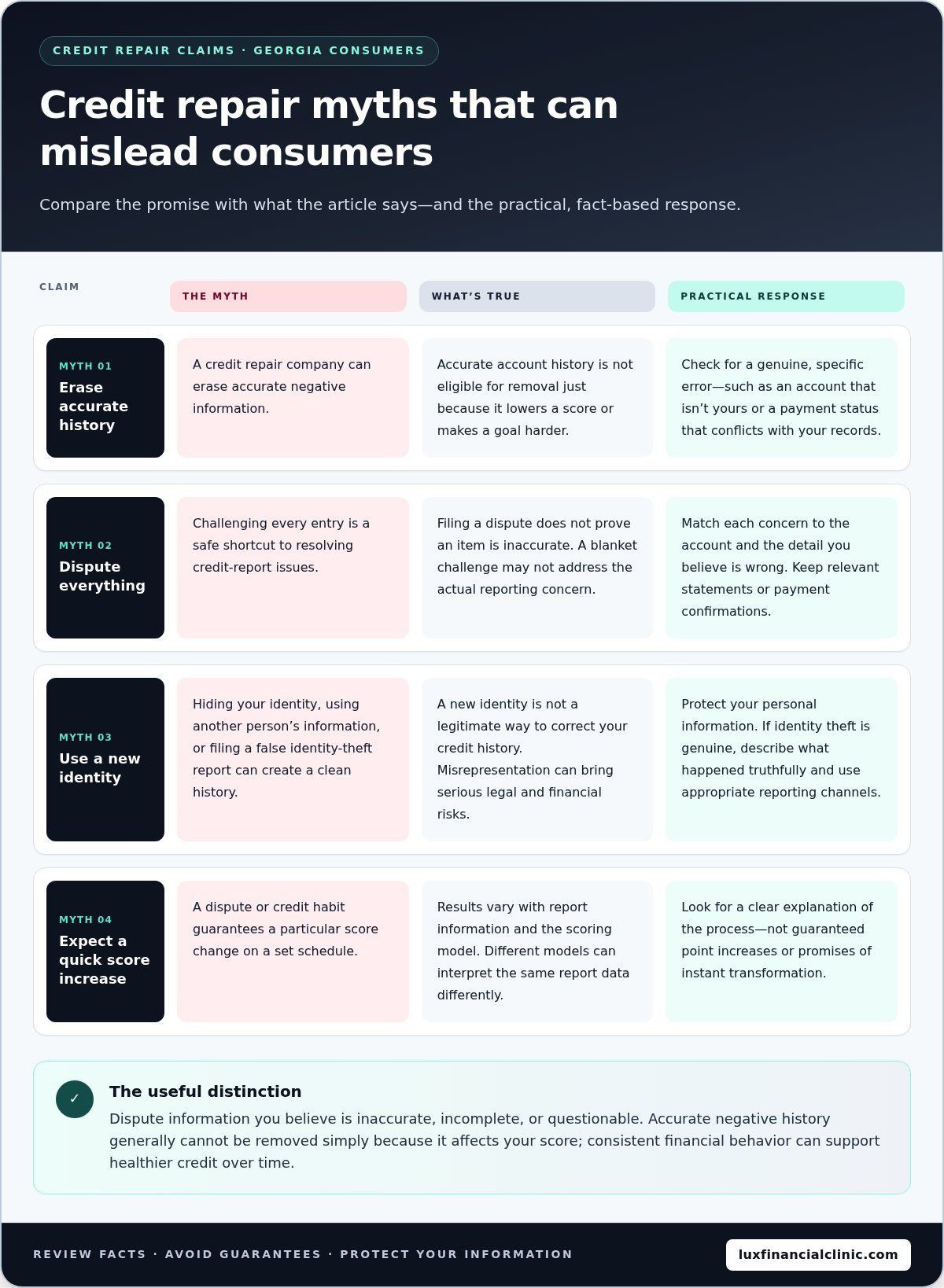
Credit Repair Myths That Can Mislead Georgia Consumers
Credit-repair claims can sound reassuring when you’re trying to understand how to fix bad credit score Georgia. To assess a claim, ask what specific information can be corrected, what evidence supports a dispute, and whether the promise relies on an outcome no one can control. These myths, facts, and practical takeaways can help you distinguish careful guidance from shortcuts that may create more problems.
Myth: A credit repair company can erase accurate negative history
Fact: A negative mark isn’t inaccurate simply because it lowers a score or makes a financial goal feel harder. If an account’s history is reported accurately, disputing it doesn’t make it eligible for removal. The Georgia Attorney General’s Consumer Protection Division warns consumers about claims that a company can erase accurate negative information.
Practical implication: Be cautious of promises to remove every collection, late payment, or charge-off regardless of the facts. Instead, check whether a specific entry contains a genuine error, such as an account that isn’t yours or a payment status that doesn’t match your records. The CFPB’s guidance on credit reports and scores explains how to review reports and dispute errors.
Myth: Disputing everything is a safe shortcut
Fact: Filing a dispute doesn’t prove that an item is inaccurate. A blanket challenge that doesn’t identify a truthful, specific concern may not help resolve a reporting issue. For example, if you recognize an account but believe its balance is wrong, focus on that detail rather than disputing unrelated entries.
Practical implication: Match each concern to the account and the detail you believe is incorrect. Keep relevant records, such as account statements or payment confirmations, so your explanation is clear and based on facts. A structured review can help you track separate concerns across reports from different bureaus.
Myth: A new identity can create a clean credit history
Fact: Advice to hide your identity, use another person’s information, or file a false identity-theft report can expose you to serious legal and financial risks. A new identity isn’t a legitimate way to correct your own credit history.
Practical implication: Protect your personal information, and don’t follow instructions to misrepresent who you are or what happened. If you suspect genuine identity theft, describe the facts truthfully and use the appropriate reporting channels.
Myth: A promised score increase will happen quickly
Fact: No single dispute or habit can guarantee a particular score change on a set schedule. Results vary with the information in your reports and the scoring model being used. Different models can interpret report data differently.
Practical implication: Look for a clear explanation of the process, not guaranteed point increases or instant transformations. For a thoughtful review of your financial picture, explore a financial diagnostic consultation to help organize your next steps.
What Can Be Challenged, and What Usually Needs Time?
A negative entry deserves a closer look when specific details don’t match your records, but a low score alone doesn’t show that a report is wrong. As you consider how to fix bad credit score Georgia, separate questions about accuracy from the longer work of building a positive history. The guide below offers an educational framework, not a legal finding about an individual account or a prediction of how a review will turn out.
| Information type | What to look for | Practical next step |
|---|---|---|
| Potentially inaccurate | An account you don’t recognize, a payment marked late despite records showing it was on time, or an inquiry you don’t recognize. | Compare the entry with your account documents and identify the precise detail that appears incorrect. |
| Potentially incomplete | Important account details may be missing or partial, making it difficult to understand how the entry is being reported. | Note what appears absent and gather records that help clarify the account history. |
| Potentially outdated | An entry’s dates or status may not align with the records you have or with other information about the account. | Check the dates and account status carefully. Applicable reporting rules can depend on the item, so avoid assuming a specific time limit without checking the relevant rule. |
| Accurate negative information | The account and its history match your records, even if a late payment, collection, or charge-off is unfavorable. | Don’t treat an accurate entry as an error simply because it affects your score. Focus on consistent positive habits while the history remains. |
Examples that may warrant a closer review
Compare each report entry with statements, payment confirmations, and other account records you have. A balance that appears inconsistent, duplicate reporting, or a hard inquiry you don’t recognize may warrant review, but each needs verification. For example, two entries that look alike could refer to separate accounts, so check account details before concluding they’re duplicates.
Collections, charge-offs, late payments, and inquiries all require fact-specific review. The type of entry alone doesn’t establish an error, and a dispute doesn’t ensure removal. A clear record of what differs and why makes it easier to describe the concern accurately.
Accurate negative information and the role of time
Accurate adverse history isn’t erased simply because it affects a score or makes a financial goal feel distant. Avoid relying on a universal reporting period without confirming the rule that applies to the particular item. The account type, dates, and circumstances matter.
An accurate negative entry doesn’t prevent constructive changes. Timely payments and manageable balances can support a healthier credit profile as new information is reported. Structured dispute support can help organize a review of potentially inaccurate items across the three major credit bureaus, but outcomes depend on the information and review process. The aim is a careful, evidence-based next step, not a promise of deletion or a particular score change.
A Realistic Plan to Improve Credit Without Quick-Fix Claims
A steady plan separates two kinds of work: correcting report information that appears wrong and strengthening the habits that shape your financial profile over time. If you’re looking for how to fix bad credit score Georgia, begin with a clear review, then choose practical steps you can maintain. You don’t need to solve every concern at once.
- Review reports from all three bureaus. Compare your reports from Equifax, a major national credit reporting agency, and TransUnion. Each may show different information, so reviewing only one can leave other entries unseen. Note unfamiliar accounts, inconsistent balances or statuses, and items that need a closer look. Organize your notes by bureau and account.
- Match concerns to your own records. Compare report details with statements, payment confirmations, and account correspondence you already have. Write down the specific discrepancy and the document that may help explain it. This is an initial review, not a reason to challenge every negative entry. Focus on accuracy before deciding whether a concern warrants a dispute.
- Address potential reporting errors separately. If a detail appears inaccurate, incomplete, or unfamiliar, consider the appropriate dispute process for that specific concern. Keep copies of relevant records and track what you submitted and when. Use a guide to disputes across all three bureaus for a detailed overview as you prepare your next steps.
- Build habits you can sustain. Aim to pay obligations on time and keep balances manageable when possible. Choose an approach that fits your budget and circumstances rather than taking on new obligations just to pursue a score change. If you’re considering a new application or account, weigh that decision against your current needs and ability to manage it.
- Track progress without expecting instant movement. Keep a simple record of report corrections, payments, balances, and any changes you notice. A score may not move immediately after a report update, and results can differ by scoring model. Track consistent actions, not just a single number.
Let accuracy and habits work together
Correcting an error can make a report more reliable; positive habits help build a stronger history going forward. Accurate information provides the foundation, while consistent habits support progress over time. Neither step guarantees a particular score, but together they offer a realistic framework for moving ahead with care.
If organized help would make the review easier, explore structured credit repair support for potentially inaccurate entries and a guided plan for building credit habits.
When Professional Credit Repair Support May Help
Organized support may be useful if you’re comparing reports from several bureaus, tracking multiple entries, or trying to understand complicated account histories. The value should be clarity and a well-structured review, not a promise that a particular item will disappear or your score will rise by a set amount. If you’re considering how to fix bad credit score Georgia, understanding the state’s rules is part of making an informed decision.
What a structured credit-repair process can and cannot do
A structured review can help sort potentially inaccurate information from accurate history, organize relevant records, and prepare focused disputes about specific reporting concerns. Lux Financial Clinic uses structured dispute protocols to address potentially inaccurate negative items, including collections, charge-offs, late payments, and hard inquiries across Experian, Equifax, and TransUnion.
This work cannot make accurate information inaccurate or guarantee that an item will be removed. Dispute support also doesn’t replace habits that contribute to longer-term credit building, such as making payments on time and managing balances. Review and dispute work addresses report accuracy; ongoing financial behavior shapes the information reported over time.
Georgia residents should understand the legal context before engaging paid credit-repair services. Under O.C.G.A. § 16-9-59, for-profit credit-repair services organizations are generally prohibited in Georgia, with certain exceptions. A service description or package name alone does not establish that a paid service falls within an exception. Avoid relying on guaranteed results or assumptions about legality when evaluating any offer.
How Lux Financial Clinic supports a more intentional next step
Lux Financial Clinic offers a basic repair package and a comprehensive build package. The comprehensive option includes a personalized credit-building roadmap and dedicated strategist support. These features describe the package structure, not a promised outcome. Score movement depends on individual report information and the scoring model used.
If your immediate need is to make sense of your broader financial picture, a financial diagnostic consultation can help frame thoughtful next steps. It’s a measured starting point for clarifying priorities, not a promise of a particular score change or a way around Georgia law. You can explore a financial diagnostic consultation when you’re ready to consider a more organized path forward.
Choose a Next Step That Fits Your Goals
Progress is easier to sustain when your next move reflects the goal you’re working toward, rather than pressure to change everything at once. As you work to fix bad credit score Georgia, consider what would bring you greater financial clarity: organizing your records, understanding a concern, or mapping out priorities for the months ahead.
You don’t need a perfect plan before you begin. A thoughtful first step can turn uncertainty into direction, while a measured approach leaves room to adjust as your circumstances change. The aim isn’t to chase a number at any cost. It’s to build a clearer foundation for decisions that support your longer-term goals.
For help identifying a practical starting point, explore a financial diagnostic consultation. A more intentional path can make steady progress feel achievable, one considered step at a time.
Frequently Asked Questions
Does checking my own credit score lower it?
No. Checking your own score is generally treated as a soft inquiry and doesn’t lower it. This differs from an application for credit, which may lead to a hard inquiry. For example, reviewing a score through a bank or credit-monitoring account is usually a soft check. If you’re applying for an apartment, a lender or other business may check your credit under different circumstances, so ask what type of inquiry it uses.
How long does it take to improve a bad credit score?
There’s no set timeline. Progress depends on what’s affecting your credit, what changes, and which scoring model is used. Correcting an error may change the information considered, while building a record of reliable payments takes continued follow-through. Track actions, such as paying bills by their due dates, alongside score updates. Don’t treat a specific number of weeks or months as a guaranteed deadline.
Can paying a collection account improve my credit score?
It can update the account’s reported status, but paying a collection doesn’t guarantee that your score will rise or that the entry will disappear. The effect depends on the account details and the scoring model used. Before paying, review whether the account is yours and whether its reported balance and status appear correct. Keep payment records and confirmation so you can refer to them if the account information later seems inconsistent.
Can I fix my credit without hiring a credit repair company?
Yes. You can review your reports, identify specific concerns, submit disputes yourself, and work on payment and balance habits without hiring a company. If you’re looking for how to fix bad credit score Georgia, set aside time to compare account entries with statements and payment records. Organized support may be useful if the review feels complex, but it isn’t required to begin taking practical steps.
Why are my credit scores different across the three bureaus?
Scores can differ because bureau reports may contain different information, and scoring models may weigh that information differently. Updates may also appear at different times. For instance, a lender might report a balance change to one bureau before another, so scores checked on the same day aren’t always based on identical records. Compare the underlying reports and note account or date differences instead of assuming one score must be an error.
Does closing an unused credit card hurt your credit score?
It might, depending on your overall credit profile. Closing a card can reduce available credit, which may raise the proportion of your available credit being used if balances remain on other cards. The effect varies, and closing an account doesn’t automatically remove its past history from your reports. Before deciding, consider whether the card has a balance, how it fits your budget, and whether keeping it open is manageable.
How much can a credit score improve in one month?
There’s no dependable amount a score will improve in a month. A corrected report detail, a changed balance, or a new payment update may affect a score, but the result depends on the full credit file and scoring model. Use a month to establish consistent routines rather than measure success by a promised point increase. Track the actions you control, then review your reports and scores periodically for changes.


