
If you’re researching how to improve credit score to buy a house, it’s natural to worry that a late payment, collection, or high balance could put your plans out of reach. But the first step isn’t chasing a higher number. It’s understanding what your credit profile shows and what a lender may review. The score in an app may differ from the score used in a mortgage decision, and lender requirements vary.
Mortgage readiness involves more than one score. Payment history, balances, credit reports, and your wider financial picture may all matter. Accurate negative information can’t simply be erased, but you can address reporting errors and build healthier credit habits.
This guide explains how credit fits into mortgage readiness and what to prioritize based on your circumstances and timing. You’ll learn how to review your reports, manage balances, and avoid credit moves that could complicate an application. The goal is a clearer plan, not a promise of a particular score or mortgage approval.
Key Takeaways
- Learn how to improve credit score to buy a house by focusing on your overall credit profile, not just a single score.
- Review reports from all three nationwide credit bureaus, compare the details, and flag information that appears inaccurate.
- Prioritize on-time payments and thoughtful revolving-balance management. Consider how new accounts or other changes could affect mortgage preparation.
- Shape your plan around when you hope to buy, what’s in your credit profile, and the progress you can track over time.
- Structured support can help you address potentially inaccurate negative items and create a personalized credit-building roadmap.
How credit scores shape your ability to buy a house
A less-than-perfect credit score doesn’t, by itself, define a mortgage decision. A score is one measure of credit risk, considered alongside factors such as income, debts, savings, and the loan program’s requirements. The What is a Credit Score? overview explains the general role of credit scores in lending. The decision itself depends on the lender’s process and the details of your application.
Mortgage credit readiness means presenting an accurate, well-supported financial profile for a suitable loan program, not pursuing the highest possible score at any cost. That distinction helps you focus on what’s relevant to your plans. There isn’t one score target that applies to every borrower.
Which credit score matters for a mortgage application?
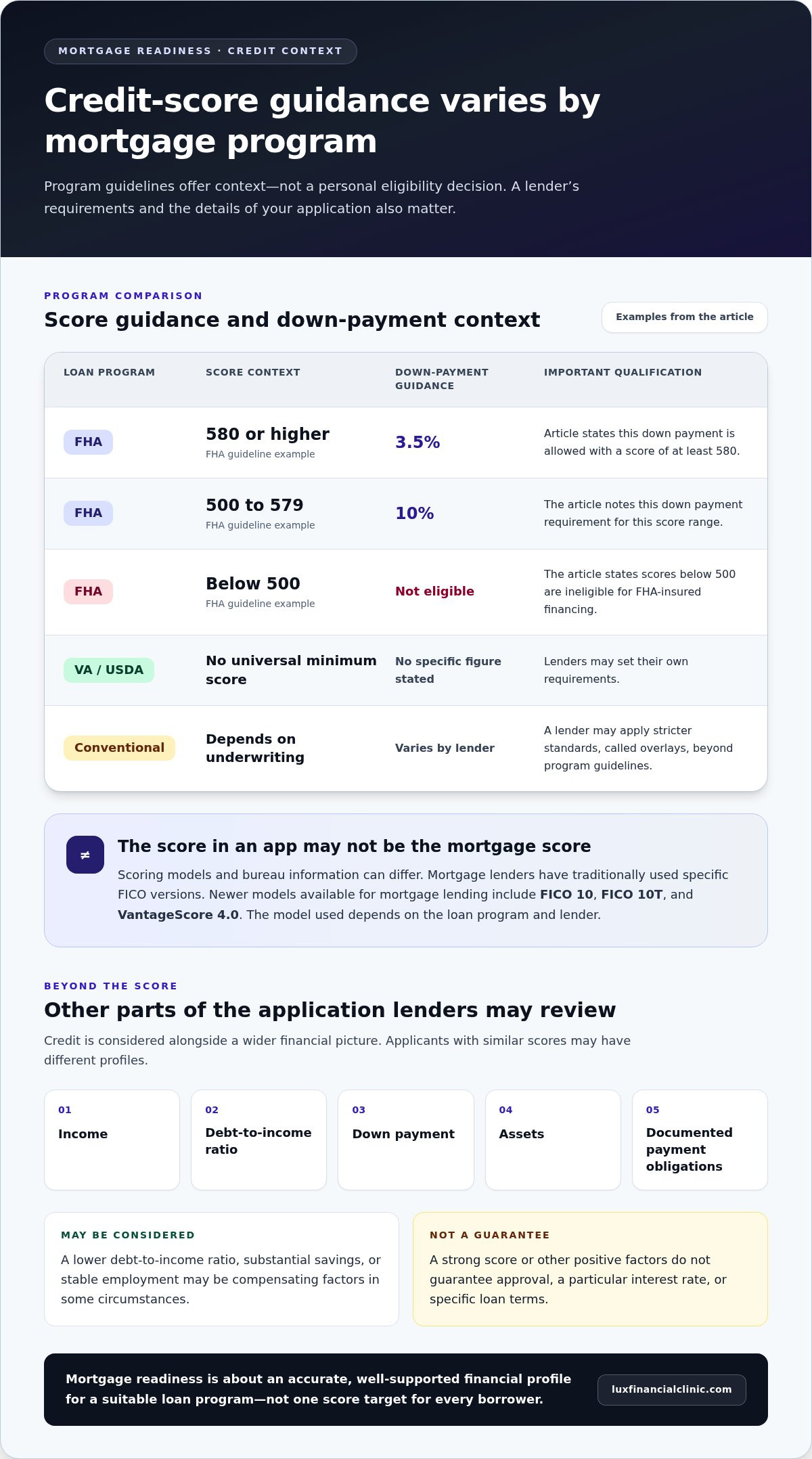
Scores can differ because scoring models use different methods and the information held by each reporting bureau may vary. A consumer app can offer a general reference, but its score may not match the model used in a mortgage decision. Mortgage lenders have traditionally used specific FICO versions. Newer models, including FICO 10, FICO 10T, and VantageScore 4.0, are now available for mortgage lending. The model that applies depends on the loan program and lender.
Requirements also vary by program. FHA guidelines allow a 3.5% down payment with a score of at least 580. Scores from 500 to 579 require a 10% down payment, and scores below 500 are ineligible for FHA-insured financing. The VA and USDA don’t set a universal minimum score, although lenders may set their own requirements. Conventional lending criteria can also depend on the lender’s underwriting process. A lender may apply stricter standards, called overlays, beyond program guidelines. These examples provide context, not a personal eligibility decision.
What else do mortgage lenders consider besides credit?
Lenders may also review income, debt-to-income ratio, down payment, assets, and documented payment obligations. These details help show whether a proposed housing payment fits your finances and what capacity you may have after paying existing debts. They are considered alongside credit information, not as substitutes for accurate reports or responsible credit use.
Two applicants with similar scores may have different application profiles because their incomes, monthly obligations, savings, or down payments differ. A lower debt-to-income ratio, substantial savings, or stable employment may be considered as compensating factors in some circumstances, but none guarantees approval. A strong score alone doesn’t guarantee a particular interest rate, loan terms, or approval.
If you’re weighing how to improve credit score to buy a house, first identify the loan path you’re considering and the parts of your profile that need attention. A mortgage-focused plan can prioritize relevant credit habits and reporting issues without treating one number as the whole decision.
How to review your credit reports before applying for a mortgage
Before changing your credit habits, get a clear view of what your reports show. Review files from all three nationwide credit bureaus because they can differ: a creditor may report to some bureaus but not others, and updates may appear at different times. A collection or balance on one report, for example, might not yet appear on another. Differences aren’t automatically errors, but comparing reports can reveal details worth investigating.
How to check and compare your three credit reports
Use AnnualCreditReport.com, the authorized source for free reports from the nationwide credit bureaus. Review each file carefully and keep a dated record of the reports and any follow-up. A spreadsheet or written checklist can help you track which bureau lists an item and whether a correction later appears.
- Obtain the reports. Save or print a copy of each bureau’s file so you can refer to the exact information shown.
- Compare key entries. Check account status, balances, payment history, dates, and account ownership. Note unfamiliar accounts, payments marked late despite records showing otherwise, or balances that seem inconsistent.
- Identify possible inaccuracies. Record the specific account and detail that seems wrong or incomplete. Don’t assume a difference between bureaus is an error without examining the underlying information.
- Track follow-up. Note when you reviewed a report, what information you questioned, which bureau’s file it appeared on, and any correspondence or supporting documents. Revisit the file to see whether the information has been corrected.
When a credit report dispute may be appropriate
A dispute may be appropriate when you believe information in a report is inaccurate or incomplete. Be specific: identify the account, explain what you believe is wrong, and gather relevant records, such as statements or proof of payment. Clear documentation helps you explain the concern and keep your records organized.
Accurate negative information isn’t automatically removable just because it affects your score or mortgage preparation. A dispute should address a genuine reporting concern, not request the erasure of correct history. Focus on errors you can describe and support, and plan around accurate entries that remain part of your credit profile.
For a closer look at disputes involving multiple bureau files, Lux Financial Clinic’s Essential Guide to 3-Bureau Credit Dispute Services for 2026 offers related guidance. A financial diagnostic consultation can help you clarify your credit position and organize next steps.
Which credit-building actions help before a mortgage, and what can backfire?
As you prepare for a mortgage, steady habits are usually a sounder foundation than last-minute score tactics. The right move depends on your credit profile and how soon you plan to apply. An action that supports long-term credit-building may still need careful timing during an active mortgage application.
No single action guarantees a mortgage-ready score, because lenders assess credit within the context of the loan program and your full financial profile. Use this comparison to weigh common steps before making a change.
| Action | Why it may help | What to consider before applying |
|---|---|---|
| Pay bills on time | Builds a consistent record of meeting payment obligations. | Set reminders or use a payment routine that fits your finances. Avoid taking on new commitments you can’t reliably manage. |
| Manage revolving balances | Lower balances relative to available credit may support a stronger credit profile. | Choose a sustainable repayment approach. There isn’t one utilization percentage that serves as a universal mortgage qualification threshold. |
| Apply for new credit | A new account may suit a longer-term credit-building plan. | An application can affect your profile, and new debt may change your monthly obligations. Timing matters near a mortgage application. |
| Close an existing account | Closing may simplify account management in some circumstances. | It can change available credit or other parts of your profile. Don’t close a long-standing account reflexively. |
Which habits should most buyers prioritize?
Start with reliable payments. Keep due dates visible in a calendar or reminder system and make payments on time as part of a consistent monthly routine. If you use automatic payments, make sure the account is funded and review statements so you notice any payment issue.
Next, review revolving balances, such as credit card balances, and consider a repayment plan that fits your budget. Avoid borrowing more simply to pursue a score target. If you’re learning how to improve credit score to buy a house, focus on sustainable habits rather than a promised point increase or a utilization percentage treated as a rule for every borrower.
Which last-minute moves deserve caution?
Opening an account or taking on new debt close to an application can affect your credit profile and monthly obligations. Even a purchase financed through a new account could change the picture a lender reviews. The effect varies by circumstance, so don’t assume a tactic will help just because it’s commonly recommended.
Closing a long-standing account can also affect your profile, depending on the account and your other credit. Before a major change during mortgage preparation, discuss it with the mortgage professional handling your application. That conversation can help you understand how the action fits your timing and application, without treating any single move as a guarantee.
How to build a mortgage-focused credit improvement plan
A useful plan starts with your purchase timeline, not a promise about how quickly a score might change. Credit reporting and score updates vary, and no one can reliably set a date by which a particular improvement will appear. You don’t need a perfect score to prepare responsibly. You need a clear view of your current position and a measured approach that fits your circumstances.
Build your plan in four steps:
- Set the timeline. Estimate when you hope to buy and whether you’re planning ahead or preparing to apply soon. This helps distinguish habits to build over time from decisions that need care during an active application.
- Review your profile. Check your reports for account status, balances, payment history, and information you believe may be inaccurate. Take stock of income, debts, assets, and regular obligations so your plan reflects more than a score.
- Prioritize actions. Keep payments on time, manage revolving balances sustainably, and address specific reporting inaccuracies through appropriate dispute channels. Avoid trying several new tactics at once, especially if you’re close to applying.
- Track progress and reassess. Record what you’ve done and review changes to your reports and finances periodically. Adjust your approach based on what you observe rather than relying on a fixed improvement calendar.
If buying is several months away
Use the extra time to build consistency. Review reports, payment activity, balances, and account-status changes on a regular schedule. If you identify information you believe is inaccurate, gather relevant records, submit a focused dispute through the appropriate channel, and record the issue and outcome. Updates can appear at different times across reports and scoring models, so review progress periodically.
Build habits you can maintain rather than making a temporary change solely to influence a number. If a balance is difficult to manage, consider a realistic repayment approach that fits your budget. Revisit the plan if your financial picture or purchase timing changes.
If you hope to apply soon
Keep your next steps measured. Organize income, debt, asset, and credit documentation, and discuss loan-program criteria and timing with the mortgage professional handling your application. Avoid rushed account changes or new borrowing without understanding how they may affect the application. Keep your financial activity consistent during review and respond carefully to requests for information.
Lux Financial Clinic’s comprehensive credit repair package includes a personalized credit-building roadmap and dedicated strategist support. A financial diagnostic consultation can also help clarify your position and practical next steps, without promising a particular score or mortgage outcome.
How Lux Financial Clinic can support your credit-readiness next steps
After reviewing your reports and considering your purchase timeline, you may want help turning that information into a practical plan. Lux Financial Clinic provides structured credit repair focused on potentially inaccurate negative items reported across the three nationwide credit bureaus. The goal is to help you understand what may warrant attention and organize appropriate next steps, not to promise a specific score or mortgage outcome.
What structured credit repair can and cannot address
A review may identify potentially inaccurate or incomplete collections, charge-offs, late payments, or hard inquiries. If an item appears wrong, a dispute can focus on the specific information and the records supporting your concern. This is different from trying to remove accurate history because it may affect a credit score or mortgage application. Accurate, current negative information isn’t automatically removable on demand.
Credit repair can’t promise score changes, removal of a particular item, or mortgage approval. Those outcomes depend on the information in your reports and other factors outside the credit repair process. If you’re considering how to improve credit score to buy a house, focus on accurate reporting and sustainable credit habits rather than expecting a dispute to erase correct history.
Lux Financial Clinic's comprehensive credit repair package includes a personalized credit-building roadmap and dedicated strategist support. The roadmap helps organize priorities around your credit profile and purchase timing while keeping expectations grounded in the information available.
When personalized guidance may bring clarity
A financial diagnostic consultation can help clarify your financial position and sort through possible next steps. It may be useful if you’re unsure which report items deserve attention, how to prioritize actions, or how credit preparation fits alongside other parts of your finances. The Financial Diagnostic: 2026 Prep and Expectations resource offers additional context for thinking through that process.
Preparation doesn’t require chasing a perfect score. It means understanding your reports, distinguishing potential errors from accurate history, and choosing a plan that fits your circumstances. With a clearer view of what needs attention, you can make deliberate decisions and discuss mortgage-specific questions with the professional handling your application.
If personalized support would help you organize your credit-readiness next steps, explore personalized credit guidance.
Take your next step with clarity
Preparing to buy a home doesn’t require resolving every detail today. Start with a decision you can act on: define your purchase timeline, identify the credit questions that remain unclear, and choose a manageable next step. This keeps how to improve credit score to buy a house grounded in your financial picture rather than pressure to reach an arbitrary number.
If inaccurate negative information may be affecting your reports, Lux Financial Clinic uses structured dispute protocols focused on potentially inaccurate items across the three nationwide credit bureaus. The comprehensive credit repair package includes a personalized roadmap and dedicated strategist support. Credit repair and a roadmap can’t guarantee a score change or mortgage approval, but structured guidance can help you organize your next steps.
You deserve to move forward without shame or guesswork. Explore personalized credit guidance and choose a considered next step aligned with your homeownership goals.
Frequently Asked Questions
What credit score do I need to buy a house?
There isn’t one score that guarantees eligibility for every mortgage. FHA guidelines allow a 3.5% down payment with a score of at least 580. Scores from 500 to 579 require a 10% down payment. The VA and USDA don’t set a universal minimum, though lenders may set their own requirements. Conventional criteria can also vary by underwriting process and lender. Ask the mortgage professional handling your application which program rules and score model apply to your situation.
How long does it take to improve your credit score before buying a house?
There’s no reliable timeline for a particular score change. The pace depends on what’s affecting your profile, how creditors report updates, and how scoring models reflect new information. If you’re researching how to improve credit score to buy a house, focus on steady habits and review your reports periodically instead of planning around a promised date. A lender or credit professional can help you consider whether your purchase timing fits your current profile.
Can I buy a house with collections on my credit report?
Collections don’t automatically prevent every borrower from buying a house, but their effect depends on the loan program, lender requirements, and the rest of your application. A lender may need to understand the account’s status and how it relates to your documented obligations. Check whether the collection is accurate, and discuss its specific impact with the mortgage professional handling your application. Paying it may not erase accurate history from your report.
Will paying off a credit card raise my score before a mortgage application?
Paying down a card may help your credit profile by reducing its reported balance, but a score increase isn’t guaranteed. The balance shown on a report may not update immediately after you make a payment, so timing can matter. Keep making at least the required payments, and weigh the tradeoff before using money needed for your down payment or reserves. Ask your mortgage professional before making a large payment during an active application.
Should I dispute every negative item before applying for a mortgage?
No. Dispute information you reasonably believe is inaccurate or incomplete, not every entry that may lower your score. For example, if a report shows a late payment but your records indicate it was paid on time, identify the account and gather supporting documentation. Accurate negative history isn’t automatically removable through a dispute. If you’re already applying, discuss the timing of a dispute with the mortgage professional handling your file so you understand how it may fit the review.
Does checking my own credit report lower my credit score?
No. Checking your own credit report is generally treated as a soft inquiry and doesn’t lower your score. It’s different from applying for new credit, which can lead to a lender inquiry. You can review your reports to understand what’s recorded without avoiding them out of fear of a score drop. If you notice an unfamiliar account or a detail that seems wrong, save the report and note the specific entry for follow-up.
What happens if my credit score drops while I am applying for a mortgage?
Tell the mortgage professional handling your application promptly and ask what the change means for your file. A lender may review updated credit information before closing, and a change could affect eligibility or the terms being considered, depending on the program and your overall application. Avoid opening accounts, taking on new debt, or making other major credit changes without discussing them first. A drop doesn’t automatically determine the outcome, so get guidance based on your application.


