
A low credit score doesn’t automatically rule out renting an apartment. If you’re denied for an apartment due to your credit score, there’s no single minimum score for every property. Screening criteria vary, so ask what led to the decision and review the report for errors.
A denial can feel personal, especially when you’re ready to move, but it’s a screening decision you can respond to with clear information and practical next steps. This guide explains what landlords may review on a credit report, what to do after a denial, and how options such as a cosigner, stronger income documentation, or a higher deposit may affect your application.
You’ll also learn how to approach a future application if your credit needs attention, so you can decide where to apply and what to address first.
Key Takeaways
- Ask what information led to the rental decision, then review the screening report for errors you can dispute.
- Strengthen a future application with clear income records and relevant rental references.
- Understand how a cosigner or a higher security deposit may affect your options before applying again.
- Explore credit repair support if inaccurate negative items are affecting your credit profile.
1. What should I do if my rental application is denied because of a tenant screening report?
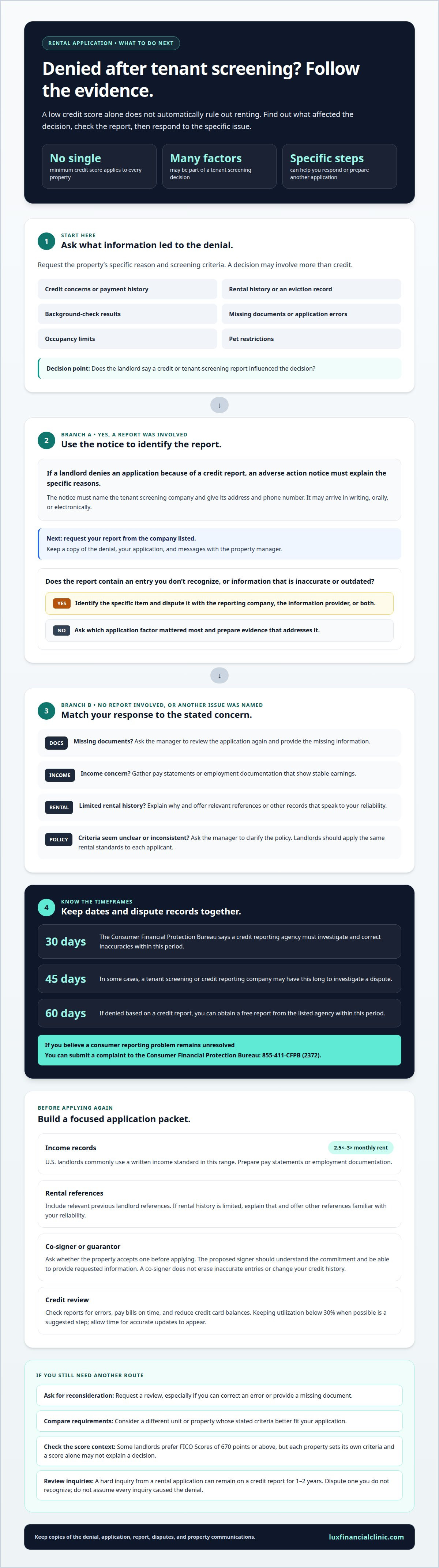
Start by asking the landlord or property manager which tenant screening information affected your rental application. A denial may involve credit concerns, rental history, an eviction record, background-check results, missing documents, application errors, occupancy limits, or pet restrictions. There’s no standard minimum credit score for every U.S. apartment, so request the property’s specific criteria before applying elsewhere.
Can you appeal an apartment denial or ask the landlord to reconsider? Yes. Ask the manager to review your application again, particularly if you can provide a missing document or correct an error. If a report contains inaccurate information, identify the specific item and dispute it with the reporting company or the company that supplied it.
Keep copies of the denial, your application, and messages with the property manager. In some cases, a tenant screening or credit reporting company may have 45 days to investigate a dispute. If you believe a consumer reporting problem remains unresolved, you can submit a complaint to the Consumer Financial Protection Bureau by calling 855-411-CFPB (2372).
For income, prepare records that show stable earnings, such as pay statements or employment documentation. U.S. landlords commonly use a written standard of 2.5x to 3x monthly rent. If you have limited rental history, explain why and offer other relevant records, such as proof of consistent income or references from people familiar with your reliability.
Landlords should apply the same rental standards to each applicant. If the stated income or screening criteria seem inconsistent, ask the manager to clarify the policy. You can also consider a different unit, a property with criteria that better fit your application, or a co-applicant. Compare the stated requirements before applying again, and organize documents that address the specific concern.
2. What Do Landlords Look for on a Credit Report?
A landlord may review payment history, unpaid accounts, collections, and other details in your credit history. Tenant screening may also include criminal history or rental records, so a credit report may be only one part of the application review. Ask which report influenced the decision, then check it for accounts or payments you don’t recognize.
What credit score do landlords typically require to rent an apartment? There’s no standard minimum score across properties. Some landlords prefer FICO Scores of 670 points or above, but each property sets its own criteria, and a score alone may not explain a decision.
Under the Fair Credit Reporting Act, a landlord who denies an application because of a credit report must provide an adverse action notice explaining the specific reasons. The notice must identify the tenant screening company by name, address, and phone number. It may arrive in writing, orally, or electronically. Use those details to request your report and identify what affected the decision.
If the report contains inaccurate or outdated information, dispute the specific entry with the reporting company, the information provider, or both. The Consumer Financial Protection Bureau says a credit reporting agency must investigate and correct inaccuracies within 30 days. Applicants denied based on a credit report can also obtain a free report from the listed agency within 60 days.
A hard inquiry from a rental application can remain on a credit report for 1-2 years. Review the inquiry details and dispute an entry you don’t recognize; don’t assume every inquiry caused the denial.
What state and local laws protect renters denied because of credit? The Fair Credit Reporting Act provides federal protections for credit-report use, while fair housing laws prohibit discrimination based on protected characteristics, including race, religion, and disability. State and city screening rules can vary. If reporting rights may have been violated, legal action under federal or state law may be available, though deadlines apply. A credit review can help identify inaccurate negative items before another application; explore credit repair support as one possible next step.
3. Can You Get an Apartment With Bad Credit?
Yes. A low credit score doesn’t automatically prevent you from renting. Landlords may weigh it alongside income, rental history, and the rest of your application. If a credit check raises concerns, strengthen the parts you can document rather than assuming every property uses the same criteria.
Prepare a concise application packet with current income records, employment information, and references from previous landlords. If you have limited rental history, explain that directly and provide other relevant references, such as someone who can speak to your reliability. Clear, relevant documents help property managers assess your full application.
A co-signer or guarantor may support an application if the property accepts one. Discuss the option before applying, and make sure the proposed signer understands the commitment and can provide the requested information. A co-signer can add financial support, but won’t erase inaccurate entries or change your credit history.
Build a stronger profile before a future application by paying bills on time, reducing credit card balances, and reviewing credit reports for errors. Keeping credit card utilization below 30% when possible is a suggested step for renters. Allow time for accurate updates to appear before relying on a recent change during screening.
After a denial, ask which application factor mattered most, then choose a response that addresses it. If documentation was missing, assemble it before applying again. If credit history was the issue, review it for errors and work on payment patterns and balances. You could also reapply later, consider a different unit, or look for a property whose stated criteria better fit your circumstances. Tailor each application to the property’s requirements, and avoid submitting incomplete records that leave questions unanswered.
4. Cosigners and higher security deposits
A co-signer or guarantor can strengthen an application when credit concerns or limited rental history raise questions. A co-signer generally applies alongside the renter, while a guarantor agrees to support the lease if the renter cannot meet payment obligations. Property managers may review the signer’s income, credit, and background as part of screening.
Before applying, ask the property manager whether it accepts a co-signer or guarantor and what documents are required. The signer should be ready to provide income and employment records and may need to complete the same credit or background checks. Make sure both people understand the arrangement and review the lease terms before signing.
A higher security deposit may also address a landlord’s concern, and some properties consider it alongside stronger income proof or positive rental references. Ask how the deposit would affect the application and whether state or local rules limit the amount. Rental screening rules vary by location, so don’t assume one property’s deposit policy applies everywhere.
Paying rent in advance is different from providing a security deposit. A renter with bad credit may ask whether paying rent in advance would be considered, but it doesn’t guarantee approval or replace the property’s screening criteria. Clarify in writing how an advance payment would be applied before agreeing.
Choose the option that addresses the landlord’s stated concern. If the issue is weak rental history, references from previous landlords may be more relevant than a larger deposit. If income is the concern, documented employment or a financially qualified signer may offer stronger support. If credit is the concern, a deposit may help at some properties, but it won’t correct inaccurate information on a credit report.
Prepare the signer’s records, rental references, and income documents together before submitting another application. For guidance on broader property decisions, explore real estate brokerage consulting.
Lux Financial Clinic
Lux Financial Clinic can help you take a structured look at credit concerns that may affect future rental applications. Its Credit Repair - Basic/Repair Package and Credit Repair - Comprehensive/Build Package use dispute protocols to address inaccurate negative items, such as collections, charge-offs, and late payments. This support is relevant when a credit report contains information you believe is inaccurate, rather than when a landlord’s decision rests on income, rental history, or another application requirement.
Reviewing the issue can clarify which credit concerns need attention before you apply again. Credit repair doesn’t guarantee a particular score or rental approval, and accurate information is not an error to dispute. For a broader look at your financial situation, a Financial Diagnostic Consultation can help you consider practical next steps.
Contact Lux Financial Clinic to discuss your credit concerns and possible next steps.
Choose a Clear Next Step
Being denied for an apartment due to your credit score can prompt a closer look at the financial information you bring to future applications. Take a deliberate next step: understand what needs attention, distinguish inaccurate reporting from accurate history, and make decisions that support your wider goals. Credit repair may help address inaccurate negative items, but it can’t promise a particular score or rental outcome.
Lux Financial Clinic offers the Credit Repair - Basic/Repair Package and Credit Repair - Comprehensive/Build Package for people seeking support with credit concerns. If your financial priorities also include a business, Business Funding Consulting is another service available to you. The right direction depends on the issue you want to address and the progress you’re working toward.
If you’re ready to discuss your credit concerns and possible next steps, contact Lux Financial Clinic. A thoughtful plan can help you move forward with greater clarity and confidence.
Frequently Asked Questions
Can You Get an Apartment With Bad Credit?
Yes, a low credit score doesn’t automatically prevent you from renting. For example, an applicant with a thin credit file may strengthen an application with documented income and positive references. A landlord may weigh these details alongside credit history, rental background, and the property’s screening criteria. Before submitting your application, make sure it addresses the factors that matter to that property.
What Do Landlords Look for on a Credit Report?
Landlords may review payment history, unpaid accounts, collections, and credit inquiries to understand an applicant’s financial record. A credit report can also show a score ranging from 300 to 850 points. The report is only one part of screening, so a landlord may consider it alongside rental history, income, and other application information. Review the actual report rather than relying on a score estimate.
What should I do if my rental application is denied because of a tenant screening report?
Ask the landlord which report information affected the decision, then obtain and review the report for errors. If it includes inaccurate details, dispute them with the reporting company and the company that supplied the information. Keep the denial notice and dispute records together. For example, if an account is unfamiliar, identify that entry specifically rather than disputing the entire report without explanation.
Can a Landlord Reject an Application for Any Reason?
No. U.S. fair housing laws prohibit discrimination based on protected characteristics, including race, color, national origin, religion, sex, familial status, or disability. Landlords can apply rental criteria such as income, occupancy limits, or pet restrictions, but should use consistent standards for applicants. If you believe a decision involved discrimination, you can file a complaint with the U.S. Department of Housing and Urban Development or seek legal counsel.
Does a Landlord Have to Give a Reason for Not Renting?
If a landlord denies an application because of a credit report, the Fair Credit Reporting Act requires an adverse action notice explaining the specific reasons. The notice must identify the screening company that supplied the report. It can be delivered in writing, orally, or electronically. This gives you a starting point for requesting the report and checking whether the decision relied on incorrect information.
Does a low credit score mean I’ll be denied housing?
No. If you were denied for an apartment due to your credit score, remember that no single minimum score applies to every property. A low score may be considered alongside income, rental references, and other screening details. A co-signer, stronger documentation, or a different unit may support a future application, though the property’s criteria determine which options it considers.


