
When credit questions, tax needs, and funding goals overlap, it can be hard to know what to address first. A financial diagnostic consultation can help you organize those concerns, connect them to your goals, and identify practical next steps. You don’t need to have a complete plan before you start. A clear account of what’s worrying you is a useful place to begin.
It can be difficult to prioritize several financial concerns, especially if you’re worried about being judged or pressured into a commitment. A consultation gives you a structured conversation to explain your situation, clarify what matters most, and consider which type of support fits. You can use the discussion to make an informed decision about what to do next.
This article explains what a financial diagnostic consultation can cover, what context to prepare, and how to evaluate possible next steps. It also explains how a personalized financial roadmap can help separate immediate priorities from longer-term goals, so you can move forward with a clearer view of your options.
Key Takeaways
- A financial diagnostic consultation can help organize connected concerns and identify which priorities need attention first.
- Before the conversation, consider your goals, main concerns, relevant financial context, and questions.
- A consultation helps clarify needs; credit repair, tax preparation, and funding support address more defined service areas.
- Lux Financial Clinic offers personalized financial roadmaps to connect your priorities with practical next steps.
- Use the discussion to decide whether additional support fits your goals and circumstances.
What Is a Financial Diagnostic Consultation, and When Can It Help?
Financial concerns often overlap. A credit question may affect plans for a major purchase, while tax preparation or business funding can raise separate questions about timing and readiness. When those issues feel connected, it may be difficult to decide which deserves attention first. A financial diagnostic consultation is a structured conversation to sort through your concerns, clarify your priorities, and consider next steps in light of your circumstances and goals.
A financial diagnostic consultation helps clarify your financial priorities and possible next steps. It is an assessment, not a financial product or a promise of a particular result. The focus is understanding your situation, not guaranteeing a credit score increase, funding approval, or other outcome. The conversation can also help you decide whether a defined service, such as credit repair, tax preparation, or business funding consulting, addresses the need you’ve identified.
This conversation connects naturally with financial planning, which considers goals and choices over time. A diagnostic discussion can help you identify the questions to resolve before deciding how to proceed. You don’t need to arrive with a polished plan or every detail in order. Being unsure where to start is useful context in itself.
Which financial questions can a consultation help clarify?
You can bring one concern or several related questions. For example, you may want to understand your credit while planning a major purchase, or you may be preparing taxes as a self-employed person while considering funding for your business. The discussion can help separate the issues, identify what information matters, and decide which topic to explore first. The right focus depends on your circumstances and goals, not a checklist that applies to everyone.
Who may benefit from a diagnostic conversation?
A structured conversation may help if a financial setback has left you unsure how to begin, or if a personal goal has raised new questions. It can also be useful when you’re weighing several priorities and need to distinguish a time-sensitive issue from something that can wait. You don’t need to know the perfect solution before seeking guidance. Wanting a clearer starting point is reason enough to discuss your situation.
Entrepreneurs may find a diagnostic discussion useful when thinking about credit readiness or business funding. It can help frame questions such as whether a credit concern or tax preparation should be considered alongside funding plans. The purpose is to develop a clearer view of your options and priorities, then consider relevant support. Any next step should reflect the goals discussed.
What a Financial Diagnostic Consultation Can Review
A useful review starts with your goals and concerns, then considers the financial context that helps explain them. That might mean discussing a credit question connected to a future purchase, a tax concern related to self-employment income, or business funding plans and your current position. There is no single checklist for every conversation. The aim is to understand how the pieces relate and which questions merit attention first.
Your circumstances matter because the right next step depends on what you’re working toward, what’s happening now, and how those priorities connect. A near-term tax question may call for a different response from a longer-term business goal. Separating the two makes it easier to consider your options without assuming that every concern needs the same kind of support.
Credit concerns and financial goals
Collections, late payments, or questions about credit readiness can be part of the discussion, particularly if you’re planning a major purchase or trying to understand your financial options. The first step is to identify the concern and how it relates to your goal. A consultation does not establish that an item can be removed or that a score will improve. If you want to learn how credit reporting concerns may be approached, this three-bureau credit dispute service guide offers related context.
The conversation can help distinguish a credit concern that may benefit from a defined credit repair service from a broader goal that involves other planning. A major purchase, for example, can raise questions beyond credit alone. Clarifying the credit-related issue helps keep the next step focused, without implying that credit repair guarantees a particular result.
Tax, business funding, and major-purchase questions
Tax needs may involve individual or small business preparation, including questions related to self-employment. Identifying the type of return or concern and how it fits your current goals can help clarify whether tax preparation is the relevant next step. This can be especially useful when tax questions come up alongside business planning and you’re deciding what to address first.
For entrepreneurs, credit readiness and funding plans may overlap, but they are not the same question. A discussion can help you define what you want to understand about your business and what guidance may be relevant. The credit readiness for business funding guide explores that connection. Business funding consulting provides guidance, not a promise of approval or access to capital.
Major purchases can raise practical questions about timing, credit, and other priorities. A diagnostic conversation can help you name those questions and consider which service area fits, without treating a purchase goal as a guarantee of financing or a particular outcome. Lux Financial Clinic’s financial diagnostic consultation provides a structured way to discuss how your priorities connect.
How a Diagnostic Consultation Differs From Credit Repair, Tax Preparation, or Funding Support
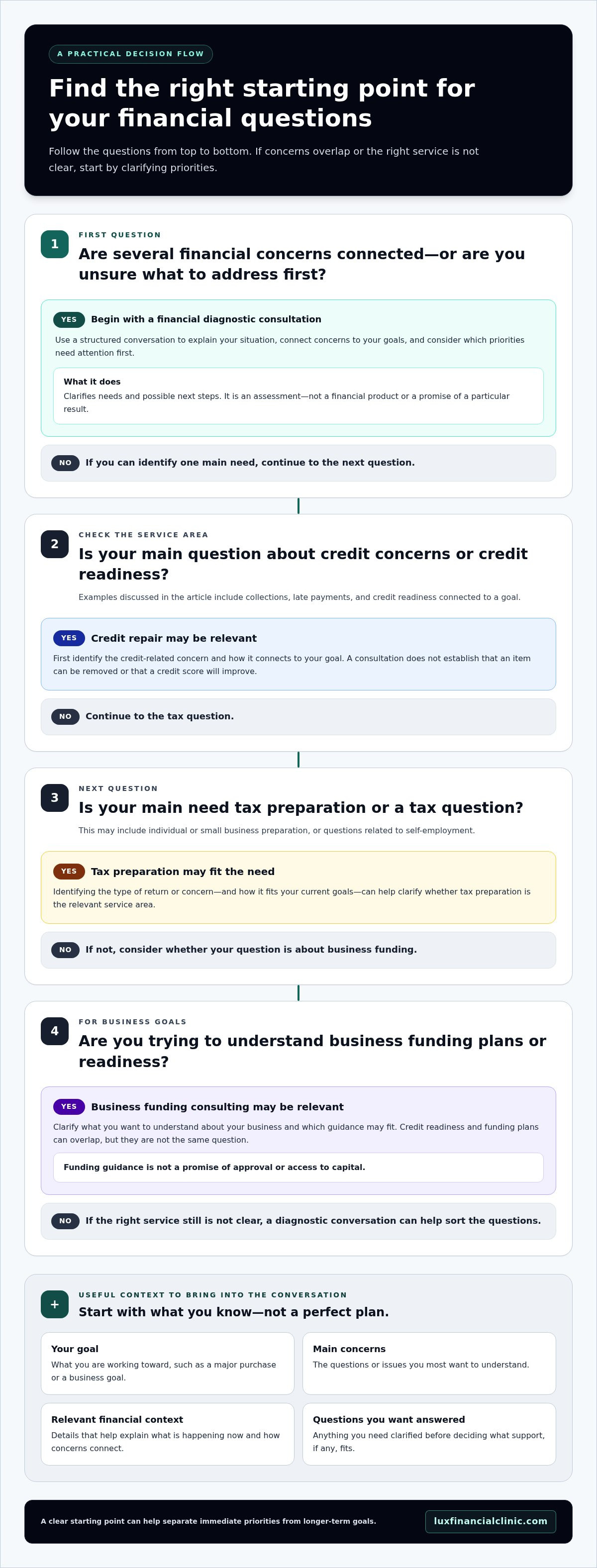
A consultation helps clarify the question before you choose a more focused service. Credit repair, tax preparation, and business funding consulting each address a distinct area. General educational information can explain a topic, but it does not assess your circumstances or carry out service work. Understanding the differences can help you identify the kind of support that fits your need.
| Type of support | Primary purpose | What it doesn’t promise |
|---|---|---|
| Diagnostic consultation | Assess concerns and help clarify priorities and possible next steps. | A specific financial result or a requirement to pursue another service. |
| Credit repair | Address eligible negative credit items through a defined service. | Deletion of every negative item or a particular score change. |
| Tax preparation | Support the preparation and filing of tax returns. | A particular refund or broader financial planning. |
| Business funding consulting | Provide guidance related to business funding questions. | Loan origination, lender decisions, or guaranteed access to capital. |
| Educational information | Explain general concepts and help build understanding. | Personalized assessment or service work. |
The distinction is simple: a financial diagnostic consultation helps identify what you need to address, while a defined service focuses on that area. The discussion may point toward credit repair, tax preparation, or funding guidance, but it does not require you to pursue any of them. Educational resources can help you learn about a topic, though they do not replace a review of your specific situation.
Consultation versus a credit repair program
A consultation can help you explain credit concerns, understand how they relate to a goal, and consider whether credit repair is relevant. A credit repair service focuses on eligible negative items. Not every entry is inaccurate, disputable, or removable, and no particular deletion or score improvement is guaranteed. For more detail, the credit dispute service overview provides additional context.
Consultation versus tax or funding services
Tax preparation centers on preparing and filing returns, rather than broad financial planning. If you’re sorting out filing questions, this personal tax preparation guide offers general information. A consultation can help distinguish a tax filing need from other priorities, such as a business funding question.
Funding consulting provides guidance, not lending or loan origination. It cannot assure a lender’s decision or access to capital. Keeping that distinction in mind sets realistic expectations and helps you choose a next step that matches your goals. Lux Financial Clinic’s diagnostic consultation offers a structured review of your priorities.
How to Prepare for a Financial Diagnostic Consultation
You don’t need every detail organized or a decision about which service you need. A little preparation can keep the conversation focused on what matters to you. Use this four-step checklist as a starting point, and bring only information related to the topics you want to discuss.
- Define your goal. Note what you hope to understand or work toward, such as addressing a credit concern or exploring a business funding objective.
- List your main concerns. Write down the issues that feel most pressing and how they may connect to your goal.
- Gather relevant context. Note useful dates, account concerns, income context, or filing questions related to the topics you want to raise.
- Prepare your questions. Choose a few points you’d like clarified, including what a practical next step might involve.
Clarify your goals and immediate questions
Be specific about the decision or concern that prompted you to seek guidance. If business funding is on your mind, note what you’re trying to understand about readiness. If credit is the main concern, describe how it relates to your broader plans. A short question list can help you keep track of what you want answered while leaving room for related issues to come up.
Organize relevant information without over-preparing
Brief notes can help explain the context: when a concern arose, which account or filing question it involves, or how income relates to a self-employment or business topic. Focus on information that helps explain your questions rather than trying to assemble a comprehensive file. Don’t share account passwords or other sensitive login credentials in article comments or public channels.
Set realistic expectations for next steps
Recommendations depend on your circumstances and the issue being discussed. Consider what useful progress would mean to you, such as understanding a credit concern, organizing tax questions, or identifying what to explore about business funding. These are goals, not promised outcomes. Guidance can clarify actions to consider, but it cannot guarantee a credit score change, a particular tax result, or a funding decision.
Preparation supports a focused conversation; it is not a test of how organized you are. A financial diagnostic consultation with Lux Financial Clinic can help you discuss your priorities and consider a direction that fits your goals.
What Happens After a Lux Financial Diagnostic Consultation?
A consultation helps make your concerns easier to interpret and gives you a clearer basis for deciding what to address. Lux Financial Clinic offers diagnostic consultations and personalized financial roadmaps to connect the issues you discuss with possible next steps. The focus is understanding your priorities and considering which direction fits your situation, rather than pushing everyone toward the same service.
From financial concerns to a personalized roadmap
Once your goals and concerns are clear, you can organize what to address next. If credit questions are central, credit repair may be relevant. If your immediate need is filing, individual or business tax preparation may fit better. An entrepreneur considering business funding may benefit from consulting focused on that goal. These services address distinct needs, so separating related concerns can help you choose a more focused next step.
A personalized roadmap provides a structure for considering those priorities. You may come away with a clearer idea of which question to address first and which connected topics can be revisited later. The details should reflect the concerns and context you brought to the conversation, not a standard sequence assumed to work for everyone. A roadmap is guidance for considering next steps, not a guarantee of a particular credit, tax, or funding result.
You can also identify what you still need to understand before taking action. That may mean clarifying whether a concern is mainly about credit, tax preparation, or business funding, or weighing how a financial goal fits alongside other priorities. A clearer question can make the next decision more manageable.
Decide whether further support fits your goals
Additional support is a choice. Consider whether a proposed next step addresses the concern you want to resolve, fits alongside your other priorities, and supports your goals. Credit repair, tax preparation, and funding consulting serve different purposes. Understanding those differences can help you decide whether one is relevant now or whether you need more time to think.
You should have enough information to make a decision at your own pace. If you choose further support, the relevant service area can move the conversation from broad concerns toward a more defined focus. If you decide not to continue, you can still use what you clarified to shape your own next steps.
For a considered conversation about your priorities, Explore a financial diagnostic consultation with Lux Financial Clinic. It’s a starting point for understanding which direction may align with your goals.
Choose a Clearer Starting Point for Your Next Financial Step
You don’t have to resolve every financial question before deciding what to do next. Start by choosing one priority to understand, then consider how it fits with the goals you want to pursue. You can make that decision carefully, without committing before you feel ready.
A financial diagnostic consultation with Lux Financial Clinic can help bring your priorities into focus through a personalized financial roadmap. If your needs point toward a more defined area, the clinic also provides credit repair, tax preparation, and business funding support. The right direction depends on your circumstances, and no conversation can promise a specific financial result.
When you’re ready to discuss your priorities, explore a financial diagnostic consultation with Lux Financial Clinic.
Frequently Asked Questions
What is a financial diagnostic consultation?
A financial diagnostic consultation is a focused conversation to assess financial questions and identify what to explore next. You might use it to sort out whether a concern relates mainly to credit, an upcoming tax return, or a business goal. It does not guarantee a result or require you to choose a service. The practical benefit is a clearer understanding of the issue and the options relevant to it.
What happens during a financial diagnostic consultation?
The conversation centers on the concerns you bring and why they matter to you. For example, if you’re self-employed and unsure how a tax question relates to a business funding goal, you can explain both and work toward separating the issues. The discussion can help identify useful follow-up questions or a relevant service area. The focus depends on your situation, and no particular credit, tax, or funding outcome is assured.
How should I prepare for a financial diagnostic consultation?
Write down the main issue you want to discuss and what you hope to understand. A specific example, such as a question about a late payment or a self-employment return, can make the concern easier to explain. Bring context connected to your questions, but don’t assume a particular document is required. Keep passwords and sensitive account credentials private, especially in public comments or messages.
Can a financial diagnostic consultation help with credit repair?
Yes. It can help you consider whether credit repair is relevant, though the consultation is distinct from credit repair itself. If a collection appears on a report, for example, the discussion can help you identify what you want to understand and whether a separate credit repair service fits your needs. Credit repair may address eligible negative information, but accurate information is not guaranteed to be removed, and a specific score is not promised.
Is a financial diagnostic consultation the same as financial planning?
No. A diagnostic consultation focuses on understanding concerns and possible next steps, while financial planning can refer to a broader process. Lux Financial Clinic provides diagnostic consultations and personalized roadmaps, alongside credit repair, tax preparation, and business funding support. The consultation is not investment or wealth-management advice. When comparing services, focus on the specific question each one is intended to address.
Does a financial diagnostic consultation guarantee funding or credit improvement?
No. A consultation can help clarify which questions to address, but it cannot promise funding approval, removal of a credit-report entry, a particular credit score, or a tax result. Lenders make their own funding decisions, and credit outcomes depend on individual circumstances and the information involved. Treat the conversation as a way to understand possible next steps, not as a commitment to a specific result.


