
What if becoming more confident with money starts not with knowing every financial term, but with asking better questions about your own life? That’s the practical promise of financial literacy consulting for women: turning financial concepts into choices that feel clearer and more aligned with your priorities. If you’re unsure whether to focus first on credit, taxes, budgeting, or longer-term goals, that uncertainty is a reasonable place to begin.
Financial knowledge is most useful when it connects to everyday decisions. The right topics depend on your circumstances, responsibilities, and what you want your money to support. Thoughtful guidance can help you sort through the questions that matter now, understand unfamiliar concepts without shame, and identify manageable next steps without unrealistic promises.
This guide explains what financial literacy consulting can cover, how to apply what you learn to real-life choices, and how to choose a meaningful starting point. You’ll also see how a financial diagnostic consultation can help clarify your priorities and shape a personalized roadmap for continued learning.
Key Takeaways
- Connect cash flow, saving, credit, borrowing, taxes, and future planning to the everyday choices they influence.
- See how financial literacy consulting for women can provide structured, personalized learning without promising specific financial outcomes.
- Compare self-study, general education, and tailored guidance to understand which approach may suit your learning needs.
- Build a manageable action plan by naming a goal, identifying a knowledge gap, and reviewing relevant records.
- Consider a financial diagnostic consultation when several money questions need a clearer order and a personalized starting point.
What Financial Literacy Consulting for Women Means, and Why It Matters
Money questions can feel personal. You may be weighing a career change, trying to understand a credit report, or sorting through household priorities. You don’t need polished questions or a complete grasp of financial terminology to get started. A learning-focused conversation can begin with what feels unclear and help you decide what to explore first.
Financial literacy consulting is guided learning that helps you understand money concepts and connect them to your own decisions and goals. In practice, that can mean clarifying a financial term, identifying which questions deserve attention first, and considering how one choice might affect another. The aim is better understanding, not a prescribed answer to every financial decision. For a broad introduction, see What is financial literacy?
The Office of the Comptroller of the Currency (OCC) treats financial literacy, financial education, and financial health as related but distinct ideas. Financial literacy concerns the knowledge and skills used to make informed financial decisions. Financial education is the process of building that understanding and ability. Financial health describes how effectively someone manages financial needs and works toward goals. Put simply, learning can strengthen your decision-making, while financial health reflects how your finances are functioning in your life.
That distinction matters because knowing a concept is not the same as knowing how it applies to you. Learning about credit, for example, may help you understand how borrowing works. Your next question could be how a payment fits alongside regular expenses. Individualized guidance can help make that connection without assuming that every woman has the same resources, responsibilities, or priorities.
How financial literacy differs from financial advice
Financial literacy consulting focuses on understanding, asking informed questions, and clarifying options. It can help you learn how a financial concept works and identify considerations relevant to a decision. That educational role is different from investment or wealth-management recommendations, which are not the purpose of this guidance. Education can support a more considered choice, but it cannot guarantee a particular financial result.
A useful way to distinguish the two is to notice the focus of the conversation. Is it helping you understand terms and organize questions, or directing you toward a specific product or outcome? Learning gives you a stronger foundation for evaluating choices; it doesn’t remove uncertainty or replace your judgment. Clear boundaries make the process more useful and help keep expectations grounded.
Why women's financial learning needs can change
Financial questions often shift with life circumstances. A career transition may prompt questions about changing income; caregiving can affect household responsibilities; and self-employment may bring new tax and cash-flow considerations. A change in partnership, family structure, or living arrangements can also alter priorities. These are examples, not assumptions about what women experience.
Broader conditions, such as differences in earnings and access to certain roles, can shape the choices available to some women. Personal goals and circumstances still vary widely. One person may want to understand credit; another may need to organize tax questions or plan around fluctuating income. Financial literacy consulting for women is most useful when it begins with the person, not a stereotype, and turns her particular questions into a clear learning agenda.
The Financial Literacy Topics Women Can Connect to Everyday Decisions
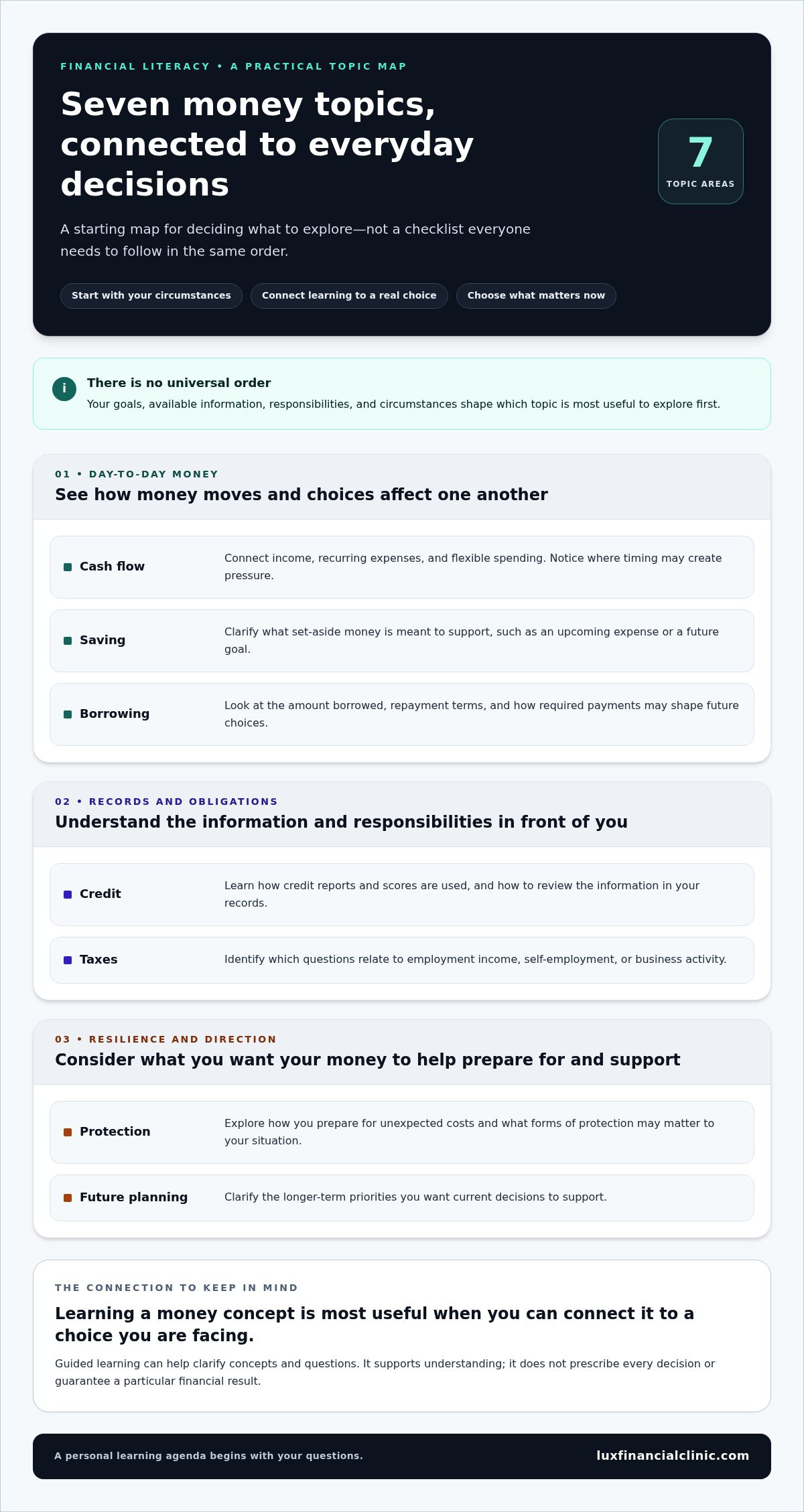
Financial topics make more sense when they connect to choices you’re already facing. A change in income can affect monthly cash flow; a new borrowing obligation can reduce flexibility for other priorities. The most useful learning agenda depends on your goals, the information available to you, and the circumstances shaping your decisions. These areas offer a starting map, not a checklist everyone must follow in the same order.
- Cash flow: Understand how income, recurring expenses, and flexible spending fit together, and where timing may create pressure.
- Saving: Consider what money set aside is intended to support, such as an upcoming expense or a future goal.
- Credit: Learn how credit reports and scores are used, and how to review the information in your own records.
- Borrowing: Examine the amount borrowed, repayment terms, and how required payments may shape future choices.
- Taxes: Identify which questions relate to employment income, self-employment, or business activity.
- Protection: Explore how you prepare for unexpected costs and what forms of protection may matter to your situation.
- Future planning: Clarify the longer-term priorities you want current decisions to support.
Everyday money decisions: cash flow, saving, and borrowing
Start by looking at how money moves through a typical month. Income is what comes in; recurring expenses are regular commitments, while flexible spending covers costs that may vary. Reserves are funds set aside for a purpose or unexpected needs. Seeing these categories together can help explain why a decision that seems manageable on its own may affect other plans.
Borrowing is one example. A loan or credit account comes with terms and repayment obligations, and those payments can reduce the amount available for other expenses or savings. Before seeking an explanation, gather the relevant account statements and loan documents. Reviewing the actual terms can help you ask focused questions about payment timing, fees, and how the obligation fits your broader cash flow.
Longer-term decisions: credit, taxes, and future priorities
Credit reports and scores are useful subjects for learning, not promises of a particular result. Understanding what a report contains can help you identify questions about accuracy, history, or how credit may be considered in a future application. If you’re exploring business credit as an entrepreneur, the practical guide to credit repair for women entrepreneurs offers a related topic to explore.
Tax questions also vary depending on how income is earned. An employee may want clarity about withholding or tax documents, while a self-employed person may have questions about business income and records. Business owners may need to understand how personal and business tax matters relate. The right questions depend on your work and responsibilities, so organize relevant documents before deciding what to learn next. Lux Financial Clinic provides individual, self-employed and 1099, and small-business tax preparation.
Protection and future planning deserve the same personal approach. Your questions may concern preparing for an unexpected expense, understanding coverage, or aligning present choices with goals further ahead. The Financial empowerment for women resource from the North American Securities Administrators Association offers educational material on financial empowerment and investing-related topics. If you’re balancing questions across several areas, a financial diagnostic consultation can help organize them into a personalized starting point.
What Financial Literacy Consulting Can, and Cannot, Do
Guidance can make money questions easier to organize, but it should come with clear expectations. Financial literacy consulting can help you understand concepts, connect them to your stated goals, and identify useful questions to explore. It cannot guarantee wealth, credit-score changes, debt resolution, or any other particular financial outcome. Results depend on individual circumstances, decisions, and factors outside an educator’s control.
Different learning formats offer different kinds of support. None is automatically right for everyone. Your choice may depend on whether you want to explore a topic independently, learn general principles, or work through questions connected to your situation.
| Approach | Purpose and personalization | May suit you if |
|---|---|---|
| Self-study | Build knowledge at your own pace using books, articles, or other learning materials. Personalization depends on what you choose to explore. | You have a clear topic and feel comfortable learning independently. |
| General education | Explain common concepts to a group or broad audience, usually with a shared structure rather than individual tailoring. | You want an introduction to a subject or a framework for forming questions. |
| Personalized consulting | Organize questions around your stated goals and circumstances, with greater opportunity to focus on the topics most relevant to you. | You have several connected questions or want support creating a learning agenda. |
Consulting versus articles, courses, and general resources
Self-study can be a comfortable first step: pause, revisit a concept, and follow the questions that interest you. A course may provide a sequence and shared explanations, while personalized consulting can help arrange your questions into a coherent order. For example, if you’re trying to understand how a borrowing decision relates to monthly commitments, a consultant can help clarify the concepts and identify what information you need to examine. Financial literacy consulting for women is not one prescribed method; its value is in making learning relevant to your stated priorities.
Setting realistic expectations for financial guidance
Education supports informed decisions, but it doesn’t make decisions for you or control how they turn out. Credit repair cannot guarantee that accurate information will be removed from a credit report or that a score will increase. Be cautious of any claim that treats a financial result as certain.
It also helps to distinguish education from specialized professional services. A learning conversation can clarify terminology and help you prepare focused questions, but it doesn’t replace every professional relationship or serve as investment or wealth-management advice. Lux Financial Clinic provides credit repair, tax preparation, and business funding consulting. A financial diagnostic consultation can help you organize what you want to understand and identify a personalized starting point. The purpose is clarity and practical direction, not a promise of a specific result.
How to Turn Financial Learning Into a Personal Action Plan
Financial learning is easier to use when it has a clear purpose. A defined goal turns financial learning into a practical way to prepare for a decision that matters to you. Instead of trying to master every topic at once, choose one question, gather relevant information, and review what you learn before deciding on another step. Your plan can change as your priorities or circumstances change.
Use this five-step process to create a manageable starting point:
- Name a goal. State what you want to understand or prepare for, such as reviewing a credit report or getting ready for a tax conversation.
- Identify a knowledge gap. Write down what feels unclear. Is it terminology, how a process works, or which documents relate to your question?
- Gather relevant records. Collect the statements, notices, or other documents connected to the topic. Keep sensitive information private and use only what helps you understand the issue.
- Learn with a purpose. Choose reliable educational material or structured guidance that addresses your specific gap. Note unfamiliar terms and questions that remain.
- Review and adjust. Summarize what you understand now, what still needs attention, and whether the original goal remains relevant.
Choose one financial question to address first
Which upcoming financial decision feels least clear? Start there. If several questions come to mind, sort them by urgency, personal importance, and the information you already have. For instance, you might want to understand an item on your credit report or prepare records for a tax discussion. Choosing one question creates focus without suggesting the others don’t matter.
A useful question is specific enough to guide your next step. “I want to understand my credit report” gives you a place to begin; “I need to fix everything about my finances” can feel too broad to act on. With financial literacy consulting for women, the learning agenda can be organized around your stated concerns rather than a general sequence that may not fit your situation.
Build a learning routine and review what has changed
Keep questions, useful sources, and decisions in one private record. A notebook or secure digital document can help you return to unresolved questions and remember why you made a particular choice. Revisit the record after a meaningful financial or life change, such as a shift in work, household responsibilities, or business activity. The purpose is to update your priorities, not to judge your past decisions.
If you’d like to prepare for a personalized conversation, what to expect from a financial diagnostic consultation can help you consider which questions and information to bring together. A diagnostic consultation can offer a tailored starting point and personalized roadmap for your learning. Explore a financial diagnostic consultation to bring greater structure to your next step.
When Financial Literacy Consulting for Women Can Offer More Structure
Sometimes one money question leads to another. A change in work may raise questions about taxes, cash flow, and credit; a household transition may bring new expenses alongside decisions about existing accounts. If information from articles or general educational resources feels difficult to connect to your situation, structured guidance can help you organize what to learn first. The aim is not to cover every topic at once, but to create a learning agenda that reflects your concerns.
Signs that a personalized learning plan may be useful
A tailored plan may help if several questions overlap, you’re unsure which documents or concepts to focus on, or you want to prepare for a specific conversation. Seeking guidance is a proactive choice, not evidence that you’ve failed to understand your finances. Clear priorities can make it easier to select relevant educational resources and use your time with intention.
- You have credit questions alongside concerns about household cash flow.
- A shift to self-employment or business ownership raises tax and funding questions.
- You have several financial documents but aren’t sure what information matters to your goal.
- You’ve gathered general information, yet still need help connecting it to your own circumstances.
Financial literacy consulting for women can offer structure by starting with your stated priorities rather than assuming everyone needs the same lesson. A personal learning agenda might begin with understanding a credit report, then identify related questions to explore. Another person may want to organize tax or business funding topics first. The order should reflect what matters in your life and what information you have available.
A supportive next step with Lux Financial Clinic
Lux Financial Clinic’s financial diagnostic consultation offers a personalized starting point for clarifying concerns and prioritizing questions. It can help shape a roadmap for learning across relevant topics, including credit, individual or business tax preparation, and business funding consulting. The purpose is to bring order to the questions you want to explore, not to promise a particular approval, savings amount, credit-score increase, or investment result.
Personalized guidance can complement self-directed financial education. You might use articles or other resources to build familiarity with a subject, then use a consultation to organize unanswered questions around your circumstances. This structure can be useful when a general resource introduces a concept but doesn’t show how it relates to your priorities. It also creates a clearer starting point for continued learning, while leaving room to revisit the plan as your goals or situation change.
You don’t need to have every question perfectly formed before seeking a more structured conversation. Begin with what feels most pressing, and let that concern help shape the learning agenda. If a tailored starting point would be useful, explore a financial diagnostic consultation.
Take One Clear Step Toward Greater Confidence
You don’t need to resolve every financial question at once. Choose one decision you want to understand more clearly, then let that question guide what you learn next. A thoughtful next step can be as simple as writing down what feels uncertain and identifying the information that would help you feel prepared.
Financial literacy consulting for women can provide structure when you want to turn that question into a personal learning path. Lux Financial Clinic offers financial diagnostic consultations and personalized roadmaps, with related support in credit repair, tax preparation, and business funding consulting. The focus is on helping you find a useful starting point, without pressure to have every answer in advance.
If a tailored conversation would help you decide what to focus on, explore a financial diagnostic consultation. Your next step can be measured and practical. Clear questions and steady learning can help you approach financial decisions with greater understanding and confidence.
Frequently Asked Questions
Is financial literacy consulting only for women who are struggling financially?
No. Women may seek financial education while their finances are stable, before a major purchase, during a career change, or while building a business. For example, you might want to understand a new benefit at work or prepare questions before reviewing household finances. The purpose isn’t to label your situation. It’s to make financial knowledge relevant to a goal or decision you want to approach with greater understanding.
Can financial literacy consulting help me feel more confident discussing money?
It can help you prepare for financial conversations by clarifying unfamiliar terms and identifying questions to raise. Before a meeting, you might write down a phrase you don’t understand and what you want to learn about it. Financial literacy consulting for women can support that preparation, but confidence develops through learning and practice, not instantly. Begin by noting which money conversations feel least clear, then choose one to prepare for.
How much financial knowledge do I need before seeking consulting?
You don’t need advanced knowledge or a complete financial plan to begin. A question such as “What does this tax document tell me?” or “Which part of my credit report should I understand first?” is enough to provide a starting point. Describe what you already know and where you feel uncertain. That helps keep the discussion at a useful level and gives you a clearer idea of what to explore next.
What should I prepare before a financial literacy consultation?
Bring a short list of the questions or goals you want to discuss, along with relevant information if it helps explain them. A credit report, account statement, or tax document may be useful depending on the topic. You don’t need to interpret the records beforehand or arrive with every detail organized. Protect sensitive information by sharing documents only through appropriate, secure channels, and focus preparation on the questions that matter most to you.
Can financial literacy consulting help women who are self-employed?
Yes. Self-employed women may want to understand cash flow, recordkeeping, credit, taxes, or business funding, depending on their work and upcoming decisions. Lux Financial Clinic provides self-employed and 1099 tax preparation, small-business tax preparation, and business funding consulting. Educational guidance can help you organize questions across these topics, but it can’t promise a tax result, funding approval, or business success. Start by identifying the decision your business needs to address.
How can I tell whether financial information online is trustworthy?
Check the publisher, publication or update date, cited evidence, and whether the page clearly separates education from promotion. Government resources such as the Office of the Comptroller of the Currency can be useful starting points for learning about financial topics, but a directory doesn’t endorse every resource it lists. For a consequential decision, compare reliable sources and consider how general information applies to your specific circumstances.
What happens if my financial priorities change after I start learning?
You can revise your learning plan as your goals or circumstances change. For instance, a job transition may make a question about benefits more relevant than one you had planned to explore earlier. Review your original notes, mark what no longer applies, and identify the next question that would be useful. Changing direction in response to new information is a thoughtful part of learning, not a sign that your earlier effort was wasted.


