
Knowing how to get a credit card after credit repair starts with reviewing your credit reports and comparing card options with your needs and budget. Late payments can remain on a U.S. credit report for up to seven years, according to the Federal Trade Commission, so credit repair does not necessarily remove accurate information right away. A secured card may be a practical starting point, but choose an option whose terms you can manage.
It’s natural to want a clear sign that your financial progress is moving forward. Negative information can make applications feel uncertain, but comparing terms carefully and paying consistently can help you take this next step with more confidence.
This guide covers how long negative information may remain, what to compare when choosing a secured or unsecured card, and how to use a card responsibly as you rebuild. You’ll also find a simple way to match your next step to your credit profile and budget.
Key Takeaways
- Review your reports from all three major credit bureaus and identify inaccurate entries before applying.
- Compare secured and unsecured cards by deposit requirements, fees, interest rates, and how the account may support your credit-building goals.
- Keep balances low relative to your credit limits, and aim to pay your statement balance in full each month.
- Build a steady payment record by paying on time and choosing a card whose terms fit your budget.
How long does negative information generally stay on your credit report?
According to the Federal Trade Commission, late payments may remain for up to seven years. Accurate negative entries don’t vanish just because credit repair is complete. The entry type and reporting dates matter. An incorrect account status, balance, or payment history deserves review rather than acceptance as accurate.
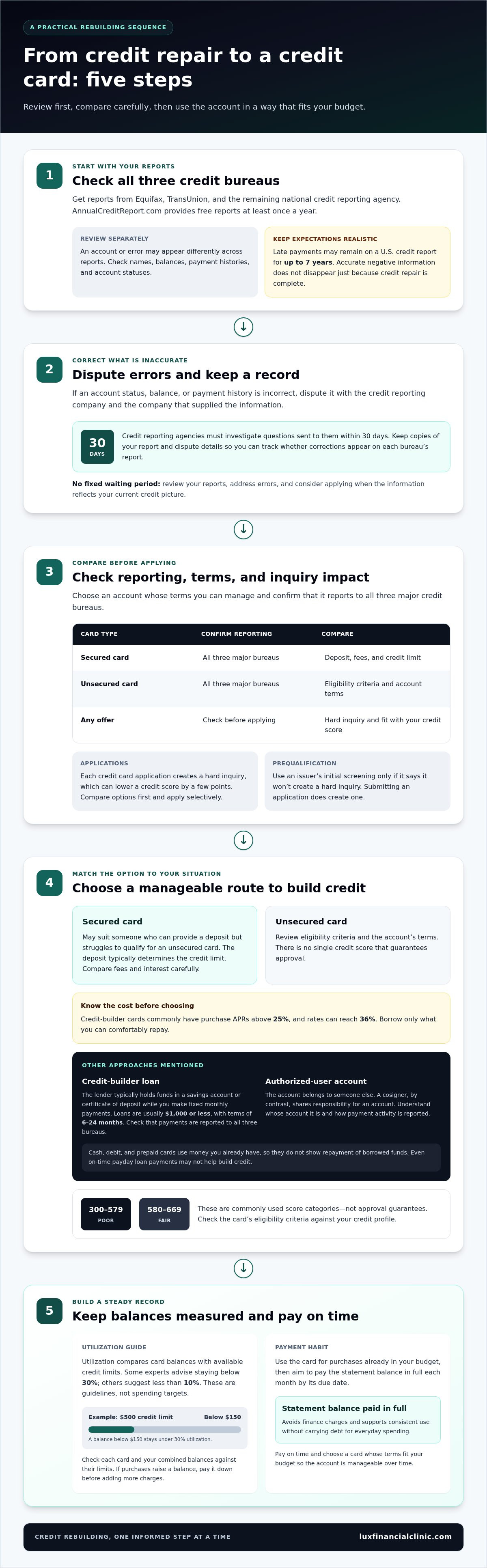
Get your reports from all three major bureaus: Equifax, TransUnion, and the remaining national credit reporting agency. AnnualCreditReport.com provides free reports at least once a year. Review each report separately because an account or error may appear differently across bureaus. Check names, balances, payment histories, and account statuses. If the information differs, your credit score may differ too.
If you find incorrect information, dispute it with the credit reporting company and the company that supplied the information. Credit reporting agencies must investigate questions sent to them within 30 days. Keep copies of your report and dispute details. A clear record helps you follow the correction and see whether it appears on each bureau’s report.
How long should you wait to apply for a credit card after credit repair? There’s no fixed waiting period. Review your reports, address errors, and apply when the information reflects your current credit picture. Check your score and the card’s eligibility criteria before submitting an application.
Applying for several cards can create avoidable strain. Each credit card application creates a hard inquiry, and inquiries can lower a credit score by a few points. Compare options first, then apply for a card whose reporting and terms fit your rebuilding plan.
| Option | Bureau reporting | What to review |
|---|---|---|
| Secured card | Confirm it reports to all three major bureaus | Deposit, fees, and credit limit |
| Unsecured card | Confirm reporting to all three bureaus | Eligibility criteria and account terms |
| Any card offer | Check reporting details before applying | Hard inquiry and fit with your credit score |
Choose a card that reports to all three bureaus and has terms you can manage consistently.
What types of credit cards are good for people with bad credit?
Choosing how to get a credit card after credit repair starts with matching the card to your budget and credit profile. Secured cards, credit-builder loans, and authorized-user accounts each offer a different approach.
Credit-Building and Rebuilding Cards
A secured card may suit someone who can provide a deposit but struggles to qualify for an unsecured card. The deposit typically determines the credit limit. Secured cards may have high fees and interest, so compare the terms carefully. Credit-builder cards commonly have purchase APRs above 25%, and rates can reach 36%.
What credit score is needed to get approved? There’s no single score that guarantees approval. Scores from 300-579 are usually categorized as poor, while 580-669 are usually considered fair.
To improve your approval odds, choose a card whose eligibility criteria fit your credit profile and apply selectively. A practical approach to how to get a credit card after credit repair is to borrow only what you can comfortably repay. Use the card for manageable purchases and pay on time.
Credit-Builder Programs and Authorized Users
A credit-builder loan creates a payment record differently from a card. The lender typically holds funds in a savings account or certificate of deposit while you make fixed monthly payments. These loans are usually $1,000 or less, with repayment terms between six and 24 months. Check that the lender reports payments to all three major credit bureaus.
An authorized-user account belongs to someone else, while a credit-builder loan has a separate repayment schedule. A cosigner shares responsibility for an account. These options differ from a secured card, where you provide a deposit and manage the account directly.
Cash, debit, and prepaid cards use money you already have, so they don’t show repayment of borrowed funds. Even on-time payday loan payments may not help build credit. Before relying on any option to build your credit history, understand whose account it is and how payment activity is reported.
Credit utilization and paying balances in full
Utilization compares your card balances with your available credit limits. Managing balances and paying on time can help keep borrowing measured as you build a financial track record.
Paying Balances in Full
Paying the statement balance in full each month avoids finance charges. Paying only the minimum leaves part of the balance unpaid. Use the card for purchases already in your budget, then pay the statement balance by its due date. This supports consistent use without carrying debt for everyday spending.
How can you prequalify for a credit card without a hard inquiry? Use an issuer’s prequalification process only if it states that the initial review won’t create a hard inquiry. Treat prequalification as an initial screening, then review the final card terms before applying. Submitting an application creates a hard inquiry.
Paying Down Balances and Keeping Utilization Low
Paying down a balance lowers the amount of available credit you’re using. Some experts advise staying below 30% of your total limit; others suggest less than 10%. These are guidelines, not spending targets. A lower reported balance can keep utilization modest, while charging more than you can repay may increase debt.
For a $500 limit, keeping the balance below $150 stays under 30% utilization. If purchases raise the balance, make a payment before adding more charges. Check both each card’s balance and your combined balances against their limits, since utilization can be assessed across accounts and individually.
A secured credit card follows the same utilization principle: the deposit typically sets the credit limit, so routine purchases can use a larger share of available credit when the limit is small. Choose manageable purchases and pay them down consistently. Keeping balances low helps manage reported credit use, while paying in full avoids finance charges.
On-time payments and keeping balances low
Consistent payments and modest balances show lenders the account habits they can assess. Set a reliable payment routine and track your balances against each card’s limit.
On-Time Payments and Autopay
Autopay can help prevent a missed due date, but choose an amount that fits your cash flow. Paying the statement balance avoids finance charges; setting autopay for at least the minimum can help keep the account current. Keep enough money in the linked account and review each statement monthly. A calendar reminder offers another check before the scheduled payment.
Payment History and Credit Scores
Payment history accounts for 35% of a FICO Score, so each due date matters. In the United States, a payment 30 days or more past due can be reported as late. Payments 60, 90, or 120 days late can hurt a score more than one 30 days late. Credit history also reflects how consistently you manage accounts over time.
Credit card issuers report to bureaus monthly, creating 12 opportunities each year to establish a positive payment record. Length of credit history accounts for 15% of a credit score. Keep an older account active when its terms fit your budget, and continue paying on time. Equifax is one of the major credit bureaus where account activity may appear.
Keeping Balances Low
On-time payments and low balances support different parts of a credit profile. Credit utilization accounts for up to 30% of a credit score. Some experts recommend using less than 30% of available limits, while others suggest staying below 10%. These are guideposts, not targets that require borrowing.
Review balances before the statement closes and pay down charges if they’re rising. For example, a $500 limit with a $150 balance reaches 30% utilization. Paying earlier can reduce the balance reported, while paying in full by the due date helps avoid finance charges. A deposit-backed card follows the same approach, since its limit may be modest.
For structured help reviewing inaccurate negative items, explore credit repair options.
Lux Financial Clinic: Credit Repair - Basic/Repair Package
Lux Financial Clinic’s Credit Repair - Basic/Repair Package can help when your reports contain inaccurate negative items that need attention. The service uses structured dispute protocols to address items such as collections, charge-offs, and late payments. Reviewing your reports first helps identify entries that appear incorrect and need focused attention.
Credit repair does not replace choosing a card with manageable terms or paying on time. Accurate negative information may remain on a report, so pair dispute support with careful card selection and steady account habits. For broader credit-rebuilding support, Lux Financial Clinic also offers the Comprehensive/Build Package.
For support addressing inaccurate entries in your credit reports, contact Lux Financial Clinic or visit luxfinancialclinic.com.
Choose a Next Step That Fits Your Goals
Make your next credit decision deliberately rather than rushing. Before applying, consider what you need the card to do: support everyday spending, help establish a positive account record, or provide a manageable first step toward broader financial goals. Your card should fit your budget and routine, not pressure you to borrow more than you can repay.
Understanding how to get a credit card after credit repair also means knowing when to address report accuracy before applying. If you’re weighing your next move or need support reviewing inaccurate negative items, a focused conversation with Lux Financial Clinic can help clarify a path that fits your situation.
Lux Financial Clinic offers credit repair support, including the Basic/Repair Package and Comprehensive/Build Package. For guidance on your next step, contact Lux Financial Clinic. Take your time, make a considered choice, and keep building toward greater financial confidence.
Frequently Asked Questions
Which credit cards are easiest to qualify for after credit repair?
A secured credit card can be a practical starting point when qualifying for an unsecured card is difficult. Approval still depends on the issuer’s criteria and your overall credit profile. Before applying, compare eligibility requirements and account terms, including whether the issuer reports payment activity to the major bureaus. A card with manageable terms may be more useful than an easy-to-get offer that is costly to maintain.
Secured vs unsecured credit cards after credit repair: which is better?
A secured card may suit you if you can set aside a deposit and want a more accessible entry point. An unsecured card doesn’t require a deposit, but approval depends on the issuer’s review of your application and credit history. Compare the total cost, credit limit, and reporting practices. Choose an option that lets you manage spending comfortably without relying on borrowed funds.
How much does a secured credit card deposit cost, and is it refundable?
A secured card deposit is commonly around $200, though the amount varies by card. It’s generally refundable, but the card agreement explains how and when the issuer returns it. Since the deposit may determine your credit limit, set aside only money you can leave committed to the account. Don’t use funds needed for rent, bills, or other essential expenses.
Can you get a credit card after bankruptcy or with recent collections?
Yes, you can apply, though approval depends on the issuer’s criteria and your current credit profile. Chapter 13 bankruptcy generally remains on a U.S. credit report for seven years; Chapter 7 generally remains for ten years. Recent negative information can affect a score more than older information. Review your current reports and consider whether a secured card fits your budget before applying.


