
Should you save or invest? A personal financial roadmap can make room for both: keep money for near-term needs accessible, and consider investing for goals farther away. Creating a personal financial roadmap starts by matching each goal to a time frame, then deciding how much of your income can support it.
Budgeting can feel complicated when essential costs, debt, savings, and everyday enjoyment all compete for attention. You don’t have to solve everything at once. A clear plan gives each dollar a purpose while leaving room to adjust as your circumstances change.
This guide walks you through setting goals, organizing needs and wants, directing money toward savings and debt, and using tools such as calculators and automatic transfers to stay consistent. You’ll also learn how to review your plan over time so it remains aligned with the life you’re building.
Key Takeaways
- Turn personal priorities into clear money goals, then give each goal a time frame and a practical next step.
- Use a budget to balance essential expenses, personal spending, savings, and debt repayment.
- Review your plan regularly and adjust it when your income, responsibilities, or priorities change.
- Use calculators to make choices more concrete and automatic transfers to help build consistent saving habits.
Setting financial goals and identifying personal values
Start by connecting financial goals to the life you want to build, then assign each one a time frame and next step. For goals more than ten years away, growth-oriented investments such as stocks may be worth considering; shorter-term goals may suit more conservative options such as bonds or cash equivalents. Let your investment horizon and risk tolerance guide your allocation.
-
Set Goals Across Time Horizons
Write down one specific goal for each time frame: short-term goals for one to two years, medium-term goals for three to five years, and long-term goals beyond five years. Give each goal a target amount, a date, and a reason. For example, “save for a home down payment by 2030” is more actionable than “buy a house.” Check that the deadline reflects your circumstances.
-
Prioritize Financial Goals
Rank goals by urgency, personal importance, and the consequences of delaying them. A near-term goal, such as replacing a necessary vehicle, may take priority over a home upgrade. Then identify which goals can move forward together and which need focused funding. An advisor can help assess whether a target fits your resources, but your values determine what matters most.
- Identify the values behind each goal before deciding how much to spend on it. If family education matters most, a child’s college savings may outrank a major vacation; if homeownership is central, a down payment may come first. Write one sentence about why each goal matters. This makes trade-offs clearer when income or competing priorities change.
- Turn your highest-priority goals into practical actions. Estimate what each requires, choose a regular contribution that fits your budget, and decide where to hold or invest the money. For retirement, review whether an employer-sponsored plan aligns with your time horizon and risk tolerance. Don’t choose investments solely because they performed well recently; the goal’s timing and your comfort with risk matter.
Budgeting for needs, wants, savings, and debt repayment
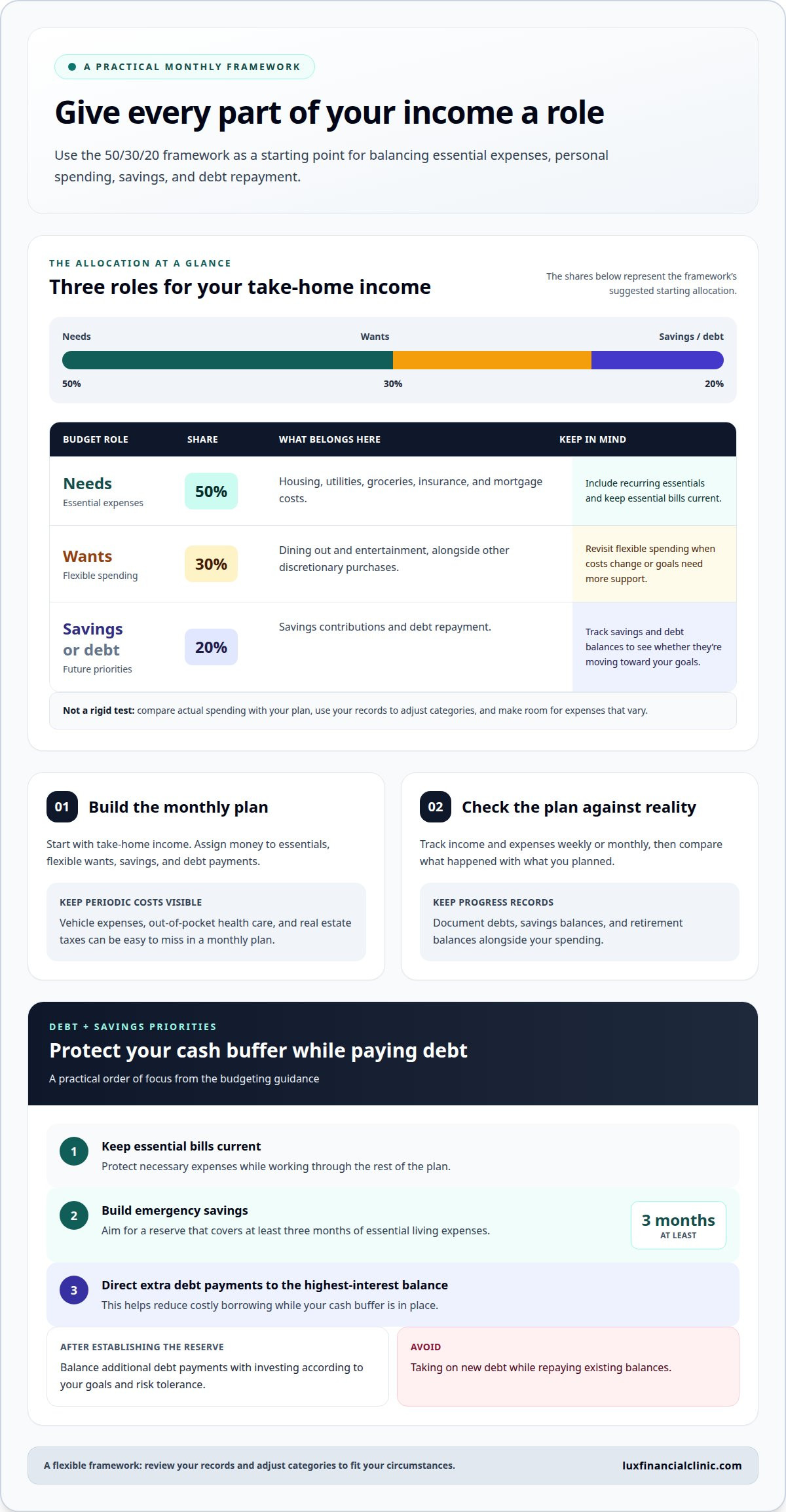
Give every part of your income a role, and keep recurring and periodic expenses in view. Use your budget to protect essentials, support priorities, and direct money toward savings and debt.
-
Create a Budget and Spending Plan
Build a monthly spending plan around take-home income, essential expenses, flexible wants, savings, and debt payments. Count housing, utilities, groceries, insurance, and mortgage costs as needs; dining out and entertainment are wants. Include periodic costs such as vehicle expenses, out-of-pocket health care, and real estate taxes. Assign money deliberately, with room for expenses that vary.
-
Track Spending and Apply the Budgeting Rule
Track income and expenses weekly or monthly, then compare actual spending with your plan. The 50/30/20 framework allocates 50% to needs, 30% to wants, and 20% to savings or debt repayment. Use it as a starting point, not a rigid test. Adjust categories based on your records, and document debts, savings balances, and retirement balances to track progress.
-
Balance Debt Repayment with Saving and Investing
Keep essential bills current and build emergency savings that cover at least three months of essential living expenses. Then direct extra debt payments toward the highest-interest balance. This creates a cash buffer while reducing costly borrowing. After establishing that reserve, balance additional debt payments with investing according to your goals and risk tolerance. Avoid taking on new debt while repaying existing balances.
- Plan retirement expenses for housing, utilities, health care, Medicare premiums, out-of-pocket costs, travel, and leisure. List potential income from Social Security, retirement withdrawals, pensions, and other investments. Include an employer-sponsored 401(k), an IRA, or a Roth IRA where appropriate, and record each applicable annual contribution limit. IRA choices depend on income and tax situation; use current limits when setting contributions. Keep children’s education savings visible beside retirement goals.
Reviewing and adjusting a financial plan
Schedule an annual review and revisit your plan after a significant life change. Compare your current resources with your goals, then adjust your strategy to keep income and expenses aligned.
-
Monitor Progress Toward Financial Goals
At your annual review, compare current income, expenses, assets, liabilities, and investments with your previous records. Check whether savings and debt balances are moving toward your goals. If progress has slowed, identify the cause, such as a changed expense or lower income, before changing your strategy. A clear comparison helps distinguish a temporary setback from a plan that needs revision.
-
Balance Needs and Wants
Review spending alongside essential costs, flexible purchases, and contributions toward your goals. If a higher utility bill reduces savings, reconsider discretionary spending before pausing an important commitment. Keep emergency fund contributions and debt payments visible in the same review. This helps you decide which wants can shift while protecting necessary expenses and progress toward longer-term priorities.
-
Review the Plan After Life Changes
Reassess your plan after changes such as a new job, marriage, a child, a move, or retirement. Update income and expenses, household responsibilities, savings targets, and debt obligations to reflect your new circumstances. Review insurance coverage and beneficiaries after major family changes. A plan based on yesterday’s household needs may no longer support today’s priorities.
-
Adjust the Financial Plan
Use your review to make specific adjustments, such as changing a savings contribution or revising a goal’s timeline. If income rises, decide how much will go toward needs, wants, debt, and savings before increasing spending. If credit balances grow, examine the expenses or borrowing that contributed. Record each adjustment and its purpose, then assess the effect at your next annual review.
Using financial calculators and automatic payments
Use calculators to test how different choices affect a goal, then automate contributions that fit your cash flow. These tools can turn a financial plan into manageable actions.
- Choose a calculator that fits the decision, such as estimating savings growth, comparing debt repayment approaches, or projecting a goal’s timeline. Enter your current balance, planned contributions, interest, and time horizon when those fields are available. Treat the result as a planning estimate, not a promise. Change one input at a time to see which assumption has the biggest effect.
- Use a debt calculator to compare putting extra money toward a credit card with building savings. The interest rate, balance, payment amount, and available cash all affect the comparison. Keep room for unexpected expenses before committing every spare dollar to repayment. For investment projections, account for your time horizon and risk tolerance, and don’t treat estimated returns as guaranteed.
- Set automatic transfers for savings after income arrives, choosing an amount that leaves enough for essential bills. Automatic payments can also help keep recurring obligations on schedule, but confirm the account has enough funds and the payment date works with your cash flow. Start with one transfer, then compare it with your actual expenses before adding more. Adjust promptly if your income or circumstances change.
- Pair automation with a regular review rather than letting payments run unchecked. Compare calculator estimates with actual balances, confirm transfers still support your priorities, and update inputs when expenses or goals shift. If you’re unsure how the pieces fit together, a Financial Diagnostic Consultation can help organize your financial picture and clarify practical next steps toward achieving your goals.
Lux Financial Clinic
Lux Financial Clinic can support specific parts of your financial plan when you need help with credit, tax preparation, or business funding. If inaccurate negative items are affecting your credit profile, its Credit Repair - Basic/Repair Package and Credit Repair - Comprehensive/Build Package provide credit restoration support. For business owners exploring funding options, Business Funding Consulting can help clarify that part of the planning process.
Self-employed individuals may also find 1099 tax preparation useful when organizing annual finances and planning around tax obligations. These services address distinct financial needs; they do not replace your personal goals, budget, or investment decisions. Consider the relevant support when a particular issue is making it harder to follow your roadmap. For a thoughtful next step, contact Lux Financial Clinic.
Take the Next Step Toward Greater Financial Clarity
A financial roadmap is most useful when it supports decisions you can carry forward, even as your priorities evolve. Creating a personal financial roadmap isn’t about controlling every outcome. It’s about having a thoughtful framework for choosing your next move and adapting with intention.
If credit concerns or business funding questions are affecting your plans, Lux Financial Clinic offers the Credit Repair - Basic/Repair Package, Credit Repair - Comprehensive/Build Package, and Business Funding Consulting. These services address specific needs that may form part of your broader financial picture, while your goals and choices remain your own.
When you’re ready to discuss a practical next step, contact Lux Financial Clinic. Each deliberate decision can help you move forward with greater clarity and confidence.
Frequently Asked Questions
Should you save or invest?
Save for money you may need soon or for expenses you can’t postpone; consider investing for goals with a longer horizon. For example, funds for an upcoming move need stability and access, while retirement money may have more time to grow. Your choice should reflect when you’ll need the money and how much fluctuation you can tolerate.
What is financial planning?
Financial planning connects today’s money decisions with future priorities. It can help you weigh whether a new monthly commitment fits alongside family responsibilities or whether a career change calls for a different cash-flow approach. A useful plan makes those trade-offs visible, so each decision supports your broader direction instead of being considered in isolation.
What’s next?
Choose one action that makes a priority easier to pursue, and build it into your routine. For instance, if a goal depends on reducing a recurring expense, review that expense before the next billing cycle and decide what change is realistic. Keep the action small enough to complete, then use what you learn to choose your next step.
What are the steps to create a personal financial roadmap?
Creating a personal financial roadmap begins with a clear picture of your current finances and the outcomes you value. Write down your priorities, identify the resources and obligations that affect them, then turn each priority into an action. For example, a career transition might call for a plan that accounts for changing income, essential commitments, and the timing of the move.
How do you set short-term, medium-term, and long-term financial goals?
Group goals by when you expect to pursue them: short-term goals within one to two years, medium-term goals within three to five years, and long-term goals beyond five years. Then make each goal concrete by naming the intended outcome and a target date. A near-term professional course and a later career change, for example, may need different savings timelines.
What budgeting methods help track spending and savings?
A category-based budget or the 50/30/20 framework can help organize spending and savings. A cash-flow calendar adds another useful view by showing when pay arrives and when bills are due. For example, if several large bills fall before payday, the calendar can reveal a timing gap even when monthly income covers total expenses. Choose a format you’ll keep using.


