
A credit report is easier to review section by section than as a single scorecard. To learn how to read my credit report for errors, check your personal information, accounts, payment history, balances, and inquiries for inaccurate, incomplete, or unfamiliar details. The Federal Trade Commission says you can check your reports from all three major credit bureaus for free once a week.
It’s understandable to be unsure what deserves attention. Account details and dates can be hard to interpret at a glance. A careful review helps you distinguish an actual reporting error from information that simply needs context.
This guide explains what each section shows, which common errors to look for, and how to submit a dispute with supporting documents. You’ll also learn what happens during an investigation and how inaccurate information may be corrected, so you can approach the process with greater clarity.
Key Takeaways
- Review your report section by section so unfamiliar accounts, incorrect personal details, and inaccurate account information are easier to spot.
- Pay close attention to ownership, account status, payment history, dates, balances, and duplicate listings when looking for errors.
- Build a clear dispute with a specific explanation and relevant documents, and keep records of your correspondence as the investigation proceeds.
- Learn what a credit report contains and how correction outcomes may affect the information shown in your file.
What are common credit report errors that I should look for on my credit report?
Review each bureau’s report section by section, matching account details against your records. Under the Fair Credit Reporting Act, U.S. Congress says consumers can request a free report from each of the three major credit bureaus once every 12 months. The Federal Trade Commission also says consumers can check their reports for free once a week.
-
Review Report Sections and Account Details
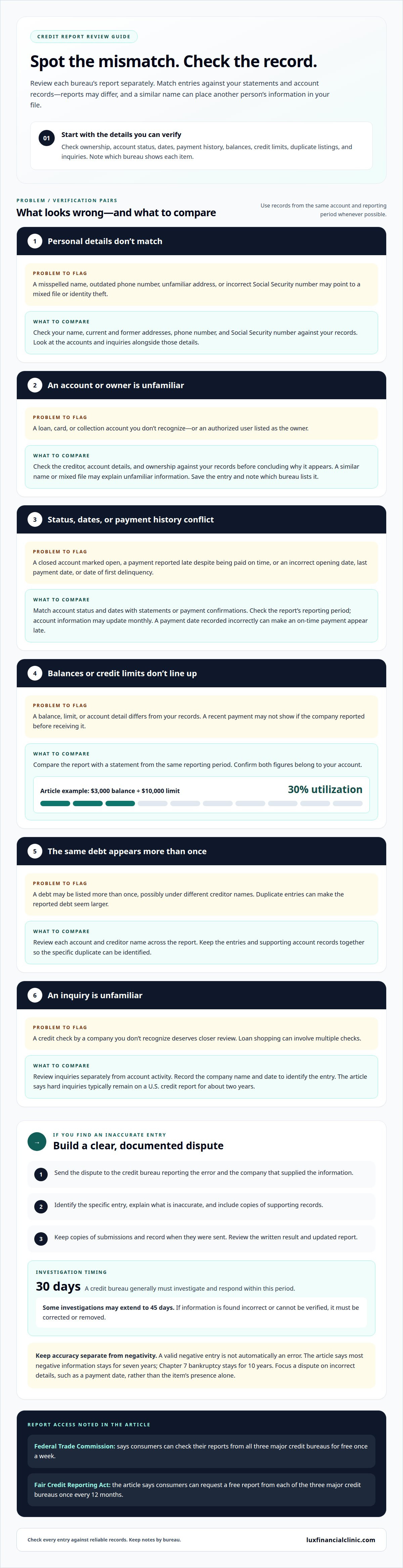
Start with your identifying information, then review each account and inquiry. Check your name, address, phone number, account ownership, opening dates, payment history, balances, and credit limits. Compare entries with statements and account records to spot errors. A similar name can cause another person’s account to appear in your file.
For example, a $3,000 card balance against a $10,000 credit limit represents 30% utilization. Confirm both figures belong to your account.
-
Flag Accounts You Did Not Open
Mark any loan, card, or collection account you don’t recognize. Check the creditor and account details before concluding that the entry involves identity theft. A similar name or mixed file may also explain unfamiliar information, so compare identifying details and account ownership.
If the account still appears unrelated to you, save the report entry and gather records that support your concern. Note which bureau lists it and what distinguishes it from your own account history.
-
Check Account Status and Duplicate Debts
Compare each account’s status with your records. Look for closed accounts marked open, an authorized user listed as the owner, or payments incorrectly reported late. Check whether the same debt appears more than once, perhaps under different creditor names. Duplicate entries can make the reported debt seem larger.
Incorrect late payments, balances, or account details can affect your credit score and a lender’s assessment. Review each bureau’s report separately because the information can differ.
Investigation timelines and correcting inaccurate information
Once you identify an inaccurate entry, organize your evidence and follow the dispute through to its written result. The investigation timeline and type of information involved shape what happens next.
-
Check Personal Identifying Information
Compare identifying details on each report with your records, including your name, current and former addresses, and Social Security number. A misspelled name or unfamiliar address can signal a mixed file or identity theft. An incorrect Social Security number may connect your credit history to another person’s activity.
Review the accounts and inquiries alongside those details. Credit reports can include account types, payment history, credit limits, and companies that checked your credit. Mark incorrect or unfamiliar entries, then gather documents showing the accurate information. Keep relevant records with the report and note which bureau displays each error.
-
Track Investigation and Correction Timelines
Send a clear dispute to the credit bureau reporting the error and the company that supplied the information. Identify the specific entry, explain what is inaccurate, and include copies of supporting records. Keep a copy of each submission and record when it was sent, so you can track the investigation without relying on memory.
According to the Consumer Financial Protection Bureau, a credit bureau generally must investigate and respond within 30 days, with some investigations extended to 45 days. If information is found incorrect or cannot be verified, it must be corrected or removed. Review the written result and the updated report for the change.
- Separate inaccurate information from negative information that may be correctly reported. The Federal Trade Commission says most negative information stays on credit reports for seven years; Chapter 7 bankruptcy stays for 10 years. A valid negative entry is not automatically an error because it remains on a report. Focus the dispute on inaccurate details, such as an incorrect payment date, rather than the item’s presence alone.
Common credit report errors
Check every bureau report for mismatches, not just accounts you don’t recognize. Dates, balances, and inquiry records can also be inaccurate. Learning how to read my credit report for errors means checking each detail against reliable records and identifying exactly what differs.
- Compare personal details across reports from Equifax, TransUnion, and other major reporting agencies. Look for misspelled names, outdated phone numbers, or unfamiliar addresses. A similar name can cause another consumer’s information to appear in your file. Note which bureau shows each difference, since reports may not contain identical information.
- Match account dates and payment history with statements or payment confirmations. Check the opening date, last payment date, and date of first delinquency. For example, a payment made on time may appear late if its date was recorded incorrectly. Check the report’s reporting period, too, because account information may update monthly.
- Review inquiries separately from account activity. Identify the company and whether you recognize the credit check. Shopping for a loan can involve multiple checks, while an unfamiliar inquiry may deserve closer review. Hard inquiries typically remain on a U.S. credit report for about two years. Record the company name and date to identify the entry clearly.
- Compare balances, credit limits, and account status with statements from the same reporting period. A recent payment may not appear if the company reported the balance before receiving it. Look for closed accounts marked open or a late status that conflicts with your records. Keep the matching statement beside the report entry to support a specific dispute.
- Distinguish unfamiliar information from inaccurate information. A creditor’s reporting name may differ from the brand you remember, even when the account is yours. To learn how to read my credit report for errors, clients at Lux Financial Clinic compare account details and reporting dates rather than relying on a name alone. Reviewing reports regularly can also help you notice changes and track corrections.
Credit report structure and sections
Read the report as an organized record, not as a credit score. Its sections group identity details, credit accounts, inquiries, and public records, making it easier to review each type of information on its own.
- Begin with personal identifying information. Check the name and addresses associated with the file before moving to account entries. This section provides context for the records that follow. For example, an unfamiliar address may help explain why an account or inquiry seems unfamiliar.
- Review the account-history section one account at a time. Entries can include account type, payment history, balance, credit limit, and status. Note the reporting date, since a recent payment might not yet appear. Lenders use credit report information to assess risk, including whether someone pays bills on time.
- Read the inquiry section separately. U.S. credit reports generally list people and companies that checked a consumer’s credit during the past two years. Identify the company and any related application or activity you recognize. An inquiry records a credit check. It isn’t an account balance or proof that a lender opened an account.
- Examine public records and negative entries as distinct parts of the report. Reporting periods vary by record type, so an older entry isn’t automatically inaccurate. For example, a Chapter 7 bankruptcy follows a different reporting period from most negative information. Focus on whether the record belongs to you and whether its details are correct.
- Keep the report separate from your credit score. FICO scores generally range from 300 to 850. FICO attributes 35% of its score calculation to payment history. The report shows underlying account and inquiry information; the score summarizes data through a scoring model. An inaccurate entry can affect your credit, but the report itself isn’t the score.
- Use AnnualCreditReport.com to request reports and review each bureau’s file individually. It is the only official website authorized by the U.S. federal government for requesting free credit reports. Record the section and entry that need attention. This gives you a clear reference for comparing reports and preparing a focused dispute.
Lux Financial Clinic
Lux Financial Clinic helps address inaccurate negative items through structured credit repair dispute protocols. If you’ve identified information that appears wrong and want help organizing the next steps, the Credit Repair - Basic/Repair Package and Credit Repair - Comprehensive/Build Package offer options for credit repair support.
The process starts with the details in your credit file and the items you’re disputing. Clear records and a focused explanation help establish which information needs attention. Credit repair can support disputes over inaccurate reporting, but it cannot guarantee a particular score or outcome.
For guidance on your credit report and possible next steps, contact Lux Financial Clinic.
Turn your review into a clear next step
Learning how to read your credit report for errors gives you a foundation for informed financial decisions. Turn any confirmed discrepancy into a focused, well-documented plan, and keep your records organized as you follow the dispute process. For support, Lux Financial Clinic offers the Credit Repair - Basic/Repair Package and Credit Repair - Comprehensive/Build Package, as well as Business Funding Consulting for business funding needs.
Credit repair can help address inaccurate negative items through structured dispute protocols, while investigation and correction depend on the information reported and supporting records. The aim is clarity and careful progress, not a promised score or outcome. Choose the level of guidance that fits your circumstances and take the next step at a manageable pace.
Contact Lux Financial Clinic to discuss support with your credit report and move forward with greater clarity.
Frequently Asked Questions
How long does information stay on a credit report?
Reporting periods depend on the information type. According to the Federal Trade Commission, most negative information stays on reports for seven years, while Chapter 7 bankruptcy stays for 10 years. Accounts in good standing may remain for 10 years after closure. A record remaining within its applicable period isn’t automatically an error; focus on whether its details are accurate and belong to you.
How do I spot and dispute errors?
Compare the report entry with a statement, payment confirmation, or other account record showing the correct detail. Then explain the specific discrepancy in writing to the credit bureau and the company that supplied the information. Include copies of relevant documents, not originals, and keep a dated copy of your submission. A focused dispute makes clear which entry and detail need investigation.
Still having trouble with a credit reporting company?
If a written dispute doesn’t resolve the issue, you can submit a complaint to the Consumer Financial Protection Bureau. The CFPB forwards the complaint to the company, provides a tracking number, and shares status updates. Keep your dispute response and related correspondence together so you can explain what remains unresolved and follow the complaint’s progress.
What’s a delinquent account on my credit report?
A delinquent account is reported as past due because a payment wasn’t made by its due date. A report may show delinquency once an account is at least 30 days past due. Check the reported payment status against billing statements and payment confirmations. A late mark tied to a payment you made on time may be inaccurate and can be disputed.
What sections are included in a U.S. credit report?
A U.S. credit report typically organizes personal identifying information, credit accounts, payment history, inquiries, and public records. Account entries may include the type of credit, balance, and credit limit. Inquiries identify companies or people who checked your credit, generally during the past two years. Review each category separately, since an error may appear in one section while the others look accurate.
What are common credit report errors to look for?
Look for accounts you don’t recognize, another person’s information mixed into your file, incorrect account ownership, and duplicate debts. Also watch for inaccurate payment dates, balances, credit limits, or account statuses. A familiar creditor name doesn’t mean every detail is correct. Compare the specific entry with your records, and note which bureau displays it before preparing a dispute.


