
A business credit history begins when your company has an identifiable profile and builds a record of payments reported to commercial credit bureaus. If you’re learning how to establish business credit for the first time, register your business, obtain an EIN and D-U-N-S Number, separate business and personal finances, and pay reporting vendors on time. A business credit card that reports to commercial bureaus can also help build that history.
It’s reasonable to expect responsible bill payments to count toward your business credit. The key detail is that vendor payments help build a history only when the vendor reports them. A business credit score reflects creditworthiness and can influence access to credit products, so the goal is a clear record of responsible business activity.
This guide explains what a business credit score measures and how to build a foundation step by step. You’ll learn how to choose reporting vendors, separate business finances, open a dedicated bank account, and consider a business credit card carefully, including what to know about personal guarantees and payment reporting.
Key Takeaways
- Build a business credit profile by establishing a distinct business identity and understanding what a score reflects.
- Choose vendors that report payment activity to commercial credit bureaus, then pay invoices on time to build a record.
- Keep business and personal finances separate, and understand when a card application may involve a personal guarantee or affect personal credit.
- Use a dedicated business bank account to make transactions easier to track and accounting more straightforward.
- Consider a business credit card as another way to build credit, and explore credit repair support if inaccurate negative items are holding you back.
What is a Business Credit Score?
To create a business credit profile, register your business, obtain an employer identification number (EIN) through the Internal Revenue Service, and request a D-U-N-S Number from Dun & Bradstreet. The D-U-N-S Number is a free, unique nine-digit identifier that helps track company credit activity and establish a file with Dun & Bradstreet.
There are three major business credit bureaus in the United States. Dun & Bradstreet and Equifax Small Business are two of them. Commercial bureaus collect business credit information and produce reports or scores using their own models.
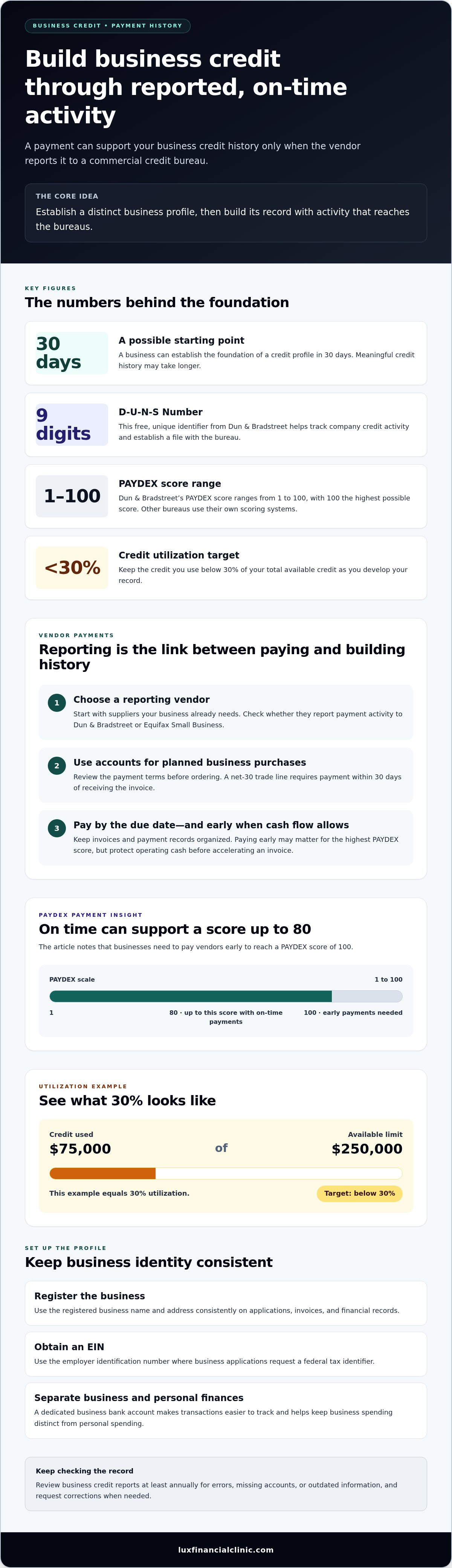
A business can establish the foundation of a credit profile in 30 days, but meaningful history may take longer. Dun & Bradstreet’s PAYDEX score ranges from 1 to 100, with 100 the highest possible score; other bureaus use their own scoring systems.
- Register the business consistently. Use the registered business name and address on applications, invoices, and financial records. Consistent details help vendors and bureaus match activity to the correct profile. A separate legal business identity can also make its credit history easier to distinguish from its owner’s.
- Apply for an EIN. The EIN is the unique identifier the U.S. federal government uses to identify a business. Businesses can apply through the IRS. Use the EIN where business applications request a federal tax identifier, and keep the details consistent across accounts and records.
- Request a D-U-N-S Number. Apply to Dun & Bradstreet for this free, nine-digit business identifier. It helps establish a credit file with the bureau and allows creditors to report payment and other activity. Keep the number with your company records so you can use it when vendors request business identification.
- Build the profile through reported activity. A business credit profile describes the company’s credit history and helps establish its ability to borrow. Opening a file creates a starting point, not a complete track record. Trade accounts, business cards, and other creditors can contribute activity when they report it to commercial bureaus.
- Learn what the scores represent. A business credit score reflects creditworthiness and can affect access to credit products, including cards and loans. Dun & Bradstreet’s PAYDEX score uses a 1-to-100 range, while other commercial bureaus maintain their own reports and scoring approaches. Lenders, investors, and vendors may review a score before an agreement.
- Monitor reports as your record grows. Check business credit reports at least annually for errors, missing accounts, or outdated information, and request corrections when needed. Businesses usually don’t need to apply separately to every major bureau for it to track their profile. Owners learning how to establish business credit for the first time can begin with registration, an EIN, and a D-U-N-S Number, then build history through reported payments.
Using vendors that report payment history
Choose suppliers that report payments to commercial credit bureaus, because vendor activity builds credit history only when it reaches a bureau. Payment history is the most important factor in building business credit; keep credit use below 30% of available credit as you develop your record.
-
Choose Vendors That Report Payment History
Start with vendors your business already needs, such as suppliers for inventory, equipment, or regular operating goods. Before opening an account, find out whether the vendor reports payment activity to Dun & Bradstreet or Equifax Small Business. Reporting matters: paying on time can support a business profile only if the vendor sends that payment history to a commercial bureau.
If reporting details aren’t readily available, ask the vendor whether it reports positive payment history. Prioritize suppliers that report to a commercial bureau, and keep invoices and payment records organized. A business bank account makes transactions easier to track and separate from personal spending. This also helps connect each payment to the correct supplier account.
-
Open Vendor Accounts With Net-30 Terms
Open a trade account for purchases your business can comfortably repay, then review its payment terms before placing an order. A net-30 trade line requires payment within 30 days of receiving the invoice. Some vendors may offer different payment terms, so confirm the due date before ordering.
Use the account for planned business purchases, not to buy supplies solely to generate credit activity. Record each invoice’s due date and the vendor’s reporting details, then pay from business funds. Consistent, reported transactions can establish trade lines and create a clearer payment history than an unused account. Keep the account aligned with regular operating needs.
-
Pay Vendors Early and Manage Credit Utilization
Pay every vendor invoice by its due date, and pay early when your cash flow allows. On Dun & Bradstreet’s PAYDEX scale, on-time vendor payments can result in a score of up to 80; businesses need to pay vendors early to reach a score of 100. Early payment can therefore matter, but protect operating cash before accelerating an invoice.
Track utilization by dividing the credit you use by your total available limit. For example, using $75,000 of a $250,000 limit equals 30% utilization; the recommended target is below 30%. Review balances before making purchases, and avoid unnecessary charges. If vendor terms are part of a broader financing plan, explore business funding options alongside your payment strategy.
Avoiding personal guarantees and mixed finances
Separate company transactions and credit activity from personal finances wherever your business structure allows. This distinction keeps records clearer and gives the business a foundation for developing its own credit profile.
-
Separate Business and Personal Finances
Use a dedicated business bank account for company income and expenses, and keep personal purchases out of it. For example, pay supplier invoices from the business account rather than a personal checking account. Consistent records make it easier to identify business transactions.
Choose a business structure that supports a distinct identity. A sole proprietor’s personal and business credit are one and the same, while forming an LLC or corporation can help separate them. An EIN from the Internal Revenue Service can also help distinguish business finances from the owner’s personal finances. Use the same business name and identifying details on accounts, invoices, and credit applications.
Keep receipts, account statements, and payment records organized by business purpose. If you pay a company expense personally, record it clearly rather than mixing it into routine personal spending. This helps explain transactions and supports accurate business reporting as the company builds its payment history.
-
Avoid Personal Guarantees and Credit Checks
Review the credit application and its terms before applying for a business card or other credit. A new business card may rely on the owner’s personal credit, require a personal guarantee, and report activity to both personal and company credit reports. These details can affect how the account appears across business and personal credit bureaus.
Ask whether the application uses the owner’s personal credit and requires a personal guarantee. First Bank says lenders may use an owner’s personal credit to evaluate a small business or startup until business credit is established. This is especially relevant when a company has little payment history in its own name.
Keep a copy of the application and note where the account reports. If the card reports to both personal and business reports, track balances and payments in both records. A missed payment could appear in more than one place. Separate business activity where possible, but understand the account terms before relying on a new credit product to build company history.
Opening a dedicated business bank account
Open a separate business bank account in the company’s name, then route business income and expenses through it. The account can make transactions more transparent and simplify accounting, but creditors and vendors are the source of reported credit activity.
- Prepare consistent business details. Use the registered business name, business address, and employer identification number (EIN) when setting up the account. Match those details to the records used for vendor accounts and credit applications. Consistency helps distinguish company transactions from the owner’s personal activity.
- Keep business and personal identifiers organized. Store the business EIN and the owner’s Social Security information separately in your records. Provide the identifier requested for each transaction, and don’t substitute personal details for business details unless an application asks for them. This helps maintain a clear record for the business entity.
- Use the account for company activity. Deposit customer payments into the business bank account and pay business expenses from it. For example, pay a vendor invoice from company funds rather than personal checking. A separate account makes it easier to trace payments, reconcile statements, and prepare accurate accounting records.
- Connect the account to a disciplined payment routine. Set aside funds for vendor invoices and business credit cards before their due dates. Review transactions against invoices and statements, then retain payment confirmations with company records. A bank account does not create a credit score by itself, but clear cash-flow records can help you manage obligations that may be reported to credit bureaus.
- Build credit activity through reporting accounts. Use vendor trade lines or credit cards that report business payment activity. That reporting is what can contribute to a credit profile. A business bank account can support reliable bill payment, while reported payments build the history lenders may review. Keep accounts active for normal business needs, rather than opening credit solely to create activity.
- Review account records regularly. Compare bank statements with vendor invoices, card statements, and recorded expenses. Correct bookkeeping mismatches promptly so the business’s payment history remains easy to follow. If the company has more than one account, label each by purpose, such as operating expenses or tax reserves, and keep personal purchases out of them.
Applying for a business credit card
A business credit card can help establish credit in the company’s name when the issuer reports account activity to commercial bureaus. Choose a card that fits planned business spending, then manage charges and payments to support cash flow.
- Match the card to a business purpose. Identify regular expenses the business already pays, such as supplies or operating costs. A card can organize those purchases and create a record of business activity. Avoid borrowing for unnecessary spending. The goal is a useful payment method, not an excuse to increase expenses.
- Check commercial reporting before applying. Confirm whether the card issuer reports payment activity to commercial credit bureaus. A card can contribute to business credit history when that activity reaches a bureau. Compare the issuer’s reporting practices with your goals, and review the terms to understand how the card works.
- Prepare consistent business information. Use the legal business name and identifying details that match company records. An employer identification number is the identifier the U.S. federal government uses for a business. Keep information consistent across the application and existing business accounts to support accurate record matching.
- Review how the application evaluates the business. Read the application carefully and note whether it considers the owner’s personal credit or requires a personal guarantee. A new business may have limited credit history for an issuer to assess. Understand the terms before submitting the application, including how it describes repayment responsibility.
- Set a spending limit within available cash flow. Decide which expenses belong on the card and how much the business can repay from operating funds. For example, routine inventory purchases may be easier to track than a mix of irregular personal and business charges. Don’t treat the credit limit as income; charges still need to be repaid.
- Pay the statement on time and track each charge. Add the due date to the company’s payment calendar and reconcile card transactions against receipts. Payment history matters to business credit, so consistent on-time payments help build a record when reported. Keep enough cash available for planned repayments without disrupting essential expenses.
- Review reports after the account has activity. Check business credit reports for the card account, payment details, and accurate company identification. If the card is missing or information is incorrect, follow the bureau’s correction process. A business credit card can support a credit profile, but its reported activity and ongoing account management determine what history it contributes.
Lux Financial Clinic: Credit Repair - Basic/Repair Package
Lux Financial Clinic can help if inaccurate negative items are affecting the credit picture you bring to business financing conversations. Its Credit Repair - Basic/Repair Package addresses inaccurate negative items through structured dispute protocols. This may be a useful next step when your focus shifts from establishing business payment history to reviewing credit report accuracy.
For guidance focused on business financing, Business Funding Consulting can help you consider funding options in the context of your business goals. Credit repair and business credit building are distinct processes: vendor reporting and responsible account management establish business history, while credit repair addresses inaccurate negative items.
For a practical next step, contact Lux Financial Clinic to discuss which support aligns with your financial priorities.
Build Your Next Business-Credit Decision With Intention
As you learn how to establish business credit for the first time, align credit activity with your company’s priorities. Consider what you want a stronger financial foundation to support, then decide whether you need help reviewing a credit report, planning for business funding, or finding a clearer path forward. This perspective helps you choose actions that fit your business instead of treating credit as a score alone.
Lux Financial Clinic offers the Credit Repair - Basic/Repair Package and Credit Repair - Comprehensive/Build Package for credit repair support, along with Business Funding Consulting for businesses considering funding. These services address distinct needs, from inaccurate negative items to business funding guidance. Begin with the concern most relevant to your plans.
For a focused conversation about your next step, contact Lux Financial Clinic for support. A considered plan can help you move forward with greater clarity and confidence.
Frequently Asked Questions
What do you need to establish business credit for the first time?
To establish business credit for the first time, prepare a consistent business identity, an EIN, and a D-U-N-S Number, then build payment activity through accounts that report to commercial bureaus. For example, organize your registered business name and address before opening supplier accounts. This helps creditors associate reported transactions with the correct company profile. Keep business records together so you can identify mismatches as the company’s credit history develops.
How do you form a business entity and get an EIN to build business credit?
Choose a business structure, such as an LLC or corporation, and register it with the appropriate state office. Then apply for an EIN through the Internal Revenue Service. Use the registered business name consistently on tax, banking, and credit documents. For instance, if the business name differs from the owner’s name, make sure vendor applications identify the company correctly. This supports clearer business records and credit reporting.
Which vendors report payments to business credit bureaus and offer starter net-30 accounts?
Look for vendors that supply goods your business already uses, such as inventory, equipment, or construction materials, and report payment activity to Dun & Bradstreet or Equifax Small Business. Reporting and account terms vary by vendor. Before opening a trade account, ask whether it reports positive payments and offers net-30 terms. Choose purchases that fit normal operations rather than buying unneeded items just to create an account.
How do business credit cards help build business credit, and what are the eligibility requirements?
A business credit card can build company credit when its issuer reports account activity to commercial credit bureaus. Issuers assess applications using their own criteria, which may include business details and the owner’s personal credit. A new company may be asked for a personal guarantee, and card activity may appear on personal as well as business reports. Review application terms and reporting practices before applying, then match spending to repayment capacity.
What mistakes can hurt a new business credit profile or create personal liability?
Late payments, mixing personal and business transactions, and relying on vendors that don’t report can weaken efforts to establish useful credit history. High balances can also raise utilization; aim to keep business credit use below 30% of available credit. A personal guarantee may make the owner responsible for repayment, while some card activity can appear on personal reports. Review account terms, separate records, and monitor business reports for errors or missing accounts.


