
An accurate late payment generally can’t be removed just because it’s hurting your credit. A late payment may be removed if it’s inaccurate or older than seven years. To correct an error, gather supporting documents and dispute it with each credit bureau whose report contains the information, as well as with the company that supplied it. This guide explains how to file a dispute with credit bureaus and what to expect.
Finding a mistake on your credit report can feel unsettling, especially if it could affect plans to borrow or rent. The process is more manageable when you know what counts as an error, how to present evidence, and what an investigation can and can’t change. Learn how to prepare and submit a dispute, understand response timelines, and distinguish inaccurate late payments from accurate information that may remain on your report. The aim is a clear, practical path to correcting errors while keeping expectations realistic.
Key Takeaways
- Compare the reports from each bureau and dispute the error with every bureau showing it, as well as the company that supplied the information.
- State exactly what is wrong and organize documents that support your account before submitting a dispute online, by mail, or by phone.
- Keep copies of your dispute and supporting records so you can follow the investigation and review the response.
- An accurate late payment may be removed if it’s older than seven years; otherwise, focus your dispute on evidence of an error.
- Lux Financial Clinic’s Credit Repair - Basic/Repair Package can support readers seeking structured help with credit report disputes.
How do I dispute an error on my credit report?
To dispute an error with Equifax, TransUnion, or another credit bureau, identify the incorrect entry, gather evidence, and submit a dispute to every bureau reporting it. The Fair Credit Reporting Act allows consumers to dispute information on their credit reports. You should also contact the company that supplied the information.
-
Choose an Online, Mail, or Phone Dispute
Start by comparing your credit reports and marking each entry that appears wrong, such as an incorrect payment date, account, name, or address. Then submit your dispute online, by mail, or by phone through the bureau reporting that information. File separately with each bureau whose report contains the error; a correction at one bureau doesn’t automatically update the others.
-
Send a Dispute Letter to the Credit Bureau
Write a letter that identifies the account, explains what is inaccurate, and states what update you’re requesting. Include copies of documents that support your explanation, and keep a copy of the letter and attachments for your record. When mailing your documents, use the official dispute mailing address provided on your credit report or directly through the bureau's official website. For any additional bureau, verify the current mailing address using their official dispute instructions before sending.
-
Dispute Information with a Specific Bureau
Open the dispute process for the bureau report containing the error, select the entry, and explain the problem clearly. For an online dispute, describe the correction you’re requesting and attach supporting documents through the bureau’s submission process. Equifax disputes can also be filed online for free. Whether you use an online form, phone, or letter, save the confirmation or another record of what you submitted.
-
Request a Statement or Reinvestigation
Request an investigation in your written dispute and specify which details the bureau should review. If the company that supplied the information considers it accurate, you can ask the credit reporting companies to add a statement explaining your dispute to their reports. Keep your explanation focused on the entry and your evidence. If a written dispute doesn’t resolve the error, you can submit a complaint to the Consumer Financial Protection Bureau.
Check the age of negative information before disputing it. Potentially negative information such as missed payments generally remains on a personal credit report for 7 years from the original missed payment. Collection accounts are removed 7 years from the date of the first late payment on the original account. Accurate information isn’t removed simply because it affects your credit.
Credit bureau investigation and response deadlines
Filing an Equifax dispute is free. Avoid vague or repeated claims: identify the exact entry and explain why it’s incorrect.
-
Track Investigation and Response Timelines
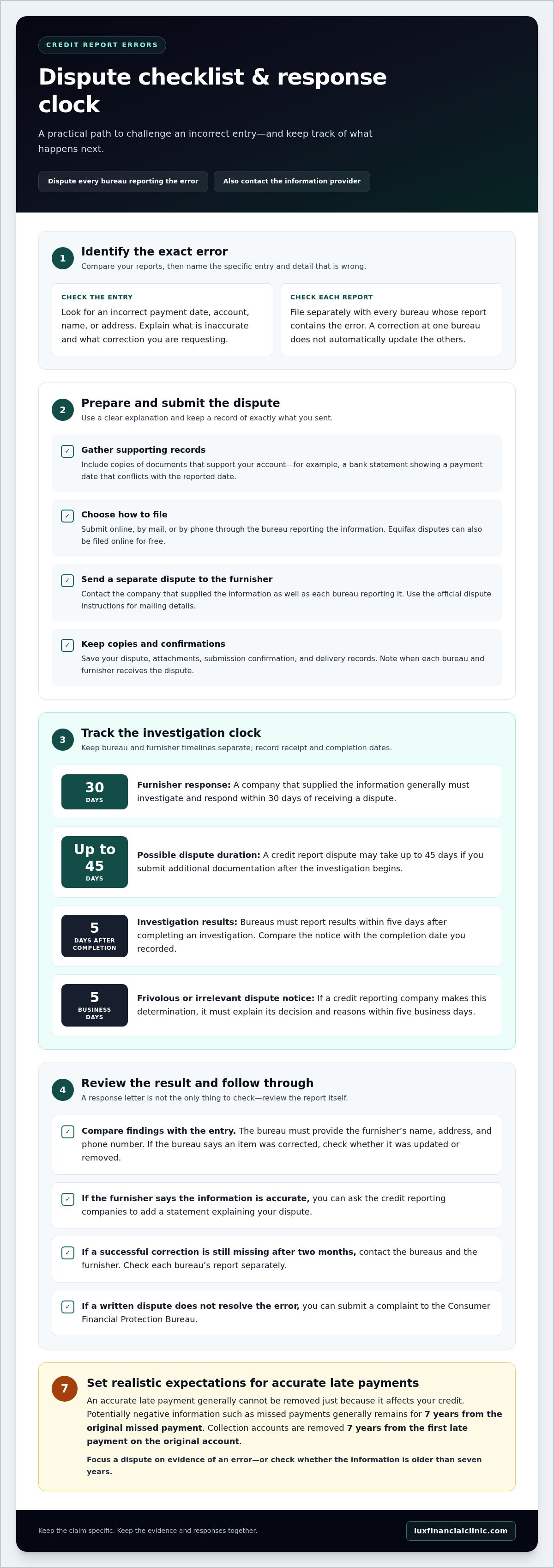
Record when each bureau and furnisher receives your dispute, then track the investigation status separately. A furnisher generally must investigate and respond within 30 days of receiving a dispute. A credit report dispute may take up to 45 days if you submit additional documentation after the investigation begins. Keep delivery confirmations and submission records together.
Understanding how to file a dispute with credit bureaus also means knowing what happens after submission. According to the U.S. House Office of the Law Revision Counsel, bureaus must report investigation results within five days after completing an investigation. Note the completion date and compare it with the date on the written notice.
-
Review Investigation Outcomes
Read the written result and compare its findings with the disputed entry. The bureau must provide the furnisher’s name, address, and phone number. If the bureau says the information was corrected, check the report itself to see whether the item was updated or removed. Don’t assume a correction by one bureau changes every other report.
According to the U.S. House Office of the Law Revision Counsel, if a credit reporting company considers a dispute frivolous or irrelevant, it must explain its decision and reasons within five business days. A focused claim helps the investigation address the specific error. Keep your explanation factual and tied to the evidence you submitted.
-
Follow Furnisher Investigations and Corrections
Track the response from the company that supplied the information, such as a lender reporting a credit card payment status. A furnisher generally investigates and responds within 30 days. Compare its findings with the bureau’s notice, particularly account details, dates, and balances. Keep both responses with your original dispute record.
If a furnisher finds the information accurate, you can ask the credit reporting companies to add a statement explaining your dispute. If a successful correction still doesn’t appear within two months, contact the bureaus and furnisher. Knowing how to file a dispute with credit bureaus also means checking the updated report, not relying only on a response letter.
Disputing incorrect information with the company that provided it
Send a separate written dispute to the company that supplied the inaccurate information, as well as to each credit bureau reporting it. A focused claim connects the reported error with the records that can help clarify it.
-
Identify Inaccurate or Incomplete Information
Compare the account entry with your records and identify the exact detail that’s inaccurate or incomplete. For example, note a payment date that conflicts with a bank statement, a balance that doesn’t match an account statement, or an account you don’t recognize. Describe the entry precisely, including the creditor name and account details shown on your report.
Separate facts from assumptions. If a payment appears late, explain which date or account detail is wrong and what your records show instead. This gives the furnisher a specific issue to review, rather than a general request to remove negative information.
-
Dispute Errors with the Information Furnisher
Write to the creditor, lender, or other company that supplied the information, using the address on your credit report or its designated address for credit reporting disputes. Send the written dispute by certified mail and keep the mailing record. Consumers working with Lux Financial Clinic can also dispute information directly with the creditor or lender that reported it.
State the error plainly and include the outcome you seek, such as correcting a payment date or account balance. A furnisher generally must investigate and respond within 30 days of receiving a dispute. Keep its response with your records, then compare the result with the account entry on your credit reports.
-
Include Information in a Mailed Dispute
Include your name, contact details, the creditor’s name, and enough account information to identify the disputed entry. Explain what is wrong, why it’s inaccurate or incomplete, and what change you’re requesting. For example, identify the reported payment date and explain how a bank record shows a different date.
Attach copies of supporting documents, not originals, and retain a complete copy of the letter and attachments. A statement, payment confirmation, or correspondence from the creditor may help explain the discrepancy. Address the letter to the furnisher’s designated credit reporting dispute office, and keep the certified-mail receipt with your dispute records.
-
Seek Removal of Inaccurate or Unverifiable Information
Ask the furnisher to correct or remove the specific information that is inaccurate, incomplete, or cannot be verified. Explain how the documents you’ve included relate to the disputed account. For instance, point to a statement that contradicts a balance or a payment record that conflicts with the reported date.
Review the response and each updated credit report for the relevant entry. If the furnisher says the information is accurate, compare its explanation with your evidence and keep a record of any unresolved discrepancy. When the furnisher finds the information accurate, you can ask the credit reporting companies to add a statement explaining your dispute.
Documents that may support a dispute
Choose documents that directly address the incorrect entry on your credit report. A bank statement, creditor letter, or identity record can help explain the discrepancy.
-
Gather Supporting Documents
Match each disputed detail with a document showing what is correct. For a payment-date error, look for a bank statement or payment confirmation. For an incorrect balance, compare the report with an account statement from the relevant period. If the account isn’t yours, gather records that help distinguish your identity or show you didn’t open it.
Use the entry to guide your search. Note the creditor name, account details, and reported date, then find records related to those specifics. A creditor letter may clarify an account status, while a statement can show a balance or payment. Avoid unrelated paperwork: each document should help explain a particular error to the bureau or furnisher.
Keep a simple list linking each document to the point it supports. For example, write “payment date” beside a bank record and “balance” beside an account statement. This organization helps you explain why the credit report entry is incorrect without asking the investigator to infer the connection.
-
Prepare Documents for a Dispute
Make clear copies of the records you plan to include, and keep the originals in your files. Mark or note the relevant line on a copy, such as the payment date or balance, while keeping the document’s context visible. If a statement covers several transactions, identify the one tied to the disputed entry.
Arrange the documents clearly: start with the report page or entry, follow with the supporting record, then add any relevant creditor correspondence. Label each copy with a short description, such as “bank payment confirmation.” This order helps connect the report error to the evidence during a credit report dispute.
Review every page before filing. Confirm that names, dates, and account details are readable and consistent with your explanation. Remove unrelated pages that don’t support the claim, but keep enough context to show where the relevant information came from. Retain a complete copy of the submission for your records.
-
Upload Supporting Documents
Submit documents through the bureau’s dispute process when it offers an upload option. Select files that correspond to the specific entry and use clear filenames, such as “statement showing payment date.” Before submitting, confirm that each file opens and its text or transaction details are legible.
Include a concise explanation with your upload. Identify the reported information, describe what is incorrect, and point to the document that supports your account. For instance, connect a payment confirmation to the payment date shown on the report. This gives the bureau or furnisher a direct path from the disputed item to the evidence.
Save the submission confirmation and copies of uploaded files with your dispute records. If you submit by mail, include copies rather than originals and retain the same materials. A complete record helps you track which documents went to each bureau or furnisher and compare them with the investigation response.
When accurate late payments can be removed
An accurate late payment generally stays on a credit report until its reporting period ends. It may be removed if it’s inaccurate or older than seven years.
- Check whether the late payment is actually inaccurate. Compare the payment status and date on your credit report with your account records. For example, if a lender reports a missed payment but your statement shows it was paid on time, identify the specific month and account entry. Dispute information that conflicts with your records, not an accurate late payment simply because you believe it should be forgiven.
Errors can involve more than payment status. Check whether the report assigns the late payment to the wrong account, lists an incorrect date, or shows a payment as missed when your records show otherwise. A clear mismatch gives the bureau and lender a specific detail to investigate.
- Review how long the entry has appeared. Potentially negative information, including missed payments, generally remains on a personal credit report for 7 years from the original missed payment. That starting point matters: focus on the original missed-payment date, rather than assuming the period begins when the account was closed or transferred.
If the entry is older than seven years, note its reported date and dispute its continued appearance. A payment that is still within the reporting period and accurately described won’t be removed just because it has affected your credit. The entry’s age and the accuracy of its details are separate questions.
- Dispute an inaccurate late payment with supporting records. State which payment entry is wrong, explain what the lender reported, and identify the correct payment information. Use relevant account statements or payment confirmations to support your explanation. Keep the dispute focused on facts: a general request to remove negative information doesn’t establish that a particular late payment is inaccurate.
Send the dispute to the credit bureau reporting the entry and to the company that supplied it. If the investigation finds the late payment inaccurate, the record can be corrected or removed. Review the updated report to make sure the account status and payment history reflect the result.
- Separate late payments from other report entries. A hard inquiry, collection account, and late payment each have distinct reporting details. For example, a dispute about a lender’s payment history should identify that account and payment, rather than challenge unrelated inquiries. Collection accounts are removed 7 years from the date of the first late payment on the original account, so identify that original date when reviewing a collection entry.
Frame your claim around this distinction: challenge inaccurate information or an entry older than seven years. Accurate, timely reported late payments aren’t eligible for deletion just because you dispute other information on your credit file.
Lux Financial Clinic: Credit Repair - Basic/Repair Package
Lux Financial Clinic’s Credit Repair - Basic/Repair Package provides structured support for disputing inaccurate negative items, including collections, charge-offs, and late payments. It may suit you if you’ve identified errors but want guidance organizing the dispute process and addressing reported information. The focus is on inaccuracies, not removing accurate information solely because it affects your credit.
Bring your credit report details and supporting records into the process so each disputed item can be clearly identified. If an entry is accurate and still within its reporting period, a dispute cannot make it inaccurate. The package is intended for credit restoration work involving negative items that may be inaccurate.
For a considered next step, contact Lux Financial Clinic to discuss credit repair support.
Take the Next Step Toward Clearer Credit
Knowing how to file a dispute with credit bureaus gives you a practical starting point, but sound financial decisions also depend on understanding what’s accurate, what needs correction, and what goals come next. Keep your records organized and use them to guide each decision. Credit disputes address information on a report; they don’t change accurate history simply because it creates a challenge.
If you’d like structured support with credit restoration, Lux Financial Clinic offers the Credit Repair - Basic/Repair Package and Credit Repair - Comprehensive/Build Package. For a separate business financing goal, the firm also offers Business Funding Consulting. Choose support that aligns with the issue you’re working through, rather than expecting one service to resolve every financial concern.
Contact Lux Financial Clinic to discuss a thoughtful next step. Progress begins with an informed decision, and you can move forward with greater clarity.
Frequently Asked Questions
How do I file a dispute with the other credit bureaus?
Submit a separate dispute to each bureau whose report shows the disputed entry. A correction made to one report doesn’t automatically change the others, so review each bureau’s file and tailor your request to the information it displays. You can use each bureau’s online dispute process, phone option, or mailing instructions. Keep a separate confirmation and response record for every submission.
Can I dispute an item more than once?
Yes. You can submit another dispute when you have new evidence, a clearer explanation, or a specific issue the earlier review didn’t address. For example, if a lender’s response overlooks a statement showing a different payment date, explain the gap and include the relevant record. Repeating the same unsupported claim may be treated as frivolous or irrelevant, so make each follow-up precise and evidence-based.
Can I get a late payment taken off my credit report?
Yes, if the payment entry is inaccurate or older than seven years. If you paid on time but the lender reported a missed payment, dispute the entry and point to records showing the correct payment status. An accurate late payment within its reporting period generally can’t be removed just because it’s damaging. Identify the original missed-payment date when assessing whether the entry has exceeded seven years.
Can information from my credit report be removed?
Yes. Information that’s inaccurate or cannot be verified may be corrected or removed after a dispute investigation. Accurate negative information generally cannot be deleted simply because you disagree with its effect. For instance, an account you never opened may need investigation, while a correctly reported late payment is different. Focus your request on the specific information that’s wrong and what the report should show instead.
How long will an item remain on my credit report?
It depends on the type of information and its relevant reporting date. According to Experian, missed payments generally remain for 7 years from the original missed payment. Experian says Chapter 7, 11, and 12 bankruptcies remain for 10 years, while Chapter 13 bankruptcy remains for 7 years from filing. Check the entry’s category and date, since different items follow different timelines.
What Happens After You Submit a Dispute?
The bureau reviews your claim and shares it with the company that supplied the information for investigation. You’ll receive written results, including the furnisher’s name, address, and phone number. Compare the result with the disputed entry instead of relying only on the notice. If the correction is accepted, review the relevant report again. If the finding doesn’t address your evidence, make a focused follow-up.
What documents will I need to provide for my dispute?
There isn’t one set of documents for every dispute. Choose records that directly support the issue. A payment confirmation can help with a reported missed payment, while an account statement may clarify a balance. If the creditor has acknowledged an error, its correspondence can add context. Send copies, keep originals, and organize each record so it’s clear which disputed detail it supports.
What information and documents should I include in a credit bureau dispute?
Identify yourself, the account or entry, the exact detail you challenge, and the correction you’re requesting. Explain the discrepancy plainly, then attach relevant copies, such as a statement or creditor correspondence. For example, if the report shows the wrong balance, name the account and connect the statement to that balance. Keep a copy of the full submission and its confirmation for your records.


