
Paying for credit repair can be worthwhile when inaccurate information is hard to identify or dispute, or when you need structured help managing the process. It isn’t essential for everyone: you can dispute errors yourself, and no service can remove accurate negative information simply because it hurts your credit. Whether it is worth paying for credit repair depends on the errors involved and the support you need.
Credit concerns can feel personal, but reviewing your reports is a practical step toward clarity. This article explains what credit repair services can and can’t do, how disputes work, how long negative information may remain on your reports, and when professional support may make sense. You’ll also learn what to consider before paying, so you can compare the value of assistance with handling disputes yourself.
Key Takeaways
- You can dispute inaccurate information with credit reporting agencies yourself; investigations are generally resolved within 30 days.
- Accurate negative information generally remains on credit reports for seven to 10 years, and credit repair can't erase it simply because it affects your score.
- Learn to distinguish reporting errors from accurate but unfavorable details before deciding what to challenge.
- Compare hands-on dispute support with managing the process yourself, based on the errors and time involved.
What Is a Credit Report Dispute?
A credit report dispute asks a reporting agency to investigate information you believe is inaccurate. The Fair Credit Reporting Act (FCRA) allows consumers to challenge false information in U.S. credit reports.
Disputing Information With Credit Bureaus
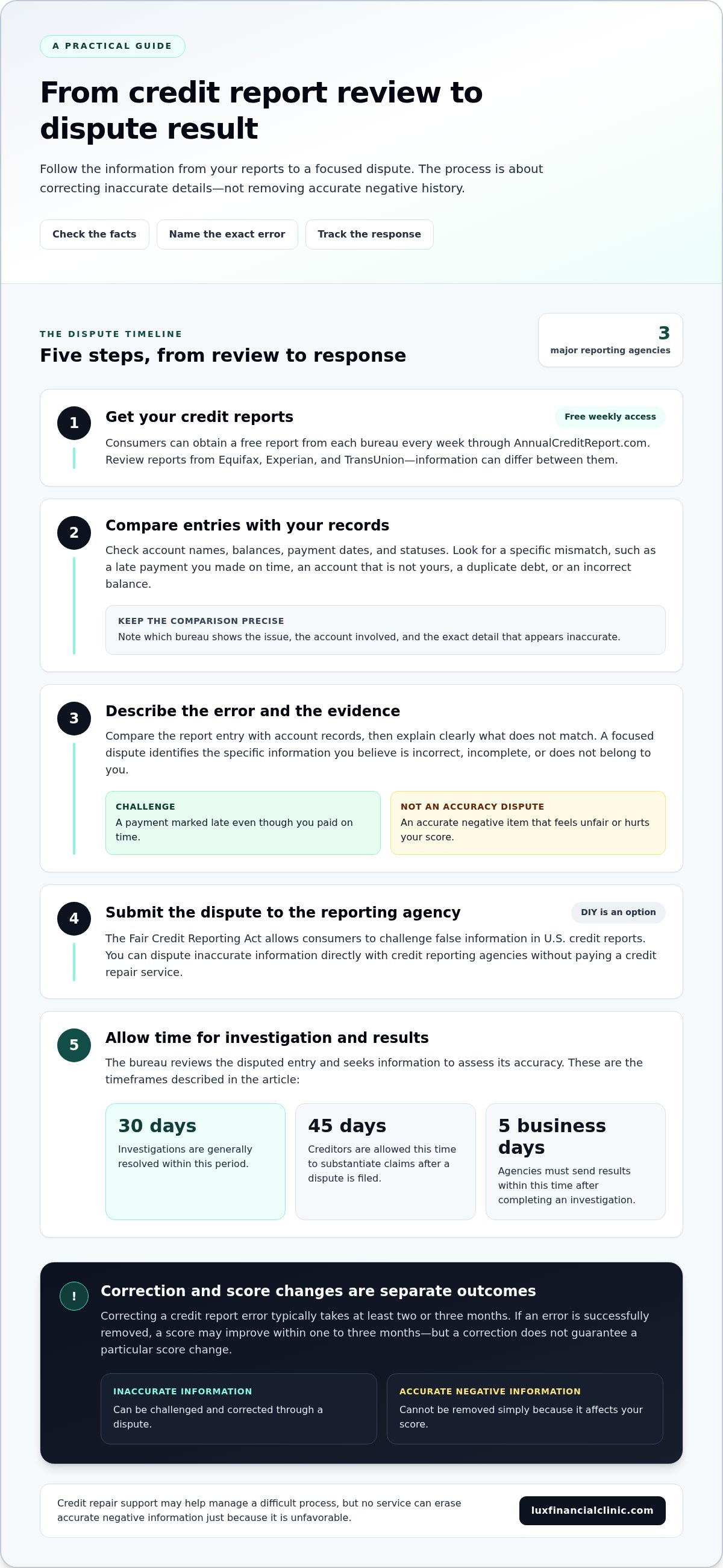
You can submit disputes to the three major credit reporting agencies: Equifax, TransUnion, and other nationwide bureaus. Identify the specific entry and explain what appears wrong, such as a payment marked late even though you paid on time. A focused dispute helps the agency assess the detail in question. You can dispute information yourself without paying a credit repair service.
Challenging Inaccurate Report Details
A dispute challenges information that is incorrect, incomplete, or doesn’t belong to you. For example, you might question a collection account you don’t recognize or a payment history showing a missed payment you actually made. Compare the entry with your account records, then describe the mismatch clearly. Disputes address accuracy, not whether accurate negative information feels unfair.
Credit Bureau Investigations
A bureau investigation reviews the disputed entry and seeks information to assess its accuracy. Investigations are generally resolved within 30 days, and creditors are allowed 45 days to substantiate claims after a dispute is filed. After completing an investigation, agencies must send results within five business days, according to the Office of the Law Revision Counsel, U.S. House of Representatives. These steps clarify when to expect a response.
DIY Disputes and Consumer Protections
The FCRA lets consumers dispute inaccurate credit report information directly with credit reporting agencies. The Credit Repair Organizations Act makes it illegal for a credit repair company to charge for actual credit repair services before performing them. How long does credit repair usually take? It can take several months or even years, and completion may take up to six months or longer. The timeline depends on the items involved and whether disputes require further review.
How long negative information stays on credit reports
Negative entries can affect a credit score long after the original financial difficulty. Their accuracy and reporting period determine what can be corrected or removed.
Effects on Credit Scores
Negative information can lower a credit score because it reflects past difficulty managing credit. The effect depends on the entry and the rest of the credit history, so the same missed payment may affect two people differently. A successfully corrected error may be followed by a score improvement within one to three months. Keep that timing in mind when planning for a credit application.
After a major event, such as bankruptcy, foreclosure, repossession, or loan default, rebuilding credit could take several years. Correcting a reporting error and rebuilding a broader credit history are separate processes. A correction can address inaccurate information, but it doesn’t erase accurate financial history. Keeping those outcomes distinct helps set realistic expectations.
Limits on Removing Accurate Items
Credit repair services can’t remove information that is accurately reported, even when it harms a credit score. A valid late payment, for example, can’t be removed simply because it makes qualifying for credit harder. The key distinction is accuracy: you can challenge an error, while accurate negative information generally remains during its reporting period.
Missed payments and collections typically remain on credit reports for seven to 10 years after the infraction. A bankruptcy can remain on a U.S. credit history for up to 10 years. These periods mean that accurate negative entries may still appear while a person works to rebuild credit. Review each item’s details and timing before deciding whether it appears incorrect.
Correcting a credit report error typically takes at least two or three months. If an entry is successfully removed, a score may improve within one to three months, though the correction doesn’t guarantee a particular score change. For instance, correcting a wrongly reported payment could remove that error while an accurate collection account remains. Separating the two helps you focus on inaccuracies you can address.
Types of credit report inaccuracies
Credit report errors can involve identity details, account ownership, balances, payment history, or medical debt. Identifying the specific mismatch helps you explain what needs correction.
Review reports from Equifax, Experian, and TransUnion, because information can differ between reports. Consumers can currently obtain a free report from each bureau every week through AnnualCreditReport.com. Compare account names, balances, payment dates, and statuses. A payment marked late on one report but correctly listed on another gives you a detail to investigate.
Some errors involve accounts that don’t belong to you, duplicate debts, or incorrect personal information that may mix your file with another person’s. Others show a balance that doesn’t match your account records or omit payments you made. Note the bureau, account, and exact field that appears inaccurate. Specific comparisons make it easier to explain the issue clearly.
Review medical debt reporting carefully, too. A collection entry may warrant scrutiny if it belongs to someone else, shows an incorrect balance, or doesn’t match the account information you have. Compare the name, amount, and payment status on the credit report with your medical billing records. Focus your dispute on the precise inaccuracy rather than assuming every medical entry is wrong.
Free credit report access makes regular reviews possible without a paid repair service. Keep a record of each discrepancy and which bureau displays it; this helps you track whether the same error appears on multiple reports. Correcting inaccurate information may improve your credit, but first identify the reporting mistake. A service acting on your behalf should focus on specific, supportable errors, not promise to remove every negative entry or charge for work before performing it.
Whether paying for credit repair is worthwhile
Paying for credit repair makes the most sense when inaccurate entries are hard to identify, involve several accounts, or require ongoing dispute follow-up. The service’s value is in organization and dispute support, not access to a process unavailable to consumers. If your reports show a few clear errors and you can manage correspondence, handling disputes yourself may be a reasonable alternative.
Consider the work involved before agreeing to recurring fees. A service may review reports, identify items to challenge, and manage dispute cycles, while you remain responsible for providing accurate account details. Weigh that ongoing support against the time you can devote to tracking responses. The central question, is it worth paying for credit repair, depends on whether the assistance addresses a real task in your case.
Be cautious of companies that promise to remove all negative information or demand payment before performing credit repair work. Accurate negative entries can’t be removed simply because they lower a score. Under the Credit Repair Organizations Act, a company may not charge for actual credit repair services before performing them. Understand what each charge covers, when it is billed, and how recurring fees relate to work performed.
When is paying for credit repair worth it compared with using a nonprofit credit counselor? Credit repair is more directly suited to challenging inaccurate credit report entries; a nonprofit credit counselor may be a better fit for broader budgeting or debt-management concerns. Choose based on the problem you need addressed, rather than expecting either service to resolve every financial challenge.
Before deciding, identify the specific report entries involved, the records you have to support disputes, and the follow-up you can manage. Then compare that workload with the service’s stated scope and billing schedule. Paying may be worthwhile when organized support meaningfully reduces the administrative burden. It is less compelling when the report contains accurate negative information or just a simple error you can address yourself.
Lux Financial Clinic: Credit Repair - Basic/Repair Package
Lux Financial Clinic offers its Credit Repair - Basic/Repair Package to help people address inaccurate negative items on their credit reports. Its structured dispute protocols focus on items such as collections, charge-offs, and late payments when those entries are inaccurate. The Comprehensive/Build Package is another credit repair option.
Consider this support if reviewing reports, identifying errors, and managing disputes feels difficult to handle alone. Credit repair cannot remove accurate information simply because it harms your credit, and no package guarantees a particular score. The right next step depends on whether your reports contain specific inaccuracies you want to challenge.
For support with credit report disputes, contact Lux Financial Clinic to discuss your next step.
Choose a Clear Next Step for Your Credit
Paid support is valuable when it helps you move from concern to a focused plan. Identify what you want to address first, what records you can provide, and how much of the dispute process you want to manage yourself. That clarity can guide a practical conversation about your options.
If you’re still weighing whether it is worth paying for credit repair, Lux Financial Clinic offers its Credit Repair - Basic/Repair Package and Credit Repair - Comprehensive/Build Package. For broader financial planning, its Business Funding Consulting may also help with business funding needs. Choose the next step that fits your priorities and gives you a clear understanding of the support involved.
Contact Lux Financial Clinic today to discuss your credit repair needs. A considered decision can help you move forward with greater confidence.
Frequently Asked Questions
Should You Use a Credit Repair Service?
A credit repair service may help if reviewing several reports, organizing supporting records, and tracking dispute correspondence feels difficult to manage. Before enrolling, identify the specific entries you want addressed and consider how much time you can devote to the process. If you have one straightforward error and can explain it with account records, handling the dispute yourself may be a practical choice.
Are They Worth It?
Whether it is worth paying for credit repair depends on the value of professional support for your particular workload. A service may help organize disputes and focus attention on specific reporting problems, but it can’t make accurate negative information disappear. Consider the complexity of the errors, the time you can commit, and whether the service addresses a need you actually have.
What services do credit repair companies provide?
Credit repair companies generally help review reports and challenge inaccurate entries with reporting agencies. Lux Financial Clinic offers Credit Repair - Basic/Repair Package and Credit Repair - Comprehensive/Build Package, using structured dispute protocols focused on inaccurate negative items such as collections, charge-offs, and late payments. Some packages may also differ in scope, so understand which activities are included before deciding whether the service aligns with your goals.
How much does credit repair cost per month and in total?
Credit repair costs vary by provider, package scope, billing structure, and how long support continues, so there is no single total that applies to everyone. With monthly billing, the final amount can depend on how long the service continues; other arrangements may use package-based fees. Lux Financial Clinic provides pricing after a quote request.
Can I repair my credit for free on my own?
Yes. You can review your credit reports and submit disputes yourself without paying a repair service. To keep the process organized, make a separate note for each bureau, account, disputed detail, and supporting record. For example, match a payment confirmation to the month shown as late. A simple tracking sheet can help you remember which issue you raised and what response followed.
What credit report errors can be legally disputed?
You can dispute inaccurate information, such as an account that belongs to someone else, a duplicate entry, or a balance that conflicts with your records. You can also challenge a payment status that incorrectly marks an on-time payment as late. Describe the exact field and why it is wrong. An accurate negative entry isn’t disputable simply because it is unfavorable.


