
A charge-off means a creditor has recorded a seriously delinquent account as a loss. It doesn’t erase the debt or automatically remove the account from your credit report. If you’re asking what a charge-off means on your credit report, the key point is that it can hurt your credit score and may remain on your reports for up to seven years from the first missed or late payment, according to the Federal Trade Commission.
Seeing this entry can feel unsettling, especially if you thought the account was closed or had already gone to collections. Understanding the term helps you distinguish the account’s reporting status from any balance you may still owe, and consider your next steps more clearly.
This article explains how charge-offs are reported, how they can affect credit scores, how long they may stay on your reports, and what to check if information seems inaccurate. It also explains how paying a charged-off account may update its status without removing its history.
Key Takeaways
- A charge-off is an accounting status, not debt forgiveness; the balance may still be owed even after the creditor closes the account.
- A charge-off can affect credit scores and make new credit harder to obtain, but the impact depends on your credit history and the scoring model.
- According to the Federal Trade Commission, a charge-off can remain on U.S. credit reports for up to seven years from the first missed or late payment.
- Paying the debt may update how the account is reported, but it doesn’t automatically erase the charge-off or restart the reporting period.
- Review the account details for accuracy; Lux Financial Clinic’s Credit Repair - Basic/Repair Package can help address inaccurate negative credit information.
How might this affect credit reports and credit scores?
A charge-off can affect your credit score and influence how lenders assess your credit history. The effect depends on what appears in your file, your other payment information, and the scoring model used.
Credit Score Effects
A charge-off is a negative item that can lower a credit score, with the impact shaped by your credit history and the scoring model. One market estimate places the potential decrease at 30 to 50 points, but that range doesn’t predict an individual result. A recent missed payment may matter differently from an older entry surrounded by a longer record of on-time payments.
Consider two borrowers with the same charge-off: one has several other missed payments, while the other has a longer history of timely payments. Their scores may respond differently because the rest of their credit files differ. Paying the account may help under some scoring models, but models can treat paid and unpaid charge-offs differently. Payment does not guarantee a particular score change.
Credit Report and Borrowing Effects
A charge-off may appear on reports from any of the three major U.S. credit bureaus, as identified by the Consumer Financial Protection Bureau. Reporting can vary because a creditor, collection agency, or debt buyer may report to one or more bureaus. The entry or its details may therefore differ across reports.
Review each report separately for the account’s status, payment history, balance, and reporting creditor. For example, a creditor may report the original account while a collection agency reports a transferred debt. Lenders may see the charge-off when considering your application. It can make approval harder or lead to higher interest rates and fewer rewards on available credit.
The entry’s effect is not limited to the score shown in a monitoring app. A lender may consider the charge-off alongside your current payments, balances, and account history. One score cannot show how every lender will evaluate those factors together. The terms offered can also depend on the type of credit requested and the lender’s criteria.
To understand what lenders might see, compare reports from all three bureaus rather than relying on one score summary. Note whether the creditor, account status, balance, and payment history match. If a detail differs, record which bureau shows it and what seems inconsistent. This comparison helps distinguish a bureau-specific reporting difference from a broader pattern in your credit history.
Paying down revolving balances and making current payments on time can strengthen the rest of your credit profile over time. These steps don’t erase a charge-off, but they add positive information that lenders and scoring models may consider. If you’re deciding whether to pay, remember that payment may update the account’s status without removing its history. The account’s reporting and the scoring model both matter.
How long will the charge-off stay on credit reports?
According to the Federal Trade Commission, a charged-off account can remain on U.S. credit reports for up to seven years from the first missed or late payment. Paying later doesn’t restart that period. The reporting clock is tied to the account’s original delinquency, not the date a lender sells the debt, sends it to collection, or receives payment.
How can you remove or update a paid charge-off on your credit report? Paying it does not automatically remove accurate information; the account may instead be updated as paid. If details are inaccurate or the account resulted from fraud, dispute the entry with the credit bureau reporting it and provide supporting records.
How the reporting period works
The first missed payment that led to the charge-off is the key date. For example, if a borrower misses payments and later pays the balance, the original delinquency still anchors the reporting period. Payment may change the account’s status, but it doesn’t start a new reporting period.
The Fair Credit Reporting Act limit is also described as 7.5 years from the date of first delinquency. This helps explain why dates matter when an entry appears older than expected. Compare the delinquency date listed on each report with account statements and other records. A date that changes between reports may need closer review.
How accounts may appear
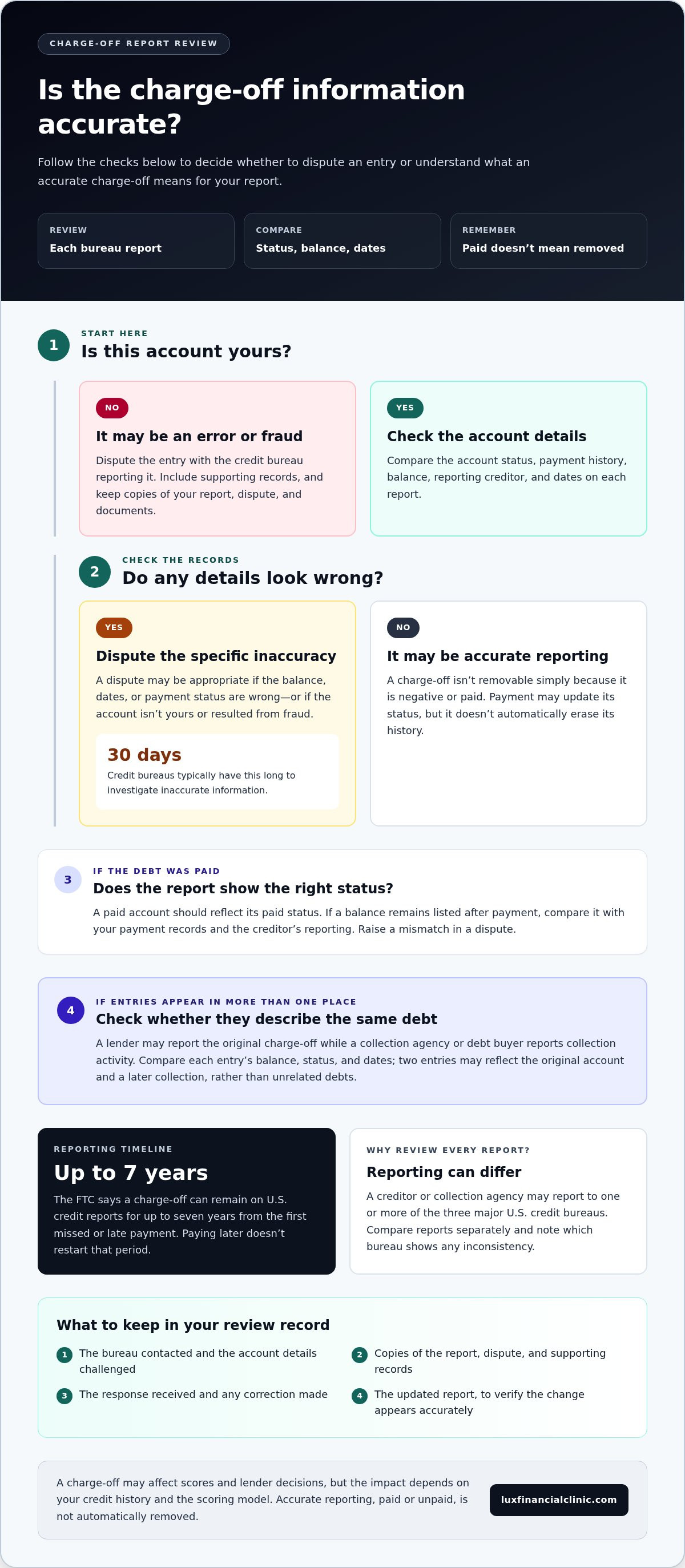
A lender may report the charge-off while a collection agency or debt buyer reports the collection account. If the lender sells the debt, both entries may appear, reflecting the original account and later collection activity. Check each entry’s balance, status, and dates to make sure the listings don’t appear to describe unrelated debts.
A paid account should reflect its paid status, while a forgiven balance may be described as settled or otherwise resolved by the creditor. “Paid” does not mean “removed.” If a balance remains listed after payment, compare it with your payment records and the creditor’s reporting. A mismatch is a specific issue to raise in a dispute.
When a correction may be appropriate
A charge-off isn’t removable simply because it’s negative or paid. A dispute may be appropriate when the account isn’t yours, the balance or dates are wrong, payment status is inaccurate, or fraud caused the entry. Credit bureaus typically have 30 days to investigate inaccurate information, so retain copies of the report, dispute, and supporting documents.
Keep a simple record of the bureau contacted, the account details challenged, and the response received. If a correction is made, review the updated report to ensure the change appears accurately. If an inaccurate negative item remains, credit repair support can help address disputed reporting through structured protocols.
Do Charge-Offs Hurt Your Credit Score?
A charge-off doesn’t cancel the unpaid debt, so the creditor or a later debt owner may still seek payment. Should you pay or settle a charged-off debt? First confirm the debt, current balance, and owner, then understand the proposed payment terms before deciding.
Debt Sales and Collections
A creditor may sell charged-off debt to a debt buyer or transfer it to a collection agency. The company contacting you may therefore differ from the lender named on your original account.
For example, a credit card lender may charge off an account and then sell the balance. The debt buyer may report a collection entry while the original account remains listed. Review both entries to see whether they reflect the same debt and whether their balances or statuses conflict.
A collection agency or debt buyer may add interest and fees while attempting to collect. A creditor may also resell the debt, so keep a record of who contacts you, the amount claimed, and any payments made. These records help you track how the account is handled as ownership changes.
Paying or Settling the Debt
Paying or settling addresses the outstanding obligation, but it doesn’t automatically remove the charge-off from your credit reports. The decision matters for both your financial planning and the account’s reported status.
Before paying, compare the claimed balance with your account records and identify whether the original lender, collection agency, or debt buyer owns the debt. If you agree to pay the remaining balance in one payment, get the terms in writing and keep proof of payment. A reported paid charge-off is not the same as an erased account.
A payment arrangement may involve settling the debt rather than paying the full balance. Make sure the written terms state the amount accepted and how the account will be reported. Don’t assume a verbal discussion changes the debt or its reporting.
A charge-off doesn’t itself release you from the obligation to repay. Even if a lender closes the account or sells it, the balance may still be owed. The creditor or debt buyer may pursue collection, and a collector that wins a lawsuit may take further steps, including seeking wage garnishment or a bank-account freeze.
Collection time limits depend on the state. The time limit for suing over a debt can vary, and the balance may still be owed. Because rules vary by state, the account’s age and location matter when considering collection activity.
Keep payment confirmations, settlement documents, and account statements together. If a collection agency reports a payment incorrectly, those records can help you identify the discrepancy. A clear paper trail also helps distinguish the original lender’s account from a later collection entry.
Meaning of a charge-off
A charge-off means a lender has written a delinquent account off as a loss in its records. In the United States, creditors generally charge off delinquent accounts between 120 and 180 days after delinquency. The account may be closed to future charges, but the write-off does not forgive the balance or make the borrower no longer responsible. It describes the creditor’s accounting treatment, not a release from the debt.
Are charge-off rules different for credit cards, loans, or medical debt? The basic meaning remains a creditor’s decision to record unpaid debt as a loss. Timing and account details can vary by creditor and debt type, so a credit card charge-off may not have the same account history as a loan or medical bill.
For a credit card, missed payments can lead the issuer to close the account and record the unpaid balance as a loss. A borrower might make some payments but still fall short of the monthly minimum; the account can remain delinquent and eventually be charged off. The lender’s decision reflects the unresolved account, not necessarily a complete lack of payments.
A charge-off also does not necessarily stop interest or fees from accumulating on a credit card balance. An account may show a charged-off status while the amount owed changes. Compare the balance and status on your report with statements or payment records. These details help distinguish the creditor’s write-off from the amount it currently claims.
The term “charge-off” can be misleading if it sounds like the debt has disappeared. A creditor may continue collection efforts, transfer the account, or sell the debt after charging it off. A collection entry is related, but a charge-off and a collection are not the same status. A report may show the original account and a separate collection entry when another company becomes involved.
The reporting period is separate from the creditor’s charge-off decision. According to the Federal Trade Commission, a charged-off account can remain on U.S. credit reports for up to seven years from the first missed or late payment. The period doesn’t begin on the day the lender records the charge-off. A later payment also doesn’t erase the original delinquency date.
For instance, if a credit card account becomes delinquent before the lender charges it off, the first missed payment remains the reference point for reporting. Reviewing that date, the balance, and the account status gives you a clearer picture of the entry. Those details can also help you check whether the report accurately reflects the account’s history.
What a charge-off means
What does a charge-off mean on a credit report? It means a creditor has recorded an account as a loss after serious delinquency. The entry is negative, but it doesn’t mean the debt was forgiven or that you’re no longer legally responsible for it.
The “charge-off” label describes the creditor’s accounting status, not a new type of account. The original credit card or loan may still be identifiable by its creditor, account history, balance, and payment status. Those details help you understand which debt the entry refers to and whether it matches your records.
Missed payments often build into a pattern before an account is charged off. For example, a report may show payments 30 days late, then 60 days late, followed by 90 days late. A borrower might make occasional payments during that period but still fail to meet the monthly minimum. The account can remain delinquent despite those partial payments.
A lender may close a credit card account to prevent future charges when it becomes seriously delinquent. That closure doesn’t necessarily stop interest or fees from accruing on the remaining balance. For example, an account may show no new purchases while its balance continues to change. Compare the reported amount with account statements and payment records.
Charge-offs can involve different account types, including credit cards and loans. An account may also be charged off after a borrower files for bankruptcy. The account type and history shape the details shown, but the central meaning is the same: the creditor has recorded unpaid debt as a loss. A charge-off and a collection are related possibilities, not identical labels.
After the charge-off, a creditor may continue seeking payment, transfer the account, or sell the debt. If another company becomes involved, the original account may appear alongside a collection entry. Read each listing carefully: identify the creditor or collector, status, balance, and payment history. This comparison can show whether entries refer to one debt or separate accounts.
To understand an entry, review the account from the earliest missed payment through its current status. Check whether the original creditor, account type, balance, and payment history align with your records. If the account is unfamiliar or a detail seems incorrect, keep the relevant statements and report information together. Clear documentation helps pinpoint what needs attention.
If a charge-off contains inaccurate negative information, get help reviewing credit report errors through a structured credit repair process.
Lux Financial Clinic: Credit Repair - Basic/Repair Package
Lux Financial Clinic’s Credit Repair - Basic/Repair Package helps address inaccurate negative items, including charge-offs, through structured dispute protocols. It may be a suitable next step after reviewing your credit reports and finding information that doesn’t match your records. Accurate charge-offs aren’t removed simply because they’re difficult or damaging; the focus is on challenging inaccurate reporting.
Gather relevant account statements, payment records, and copies of the reports showing the disputed details. This documentation can clarify what appears incorrect and support a focused review. For broader credit restoration needs, Lux Financial Clinic’s Comprehensive/Build Package is another credit repair option.
For help addressing inaccurate credit report entries, contact Lux Financial Clinic.
Make Your Next Credit Decision With Clarity
Understanding what a charge-off means on your credit report can be the starting point for a more intentional financial plan. Decide what you want your credit profile to support, then align your actions with that goal. A future application, a major purchase, or simply feeling more organized about your finances may call for a different approach.
If you’d like structured help reviewing your credit profile and addressing inaccurate negative items, Lux Financial Clinic offers the Credit Repair - Basic/Repair Package and Credit Repair - Comprehensive/Build Package. Choose the focus that reflects your current needs and longer-term priorities. Credit repair cannot promise a particular score, but a careful review can clarify what deserves attention and what steps make sense.
Take the next step at a pace that feels considered and manageable. Contact Lux Financial Clinic to discuss credit repair support and begin shaping a clearer path forward.
Frequently Asked Questions
What is a Charge-Off?
A charge-off is a creditor’s record that an account has become seriously delinquent and is being treated as a loss. It describes the account’s status, not a new kind of debt. For example, a credit card may show a charge-off while its original balance and payment history remain visible. Check the creditor and account details to identify which obligation the entry concerns.
So does that mean I don’t owe the debt any longer?
No. A charge-off doesn’t automatically cancel your responsibility for the debt. The original creditor may continue collection activity, or a debt buyer may own the account after a sale. If a new agency contacts you, compare its account details with your records and note who claims the balance. A charge-off also doesn’t tell you by itself whether a debt has been paid or settled.
Can my account be charged off even if I’ve been making payments?
Yes. Making payments doesn’t necessarily prevent a charge-off if they don’t meet the required monthly minimum and the account remains delinquent. For instance, a partial payment may reduce the amount owed but still leave the account past due. Compare your payment history with the minimum due and due dates on your statements. If you’re struggling to pay, contact the creditor to discuss possible arrangements.
How Can I Avoid Debt Charge-Offs?
Act before missed payments accumulate. If you expect difficulty making a minimum payment, contact the creditor promptly and explain what you can manage; creditors may offer payment arrangements or hardship options. Review statements for due dates and required amounts, and prioritize keeping accounts current where possible. If you’ve already fallen behind, ask about available repayment options and keep written records of any arrangement and payments.
How Does Charged-Off Debt Impact My Credit?
Charged-off debt can add negative payment history to your credit reports, which lenders may consider during an application. The entry may appear alongside a later collection account if another company becomes involved. A lender reviewing your file could see both the original account and a collection listing. Compare account names, balances, and statuses across your reports to understand how the debt is represented.
If I pay the debt, will it remain on credit reports?
It can. Paying a charged-off debt doesn’t automatically remove accurate history; the account may instead be updated as paid. Keep your payment confirmation and later compare it with the status and balance on your reports. If the reporting doesn’t reflect the payment, use your records to identify the discrepancy and dispute inaccurate information with the bureau reporting it.
What's the meaning of a credit card charge-off?
A credit card charge-off means the issuer has recorded a seriously delinquent card account as a loss. The card may be closed, preventing new purchases, while the unpaid balance remains an obligation. Interest or fees may continue to accrue. Check the reported balance and payment history against your statements, especially if the issuer or a collector has contacted you.
How does a charge-off affect your credit score?
A charge-off can lower a credit score, but its effect depends on the person’s credit history and the scoring model. A file with several missed payments may be evaluated differently from one with an otherwise strong payment record. Paying the account may help under some models, but its history can remain. Focus on accurate reporting and consistent payments on other accounts as you manage your credit profile.


