
What if the credit score you see isn’t the one an auto lender uses? If you’re asking, “what is a good credit score to buy a car,” the answer depends on more than a single number. Score ranges can help you set a target, but they can’t guarantee approval or a particular interest rate.
A lower score doesn’t automatically rule out financing, and a higher one doesn’t tell the whole story. Auto lenders may use scoring models that differ from consumer apps, then consider details such as income stability, existing debt, recent payment history, and the loan itself.
This guide explains how credit score ranges can relate to auto-loan decisions in 2026, why the score a lender sees may differ from yours, and what else can shape approval and rates. You’ll also find practical ways to review your credit, address report errors, and prepare before applying, without assuming you need a perfect score or a particular outcome.
Key Takeaways
- There’s no universal score that guarantees approval or a particular rate. Use common score ranges as a starting point, not as a promise.
- Ask “what is a good credit score to buy a car” with the scoring model in mind, since the score you check may differ from the one used for an auto loan.
- Look beyond your score by reviewing the financial details that may also shape a lender’s decision.
- Prepare in sequence: review your credit reports, identify possible inaccuracies, and organize your budget before comparing loan options.
- If your score is lower than you hoped, weigh the trade-offs of applying now against taking time to strengthen your readiness.
What Is a Good Credit Score to Buy a Car? Start With the Score Ranges
A stronger credit score can help you qualify for more favorable auto-loan offers, but no single score guarantees approval or specific terms. If you’re asking what is a good credit score to buy a car, the practical answer is a score that meets a lender’s criteria and helps you access terms that fit your budget. Which score matters depends on the lender, the scoring model, and the details of your application.
Think of score bands as orientation, not promises. A lender may group applicants into categories such as prime or near prime, but those labels aren’t universal approval rules. Borrowers with similar scores may receive different decisions or offers because lenders also consider other information. Your score is one part of a lending assessment, not a complete measure of your financial readiness.
What does “good credit” mean for an auto loan?
“Good” is relative to the lender’s criteria, the scoring model, and the decision being made at that time. A score that supports competitive terms with one lender may not produce the same result with another. In practice, a good auto-loan score is one that helps you access an offer with manageable costs, after you’ve considered the complete loan terms and your budget.
Credit scores are calculated from information in a credit report using a particular model. For a plain-language introduction to What is a Credit Score?, it helps to remember that a score is a summary generated from credit information, not a permanent personal rating. The model and report data matter. When comparing score ranges, check which model they describe and when the information was published. Use a category to guide your questions, not to predict a lender’s decision.
Also distinguish a minimum threshold from a favorable offer. Meeting a lender’s basic eligibility standard may make an application possible, while a stronger overall profile may support better pricing. Neither outcome is assured by a score alone.
Is there a minimum credit score to buy a car?
There isn’t one universal minimum for every auto lender. Lenders set their own criteria, and some may consider applicants with a range of credit histories. A score below one lender’s preferred threshold doesn’t automatically close every financing option. Likewise, meeting a stated threshold doesn’t guarantee approval.
Eligibility and affordability are different questions. You might qualify for financing and still receive terms that make the vehicle costly over time. Before focusing only on whether you can be approved, consider whether the payment and full borrowing cost fit your financial plan. A lower score may narrow the offers available or affect their terms, but it isn’t a judgment of your ability to make a thoughtful plan.
Use your score as a starting point for comparison, not a pass-or-fail verdict. Next, find out which score a lender may review and what else in your application could influence the decision.
Why Your Auto-Loan Score May Differ From the Score You Check
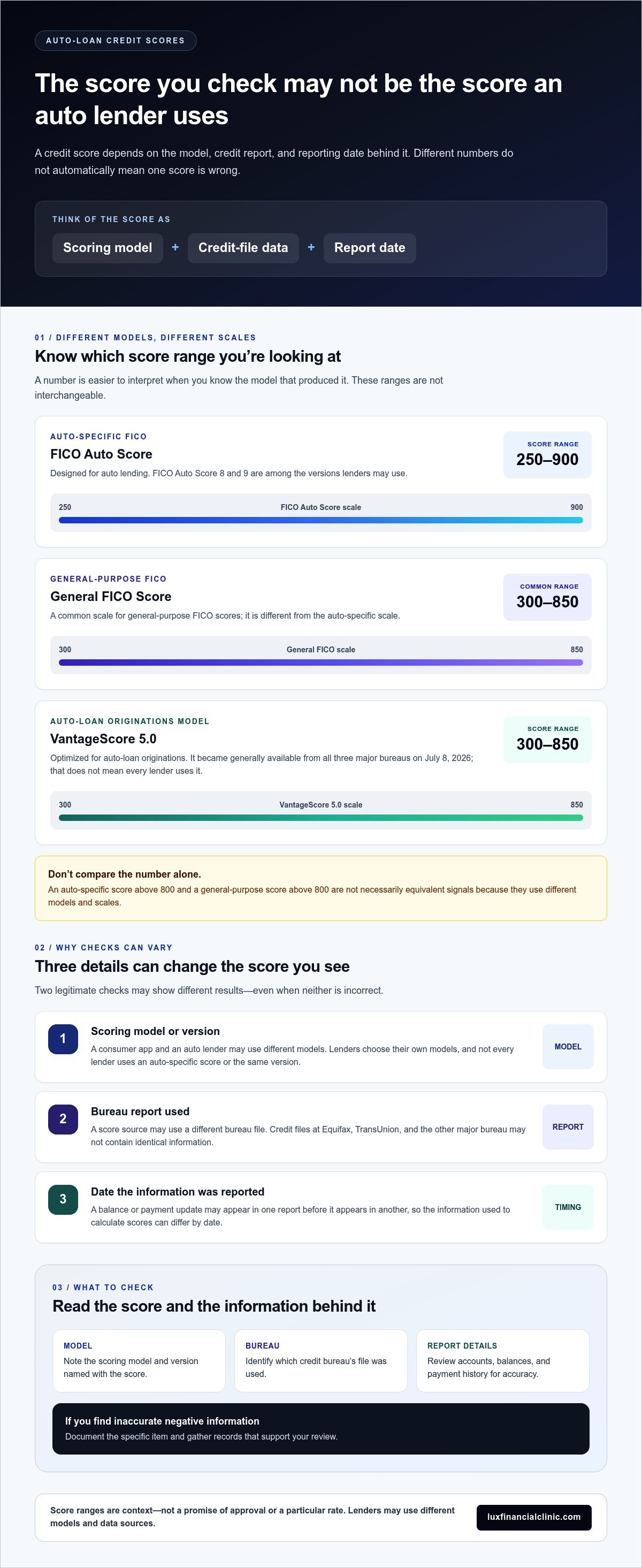
A credit score isn’t one permanent number attached to you. It’s calculated from information in a credit report using a particular scoring model. Change the model, the report data, or the date the information was gathered, and the result can change too. That’s why the score in a consumer app may not match the score a lender reviews for an auto-loan application.
Two legitimate credit checks can show different scores because they may use different scoring models, bureau reports, or reporting dates. A difference doesn’t automatically mean one score is wrong. To understand what a score tells you, look at both the number and the information behind it.
What is an auto-specific FICO Score?
FICO Auto Scores are designed for auto lending and use a different range from general-purpose FICO Scores. FICO Auto Scores use a 250-900 range, while general-purpose FICO Scores commonly use a 300-850 range. FICO Auto Score 8 and 9 are among the versions lenders may use, but not every lender uses an auto-specific score or the same version. The score you can access also depends on the source providing it.
A different range can make a number seem hard to compare. For example, an auto-specific score above 800 and a general-purpose score above 800 aren’t necessarily equivalent signals because they come from different models and scales. Read each score in the context of the model named beside it rather than treating one number as a universal measure.
Why can credit scores from different sources vary?
Several details can differ between score checks. A source may use a different scoring model or version, pull a different credit bureau’s file, or calculate the score using information reported on another date. Equifax and TransUnion, along with the other major credit bureau, each maintain credit files, and the information in one file may not be identical to the others. A balance or payment update, for instance, might appear in one report before it appears in another.
Auto-specific models are one part of a changing score landscape. VantageScore 5.0, which became generally available from all three major bureaus on July 8, 2026, is optimized for auto-loan originations and uses a 300-850 range. Its arrival doesn’t mean every lender uses it. Lenders choose their own models and data sources.
Before applying, note the model and bureau behind any score you’re viewing, then review the report data for accuracy. Compare accounts, balances, and payment history, not just the headline number. If you find inaccurate negative information, document the specific item and gather records that support your review. Lux Financial Clinic provides credit report review support and structured dispute protocols for inaccurate negative items, without promising a particular score or loan result.
Does Your Credit Score Alone Decide Auto-Loan Approval and Rates?
No. Your credit score can influence an auto-loan decision and the interest rate offered, but it doesn’t tell the full story. Lenders may assess your overall financial picture, the vehicle and loan details, and their own lending criteria. That’s why asking “what is a good credit score to buy a car” is only part of the preparation. A score can help you understand your starting point, but it can’t predict an individual lender’s decision.
What else may lenders consider besides credit score?
Depending on the lender, an application may be considered alongside factors such as:
- Income and employment stability: These may help show whether the proposed payment fits your financial circumstances.
- Existing obligations: Other debt payments can affect how much room you have in your budget for another monthly commitment.
- Down payment and loan amount: The amount financed in relation to your contribution may shape the lender’s assessment.
- Vehicle and loan details: The car’s age, condition, price, and the requested loan term may matter to the decision.
These factors don’t work as a simple checklist where one strong point cancels out another concern. For example, a larger down payment may reduce the amount financed, but it can’t guarantee approval or a lower rate. Lender criteria differ, and a general guide can’t determine how a lender will evaluate a specific application.
How should you read score-based auto-loan comparisons?
Published rate comparisons can illustrate broad patterns, but averages describe groups of borrowers, not the offer you’ll receive. Before relying on a figure, look for its source and publication date, the borrower category, whether it concerns a new or used vehicle, and the loan context. Without those details, comparisons can be easy to misread.
The table below separates useful context from what a score comparison can’t establish. Use it to read published data carefully, not to forecast your own terms.
Use comparisons to form questions, then assess actual offers by their full terms rather than the advertised rate alone. If you want help reviewing your financial position before a major purchase, Lux Financial Clinic offers a financial diagnostic consultation to help you organize your next steps, without promising a particular loan outcome.
How to Prepare Your Credit Before Applying for a Car Loan
Preparation can make the financing process more orderly, whether you’re ready to apply soon or still deciding when to shop. Focus on accuracy and affordability, not on trying to force a quick score change. A practical sequence is to review your reports, address genuine errors, set a budget, and then compare financing options.
How should you review your credit before applying?
Start by reviewing your credit reports and noting which information appears in each bureau file. Check account details, balances, payment history, and negative items for errors or missing context. If something is inaccurate or incomplete, identify the specific item, gather relevant records, and dispute that information. A dispute is not a way to remove accurate negative information simply because it may affect a score.
For a more detailed walkthrough of reviewing and disputing information across bureaus, use this three-bureau credit dispute guide.
What can you do if your score needs attention?
Build preparation around habits you can sustain, such as paying bills on time and keeping credit-card balances manageable. These practices can support a healthier credit profile over time, but no particular score change or timeline is assured. Lux Financial Clinic uses structured dispute protocols to address inaccurate negative items, including collections, charge-offs, and late payments, across the three major credit bureaus.
Next, organize your monthly budget, current debt payments, potential down payment, and the vehicle price range you’re considering. A preapproval can help you understand a possible borrowing range and compare options, but it isn’t a promise of final approval or terms. A lender may review updated information and the specific vehicle before making a final decision.
Compare the full offer, not only its advertised rate. Review the annual percentage rate, loan term, monthly payment, amount financed, and any other terms before committing. Rate-shopping guidance can depend on the scoring model and timing. Some models generally treat multiple auto-loan inquiries made within a 14-day period as one inquiry for scoring purposes, but models can differ, so don’t assume every inquiry is handled identically.
Before applying, review your reports, document any errors, set a realistic budget, and compare the full terms of available offers.
For structured help reviewing your credit before a major purchase, Lux Financial Clinic provides credit repair and financial diagnostic support. Its credit repair service focuses on disputing inaccurate negative items and can help you organize your next steps. You can also review your reports and prepare your budget independently.
What to Do If Your Credit Score Is Lower Than You Hoped
A lower score is a place to begin planning, not a judgment about you or your financial potential. It may affect the offers available, but it doesn’t tell you what every lender will decide. The question “what is a good credit score to buy a car” can help set expectations, but your next decision should reflect your transportation needs, budget, and the actual terms you can access.
Should you buy now or take time to prepare?
There’s no single right answer. If you need a vehicle soon, explore current offers while setting a firm limit on what feels manageable. If your need is less immediate, taking time to review your finances and credit may help you make a more considered choice. Waiting doesn’t guarantee a higher score or better loan terms, so weigh the practical benefit against the cost of postponing a purchase.
Build your budget around more than the monthly loan payment. Consider insurance, fuel, routine maintenance, and other ownership costs, then leave room for existing obligations and savings priorities. A payment that looks workable on its own may feel different once you include these expenses.
A larger down payment, a less expensive vehicle, or applying with a co-applicant may change the overall application picture. None guarantees approval or favorable terms. A co-applicant’s financial profile may also be considered, so make sure everyone understands the proposed payment and responsibilities before moving forward. Compare the full borrowing terms and the vehicle’s total cost, not just whether an application might be accepted.
When can credit guidance help with car-buying preparation?
If you’re unsure where to focus, a financial diagnostic consultation can help you review your broader financial position and organize questions before a major purchase. Credit repair is most relevant when a report contains inaccurate negative items. Disputes should address information that is genuinely inaccurate or incomplete. Accurate history cannot simply be removed because it is inconvenient. Reviewing your reports independently is also a practical place to start.
For readers who want more structure, Lux Financial Clinic’s comprehensive credit repair package includes a personalized credit-building roadmap. It can provide direction for ongoing preparation, but it can’t promise a particular score change, loan approval, or rate. Credit support is an option, not a prerequisite for making a thoughtful decision.
If reviewing your credit and financial readiness would be useful, explore Lux Financial Clinic’s credit support. Whether you seek guidance or prepare on your own, focus on clear information, a comfortable budget, and loan terms you understand before committing.
Make Your Next Car-Buying Step With Clarity
The most useful answer to “what is a good credit score to buy a car” is one that helps you make a decision grounded in your readiness, not pressure to reach a perfect number. Give yourself room to choose a pace that fits your transportation needs and financial priorities. A clear plan can make the next conversation about financing feel more manageable, whether you’re preparing now or taking time to strengthen your position.
If you’d value tailored guidance as you plan, explore personalized credit guidance with Lux Financial Clinic. Lux Financial Clinic can help you review your credit picture and identify thoughtful next steps, without promising a particular score or loan outcome.
Your credit score is one part of the picture. With accurate information and a plan that suits your circumstances, you can move forward with greater confidence.
Frequently Asked Questions
What is a good credit score to buy a car?
There isn’t one score that every lender considers good. The answer to “what is a good credit score to buy a car” depends on the scoring model and the lender’s criteria. A stronger score may support more favorable consideration, but it can’t guarantee approval or specific terms. Treat published cutoffs as general guidance, not universal requirements. Before comparing scores, check which model they use and whether the lender’s actual offer fits your budget.
Can I get a car loan with a 600 credit score?
A 600 score doesn’t determine by itself whether you can get a car loan. Lenders may assess your full application, the vehicle, the amount financed, and their own criteria. Rather than relying on a general rate estimate, review your credit reports and consider what monthly payment fits your budget. If you receive offers, compare the actual rate, loan length, and total repayment terms before deciding whether the financing is manageable.
Do car dealerships use FICO or another credit score?
The score used for a dealership-arranged application can vary by lender and application. Some auto lenders may use an auto-specific FICO Score; others may rely on another score model or version. A consumer service’s score may therefore differ from the one used in a lending decision. If you receive an offer, ask which model and credit bureau informed it, then compare those details with the score information you already have.
Does checking my credit score lower it?
Checking your own credit score or report generally uses a soft inquiry, which doesn’t affect your score. A lender’s review connected to an application may involve a hard inquiry, and its effect can depend on the circumstances and scoring model. Before authorizing a check, clarify whether it’s a soft or hard inquiry. You can also review guidance from the relevant credit bureau or scoring provider to understand how that specific check is treated.
Will applying for multiple car loans hurt my credit?
Multiple applications can result in credit inquiries, but some scoring models treat certain auto-loan inquiries made during a rate-shopping period as a group. The applicable window and treatment vary by model, so don’t assume every inquiry will be handled the same way or leave your score unchanged. Compare offers in a focused period, keep track of application dates, and review the scoring model’s current guidance as you shop.
Should I improve my credit before buying a car?
Preparing first may be helpful, but the right timing depends on your transportation needs, budget, and the loan terms available to you. If you can wait, review your credit reports for errors and consider whether your expected payment fits alongside insurance and other ownership expenses. Waiting doesn’t guarantee a higher score or a better offer. If you need a car soon, compare actual financing terms carefully before deciding.
Can a co-signer help me qualify for a car loan?
A co-signer may affect how a lender assesses an application, but approval and terms remain lender-specific. Before applying together, discuss the responsibility clearly: a co-signer may be legally responsible for repayment under the loan agreement. Late or missed payments may affect both borrowers’ credit histories. Consider whether each person understands the obligation and could manage the payment if circumstances change, as well as the possible effects on your relationship.


