
What if the strongest way to increase your refund is to claim less aggressively and document more carefully? For anyone searching “maximize tax refund self employed,” the answer starts with accurate records and eligible tax benefits, not questionable write-offs.
If you’re unsure which expenses qualify, or your income and receipts are spread across accounts, preparing a return can feel like a puzzle. It’s also easy to confuse deductions and credits with estimated tax payments and self-employment tax. A careful process can bring those pieces into focus and help you file with greater confidence.
This guide explains how to organize income and expense records, review common deductions and credits, and understand how tax payments affect your refund. You’ll also learn why a deduction must be eligible and supported, and how self-employment tax fits into the picture. The aim is a complete, accurate return that reflects the tax benefits you qualify for without overstating a claim.
Key Takeaways
- A tax refund reflects the balance after your tax liability, payments, and applicable credits are reconciled.
- Compare invoices, payment-platform statements, bank records, and tax forms to assemble a complete picture of business income.
- Review deductions and credits against eligibility and documentation requirements before claiming them.
- To maximize tax refund self employed, focus on accurate reporting and supported tax benefits rather than claiming every possible deduction.
- A consistent monthly and year-end recordkeeping routine can make filing more orderly, while professional preparation may help with a complex return.
How a Self-Employed Tax Refund Works, and What Can Increase It
When your income changes from month to month and expenses vary with your work, self-employed taxes can feel complex. A refund is possible, but it depends on how your final tax bill compares with what you’ve already paid, not simply on how many expenses you claim.
A tax refund is an overpayment returned after your tax liability and payments are reconciled. Deductions generally reduce the income subject to tax, while credits can reduce the tax itself if you meet the applicable rules. Some credits may be refundable, which means they can contribute to a refund even if they exceed your tax liability. These are different mechanisms, and understanding the U.S. tax system can help put them in context.
What determines a self-employed tax refund?
Your return brings together business income, allowable deductions, tax liability, and payments made during the year. For many sole proprietors, Form 1040 is the individual income tax return, Schedule C reports business income and eligible expenses, and Schedule SE calculates Social Security and Medicare taxes on net self-employment earnings. The results feed into the overall return.
In broad terms, deductible business expenses can lower taxable income, which may lower income tax. They don’t necessarily reduce self-employment tax in the same way. For 2026, the self-employment tax rate is 15.3% on applicable net earnings, subject to the rules for Social Security and Medicare. The deductible portion of self-employment tax can affect income-tax calculations, but it doesn’t erase the self-employment tax itself.
A larger refund isn’t guaranteed, and it isn’t always the same as paying less tax overall. A refund can be larger because you paid more during the year, even if your total tax liability didn’t fall. To maximize tax refund self employed filers may be entitled to, focus on accurately reporting income and claiming supported deductions and credits, rather than treating refund size as the only measure of tax savings.
Why a refund cannot be promised in advance
The final result depends on several pieces: your tax liability, income tax withheld from other work, estimated tax payments, and any credits you qualify to claim. If payments and refundable credits exceed your total liability, you may receive a refund. If they fall short, you may owe. Some self-employed people receive refunds; others do not.
That’s why claiming every possible deduction doesn’t automatically create the largest refund. A deduction must be eligible and properly supported, and its effect depends on your full return. An accurate review can clarify how income, deductions, credits, and payments fit together without assuming a particular outcome.
Step 1: Organize Self-Employment Income and Expense Records
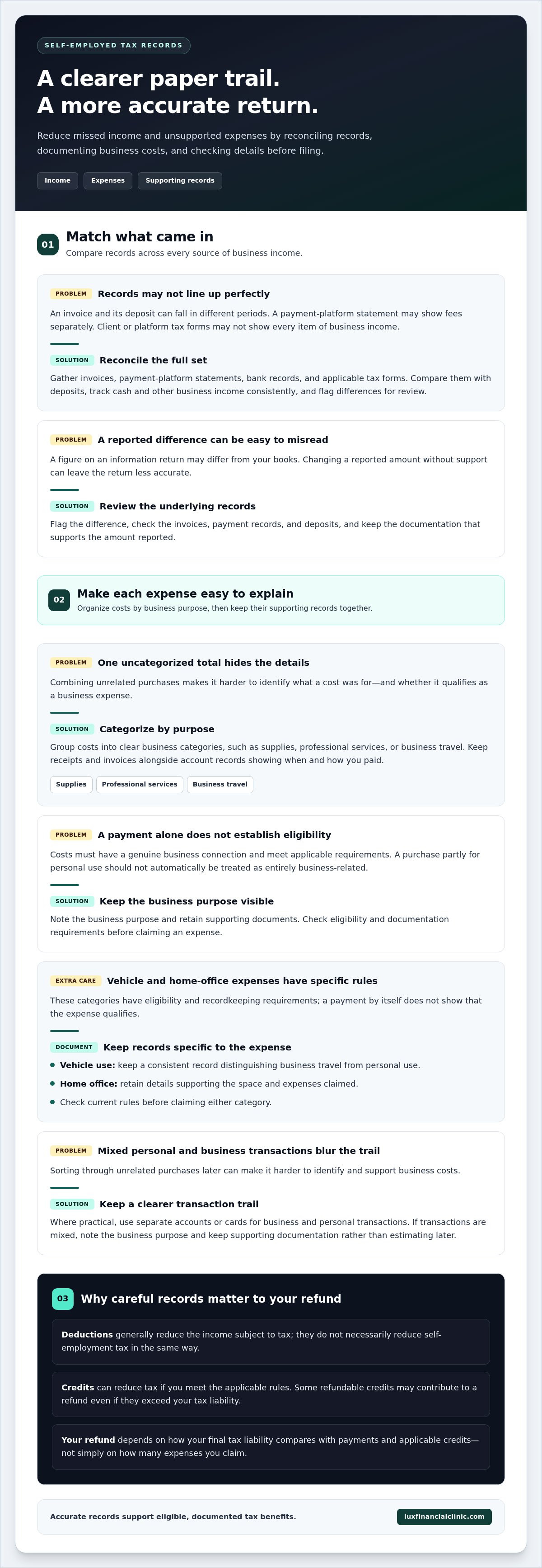
Start with a clear record of what came in and what went out. This workflow can make tax preparation more manageable and help reduce missed income, unsupported expenses, and last-minute uncertainty:
- Gather invoices, payment-platform statements, bank records, and applicable tax forms.
- Reconcile the records to confirm deposits and identify missing or duplicate entries.
- Categorize business expenses by purpose.
- Keep receipts, invoices, and relevant account records with your tax documents.
Reconcile every source of self-employment income
Compare client invoices and payment records with deposits in your bank accounts and information returns you receive. These records may not line up perfectly: a payment can arrive in a different period than an invoice, or a platform statement may show fees separately. Track cash and other business income consistently, too. Don’t rely only on tax forms from clients or payment platforms; your records should reflect all business income.
If a form’s reported amount differs from your books, flag the difference and review the underlying records before filing. Avoid changing a reported figure without support. Complete income records also help establish the net earnings used in calculating self-employment tax. The IRS explains who may owe this tax and how it applies in its Self-Employment Tax guidance.
Document business expenses before claiming them
Group costs by business purpose, such as supplies, professional services, or business travel, instead of combining them in a single uncategorized total. Keep receipts and invoices, along with account records that show when and how you paid. An expense needs a genuine business connection and must meet the applicable requirements to qualify as a deduction. A purchase made partly for personal use shouldn’t automatically be treated as entirely business-related.
Vehicle and home-office expenses have specific eligibility and recordkeeping rules. If you track vehicle use, keep a consistent record that distinguishes business travel from personal use. For a home office, retain details that support the space and expenses you claim. Check the current rules before claiming either category; a payment alone doesn’t establish eligibility.
Where practical, use separate accounts or cards for business and personal transactions. This creates a clearer trail and makes it easier to identify business costs without sorting through unrelated purchases. If transactions are mixed, note the business purpose and keep the supporting documentation rather than estimating later.
Well-organized records support an accurate return and a careful effort to maximize tax refund self employed filers may be eligible for, without overstating claims. If bringing together your 1099 income and expense records feels complex, self-employed tax preparation can help with organizing and preparing your return.
Step 2: Review Eligible Deductions, Credits, and Tax Benefits
Once your records are organized, review possible tax benefits one by one. Claim a deduction, credit, or adjustment only if you meet the applicable eligibility rules and have records to support it. A claim that doesn’t fit your circumstances can make a return less accurate, not more beneficial.
Keep the categories distinct. Business deductions generally reduce business profit or taxable income. Personal tax credits may reduce tax owed, and some may be refundable if you qualify. Certain adjustments, such as the deductible portion of self-employment tax or eligible self-employed health insurance premiums, may reduce income used in calculating income tax. Their treatment depends on the rules for your return.
Check business deductions and the qualified business income deduction
Review expense categories in light of your actual business activity. Supplies, business travel, professional services, vehicle use, and home-office costs may be relevant, but each has its own requirements. Your records should support the business purpose and amount. Review each category against the applicable Schedule C requirements rather than treating every business-related purchase as automatically deductible.
The qualified business income (QBI) deduction is conditional, not an automatic benefit for every self-employed filer. For 2026, phase-out limits begin at $201,775 for single filers and $403,500 for joint filers. Eligibility and the calculation can depend on factors beyond filing status and income. Review current IRS guidance, including the IRS Self-Employed Individuals Tax Center, before relying on a specific treatment.
Screen for credits and contribution-related tax benefits
Credits depend on individual circumstances, which may include income, household situation, dependents, and other eligibility criteria. The Earned Income Tax Credit may be available to eligible taxpayers, including some people with self-employment income. Don’t assume eligibility based on business status alone; check the current requirements for the tax year and make sure your return supports the claim.
Retirement contributions may also affect taxable income when they meet the rules for the plan and tax year. Contribution limits and calculations vary by plan and personal circumstances, so a contribution doesn’t automatically create a particular tax benefit. Confirm the current rules before filing.
If you searched for “maximize tax refund self employed,” focus on identifying the benefits you genuinely qualify for, not collecting deductions indiscriminately. A careful review of business deductions, personal credits, and income adjustments can help your return reflect your circumstances accurately.
Step 3: Estimate Payments and Review Your Return Before Filing
A long list of deductions doesn’t automatically produce the largest refund. Deductions may reduce taxable income, but the final balance also depends on your tax liability, credits, withholding, and estimated payments. The goal of your pre-filing review is to make sure the return is complete and payments are recorded accurately, not to force a particular result.
Compare tax payments with your expected tax liability
Self-employed income often has no tax withheld when it’s paid. Depending on your circumstances, you may need to make estimated tax payments during the year to cover income and self-employment taxes. Compare your payment confirmations with your records, and check the IRS estimated tax guidance for current requirements and schedules.
For calendar-year 2026, the estimated payment dates are April 15, June 15, and September 15, 2026, and January 15, 2027. Include any tax withheld from other income in your review as well. If total payments and applicable credits exceed your final liability, you may receive a refund. If they fall short, you may have a balance due. A deduction can affect your liability, but it doesn’t replace payments or guarantee a refund.
Use a calm, documented pre-filing review
Before submitting, work through the return in an orderly sequence. Confirm that personal and filing-status details are accurate, then compare reported income with invoices, deposits, payment-platform statements, and applicable tax forms. Reconcile expense totals to your records, and confirm that payment amounts match your estimated-tax confirmations and withholding documents.
- Check that income from all sources is included and discrepancies have been reviewed.
- Confirm each deduction has an eligible business purpose and supporting documentation.
- Review credits against the eligibility rules that apply to your situation.
- Verify that withholding and estimated payments appear correctly on the return.
Pause over anything that doesn’t match. Correct an error only when your records support the change, and keep the documents behind each figure together. For broader context on the filing process, consult a current 2026 tax preparation guide alongside official IRS instructions.
This careful review can help you maximize tax refund self employed filers are eligible to receive while keeping the return accurate and well-supported. If you’d like help reviewing a complex 1099 return, explore self-employed tax preparation.
Step 4: Build a Repeatable Plan for a More Accurate Self-Employed Return
A dependable tax routine is easier to maintain than a year-end scramble. Set a regular time to review business activity, save supporting records, and note changes that may affect your return. The aim isn’t to predict a particular refund. It’s to keep a clear, current picture of your finances so you can report income and claim eligible tax benefits accurately.
Create a simple year-round tax folder
Keep one organized digital or paper folder for income statements, expense documentation, tax-payment confirmations, and prior returns. Update it monthly, or after a busy period, rather than waiting until filing time to reconstruct transactions from memory. A brief note about an unusual purchase or business change can also make its purpose easier to understand later.
Include changes in household circumstances, too. A change in dependents, filing situation, or sources of income may affect which tax rules apply. Keeping these details alongside your business records gives you a more complete starting point when preparing your return.
- Monthly: Record income, categorize expenses, save receipts, and reconcile business deposits.
- At year-end: Gather tax forms, review estimated payments, and check that records cover the full tax year.
- After a change: Note new income sources, major shifts in business activity, or household changes that could affect filing.
Know when tax preparation support may help
A return may call for closer attention if you have multiple income sources, substantial or mixed-use expenses, questions about deduction or credit eligibility, or records that are difficult to reconcile. These aren’t reasons to worry. They’re signs that a structured review could help you understand how the pieces fit together before filing.
Lux Financial Clinic prepares 1099 and self-employed tax returns, reviewing income, records, eligible deductions, and credits carefully. Professional preparation can help organize a complex return and support accurate filing, but no preparer can promise a particular refund. Explore self-employed tax preparation support for more information.
A careful, repeatable process is a practical way to maximize tax refund self employed filers may be eligible to receive while keeping claims grounded in their circumstances and documentation. Carry these two steps forward:
- Organize your records: Gather income statements, expense documentation, and payment records in one place.
- Prepare or review your return: Check reported figures and claims against your records, and use preparation support if the return feels complex.
Make Your Next Tax Filing More Deliberate
A more accurate self-employed return begins with complete records, not aggressive write-offs. Reconcile income, document business expenses, and claim deductions or credits only when you meet the rules. Then compare estimated payments and withholding with your final tax liability to understand whether you may owe or receive a refund.
These habits can help you maximize tax refund self employed filers are eligible to receive while keeping your return grounded in clear documentation. A consistent routine can also make future filing feel more manageable. If your 1099 income, deductions, or credits make the return difficult to organize, Lux Financial Clinic prepares self-employed and 1099 tax returns, with e-file delivery for individual and small-business returns and remote preparation available nationwide.
Explore self-employed tax preparation with Lux Financial Clinic for support with a careful review of your return. With organized records and a considered filing process, you can move forward with greater clarity and confidence.
Frequently Asked Questions
Can I maximize my self-employed tax refund by claiming more business expenses?
No. Claiming every expense isn’t the goal; claiming eligible expenses with proper documentation is. A legitimate deduction may reduce taxable income, but it won’t automatically create a refund or lower every part of your tax bill. Keep receipts, invoices, and records that show each expense’s business purpose. Don’t claim personal costs as business expenses just to increase a refund. Check current IRS rules for the expenses relevant to your work.
What deductions can self-employed taxpayers claim?
Potential deductions depend on your work, business structure, and documented expenses, so there isn’t one universal list that applies to every self-employed person. Supplies, business-use services, and eligible vehicle or home-office costs may be relevant, but each category has specific requirements. Review expenses against current IRS guidance and keep supporting records. Claim only amounts you can substantiate and that meet the applicable rules for your return.
Do self-employed people get a tax refund?
Yes, a self-employed taxpayer can receive a refund, but it isn’t automatic. The result depends on total tax liability compared with withholding, estimated tax payments, and refundable credits for which the taxpayer qualifies. If payments and applicable credits don’t cover the final liability, tax may still be owed, including self-employment tax. The completed return determines the outcome. Deductions alone can’t guarantee a refund, and some self-employed filers will owe rather than receive money back.
How do estimated tax payments affect my refund?
Estimated tax payments count toward the tax you’ve paid during the year. If total payments exceed your final tax liability, your return may show a refund; if they’re insufficient, you may have a balance due. Keep payment confirmations and compare them with the amounts reported on your return before filing. Payment obligations vary by individual circumstances, so review current IRS requirements and schedules rather than relying on a past year’s routine.
Can I claim the Earned Income Tax Credit if I am self-employed?
Possibly. Self-employed taxpayers may qualify for the Earned Income Tax Credit if they meet the applicable income, filing, and other eligibility requirements. Household details and tax-year rules can affect eligibility, so self-employment alone doesn’t determine whether you qualify. Review current IRS criteria and report earned income accurately before claiming the credit. If your situation is complex, careful preparation can help ensure that the information used to determine eligibility is complete.
Does the qualified business income deduction increase my refund?
The qualified business income deduction may reduce taxable income for eligible taxpayers, but it doesn’t directly guarantee a refund. Eligibility and the calculation can depend on income, business type, and current tax-year rules. Review current IRS guidance before claiming it. Then consider its effect alongside your payments, credits, and total tax liability. A lower taxable income may affect the final calculation, but whether you receive a refund depends on the complete return.
What records should I gather before filing self-employed taxes?
Gather business income records, invoices, payment statements, bank activity, expense receipts, prior-year returns, and estimated tax payment confirmations. Include documentation for each deduction or credit you plan to claim, plus relevant business-use records for items such as a vehicle or home office. Reconcile income and expense totals before filing so discrepancies can be reviewed. Keep the records organized and retain them according to current IRS guidance.


