
What makes filing contractor taxes difficult is often not the return itself, but knowing which records to use. If you’re sorting through client payments, receipts, and business purchases while trying to understand what belongs on your return, you’re not alone. Useful independent contractor tax filing help starts with a clear picture of your income and expenses, not a shoebox full of unanswered questions.
Because taxes generally aren’t withheld from contractor payments, preparing early can make filing more manageable. This practical 2026 checklist walks you through gathering income records and tax forms, separating business expenses from personal spending, and preparing for key steps in your federal and state returns.
You’ll also find guidance on estimated tax payments and when personalized support may help. Once your records are organized, you can decide whether to prepare the return yourself or work with a tax professional. Lux Financial Clinic provides remote tax preparation for 1099 self-employed filers, as well as individual and small-business returns, with personalized help preparing your return.
Key Takeaways
- Build a complete picture of contractor income from payment records, not only the 1099 forms you receive.
- Organize expense receipts, estimated tax payment records, and personal filing details before preparing your return.
- Follow a clear federal filing sequence: report business results, calculate self-employment tax when applicable, then complete your individual return.
- Before submitting, review income totals, expense documentation, payment details, and applicable state requirements.
- Use independent contractor tax filing help if multiple income sources, complicated records, or uncertainty about forms make filing harder to manage.
Independent contractor tax filing help starts with identifying your income
Start by confirming your income for the tax year you’re reporting. Once you know which payments belong in that year, it’s easier to organize expenses, compare tax forms, and prepare the rest of your return. A 1099 form can help, but it may not show everything you earned. If a client doesn’t send a form, that alone doesn’t mean you can leave the related income off your return.
Confirm the tax year before sorting your records. If you’re filing in 2026, you’re generally preparing a return for income earned in 2025. Income earned during 2026 is generally reported on a 2026 tax return filed in 2027. The year you submit the return and the tax year it reports are different, so label your records accordingly.
Checklist: identify every source of contractor income
Gather the forms and records that show what you were paid, then compare them instead of relying on a single statement. Start with this checklist:
- Gather Forms 1099-NEC, 1099-K, and any other applicable income statements.
- Review invoices, payment-platform reports, bank deposits, and bookkeeping records for the same tax year.
- Flag refunds, reimbursements, duplicate forms, and differences between reported amounts and your records for closer review.
For example, a platform statement and a client’s form may reflect the same payment. Flag the overlap and trace it to the underlying transaction rather than counting it twice. A deposit total may also include payments from different sources or transactions outside the tax year. Reconciling the records helps you catch these details before they complicate the return.
Check whether your work is treated as independent contracting
Contractors commonly receive payment for services without employee wage reporting, while employees are generally paid wages reported by an employer. The label on a contract or tax form doesn’t, by itself, settle how a working relationship is classified. The Independent contractor overview explains the general distinction and related tax considerations, but it can’t determine your individual status.
Federal and state rules or reporting requirements may differ. If your role, work arrangement, or forms leave you uncertain, review current IRS guidance and the relevant state agency’s official information for your situation. Keep documents that explain the work and payments together. This gives you a more organized starting point for independent contractor tax filing help, whether you prepare the return yourself or use personalized preparation support.
Gather these records before preparing your independent contractor tax return
Once you’ve identified your income, assemble the records that support your return. A consistent system helps you report earnings accurately, distinguish business costs from personal spending, and explain the figures you enter if questions arise. Sort documents into four groups: income, business expenses, estimated tax payments, and personal filing information.
Income and business expense records to collect
Keep invoices, payment confirmations, platform statements, receipts, and bookkeeping summaries together for the tax year. For each expense, note what the purchase was for and retain the receipt or other supporting record. Regular operating costs may be easier to categorize, while purchases used for both work and personal life may require a reasonable allocation. A purchase isn’t automatically deductible just because you made it while working. Whether an expense qualifies depends on applicable tax rules and the facts behind it.
- Income: invoices, client payment records, platform reports, and bookkeeping summaries.
- Business expenses: receipts, invoices, and notes explaining the business purpose of each cost.
- Estimated payments: payment confirmations or account records showing amounts and dates.
- Personal filing details: identification information, prior-year returns, and dependent information when applicable.
For mixed-use items, such as a phone or vehicle used for both business and personal reasons, keep records that show how you determined the business portion. The IRS Self-Employed Individuals Tax Center offers federal guidance for self-employed filers. Official information can help you understand which records may matter, but expense treatment still depends on your circumstances.
Personal information and prior tax records to have ready
Set aside your prior-year return, identification details, and information about dependents, if relevant. Also collect records related to health coverage, retirement contributions, and other items that may affect your return. Include estimated tax payment confirmations and any tax notices that need attention. Keeping these documents together makes it easier to provide complete information and catch missing details before filing.
For a clearer framework for working with a preparer, read our self-employed tax preparer selection guide. If you’d like personalized support organizing your documents and preparing a 1099 return, explore 1099 tax preparation from Lux Financial Clinic.
Follow the federal filing sequence: Schedule C, Schedule SE, and Form 1040
With your records organized, work through the federal return in a logical order: calculate your business results, determine whether self-employment tax applies, then complete your individual income tax return. This sequence helps connect your business activity to your overall tax picture. The forms you need can vary with your business structure, circumstances, and tax year, so use this as a general guide rather than a determination of your filing requirements.
Step one: summarize business income and expenses on Schedule C
For many sole proprietors, Schedule C is where business income and eligible expenses are reported to calculate profit or loss. Use your records to total gross receipts and applicable expenses. Then compare those figures with income statements and bookkeeping summaries before entering them. If figures differ, pause to investigate rather than changing a number just to make the totals match.
Review expense categories carefully. If you’re unsure whether a cost qualifies or how to treat a mixed-use purchase, flag it for research or professional review instead of guessing or claiming an unsupported deduction. This first step gives the rest of the return a more reliable foundation.
Step two: review self-employment tax and the individual return
Schedule SE is used to calculate self-employment tax when applicable under current filing rules. In plain language, self-employment tax is the Social Security and Medicare tax generally associated with income from working for yourself. The result, along with your business information, may carry into Form 1040 and related schedules. Form 1040 brings together information about your income and other tax details to determine your federal return.
This sequence is useful, but it isn’t one-size-fits-all. A contractor operating through a different business structure, for example, may have different reporting requirements than a sole proprietor. Check the IRS Self-Employed Individuals Tax Center for current federal guidance on applicable forms and filing rules. State requirements may involve separate forms or adjustments.
Understanding how each form fits into the sequence can help you spot missing information and ask focused questions. Lux Financial Clinic prepares 1099 self-employed, individual, and small-business tax returns, including remote e-file preparation. Explore personalized tax preparation if you’d like support organizing and preparing your return.
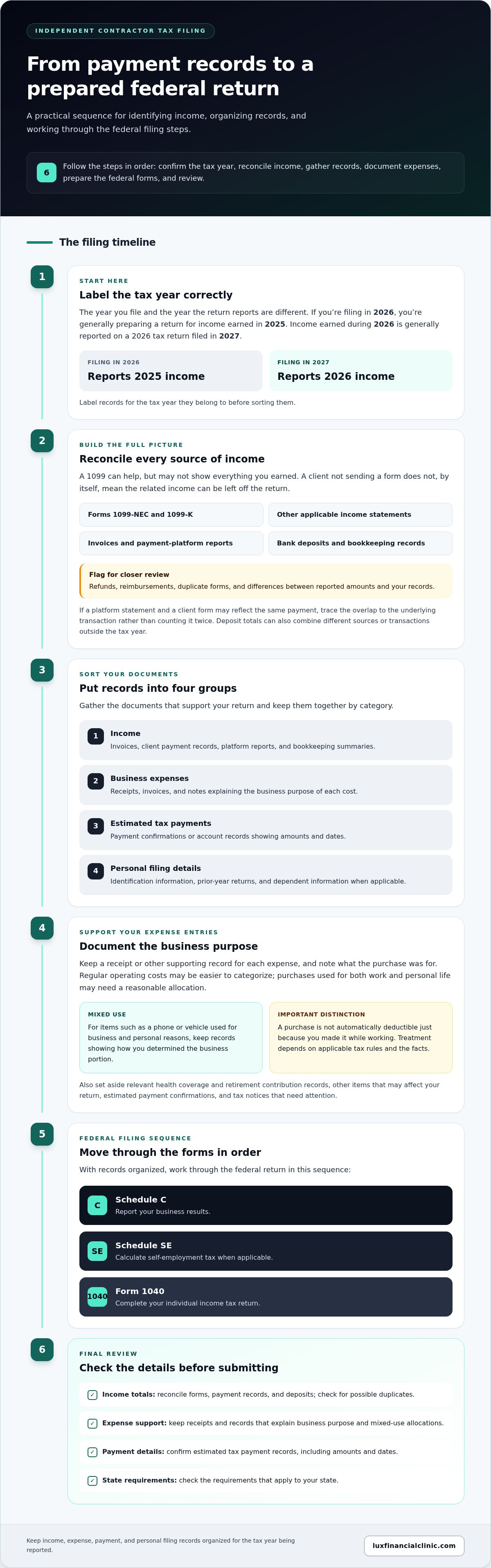
Use this final filing checklist to review payments, state returns, and common errors
A careful review before submission can catch mismatches that are easy to overlook while preparing the return. Compare your final figures with the records you organized, then confirm that payment information and filing details are complete. Estimated tax rules and state requirements can vary, so review the current instructions for your tax year and circumstances.
Check payments, estimated taxes, and state filing obligations
Match estimated tax payment confirmations against the payments reported on your return. Check each amount and payment date, and resolve any differences before filing. Whether estimated payments are required depends on current rules and your individual tax situation. If you’re unsure how those rules apply, review current IRS guidance or seek personalized tax preparation support.
Consider state filing obligations separately from federal filing. Requirements differ between states, and your circumstances may affect which state returns or forms apply. Review official guidance for each state relevant to your tax situation, including any state where you earned income or had another filing connection. Don’t assume that completing a federal return also addresses state requirements.
Catch common filing errors before submitting
Compare the return with your source documents in a final review. Look for overlooked income, duplicate entries, expenses without adequate support, and totals that don’t match your bookkeeping. A discrepancy isn’t always an error, but understand and be able to explain it before submitting.
- Confirm names, identification numbers, filing status, and dependent details where applicable.
- Check that income, expense, and estimated payment amounts agree with your records.
- Review the payment or refund section, including bank account and routing details if using direct deposit or electronic payment.
- Make sure required signatures and other submission details are complete.
- Verify current federal and state forms, instructions, and filing deadlines for the tax year.
Pause if anything remains unclear. A review now can help prevent avoidable corrections later, while guessing at a form entry or expense treatment can create more uncertainty. Independent contractor tax filing help may be useful if your payment records don’t reconcile, you’re unsure about state filing obligations, or you want an experienced preparer to review the return’s details.
For support preparing a 1099 self-employed return, work with Lux Financial Clinic on your tax return. Its tax preparation service provides personalized assistance organizing and preparing contractor returns.
When independent contractor tax filing help can make the process clearer
You don’t have to hire a professional to file every contractor return. If your records are straightforward and you understand the forms that apply to you, preparing your own return may feel manageable. Personalized support can help when the details take more time to untangle than the return itself.
Signs you may benefit from guided tax preparation
Consider getting help if payment records conflict, you have income from several sources, or you’re unsure how to categorize expenses. A prior return that needs attention, an unresolved tax notice, or uncertainty about which forms apply can also make a preparer’s guidance useful. These situations don’t automatically mean your return is unusually complicated. They’re good reasons to organize your records and talk through the next steps.
A tax preparer can organize the information you provide and prepare a return based on your records and circumstances. Clear documentation and open questions give the preparer a stronger foundation. Professional support can offer structure and a careful review, but it isn’t a promise of a particular refund, tax savings, or filing result.
Prepare for a focused tax-preparation conversation
Before beginning, gather the income, expense, estimated payment, and personal filing documents from your checklist, along with your prior-year return and any tax notices. A short list of questions can keep the conversation focused and clarify what still needs attention.
- Which forms should I expect to use for my business and individual return?
- Do my records show estimated payments clearly?
- Do I need to consider a state return based on my situation?
- Which income or expense entries still need review?
Lux Financial Clinic prepares tax returns for 1099 self-employed filers, with remote service and e-file delivery nationwide. If you’d value personalized help organizing your information and preparing your return, Explore independent contractor tax preparation support.
Move into tax season with a clear plan
A steadier filing process begins with complete income records, organized expense support, and a final review of payments and applicable state requirements. Following the federal sequence from business results to self-employment tax and your individual return can help you see how each part fits together. Keep current-year forms and instructions close, since filing details may vary with your circumstances.
Use this checklist to prepare on your own or recognize when independent contractor tax filing help could bring useful structure. If you’d like personalized assistance, Lux Financial Clinic prepares 1099 self-employed and individual tax returns, with remote service and e-file delivery nationwide.
Explore independent contractor tax preparation support and take your next filing step with greater clarity. Organized preparation can make the process feel more manageable, one record at a time.
Frequently Asked Questions
Do independent contractors have to file taxes if they did not receive a 1099?
A missing 1099 doesn’t automatically mean you can leave income off your return. Keep records of payments from every source, including client deposits, cash payments, and platform transactions that weren’t shown on an information form. Whether you must file depends on the tax year’s rules and your circumstances. Check current IRS filing guidance rather than using receipt of a specific form as your only guide.
What documents do independent contractors need to file taxes?
Gather income statements, invoices, payment-platform reports, bank records, bookkeeping summaries, and receipts for business expenses. Also collect estimated tax payment confirmations, your prior-year return, and identification information. Records about dependents, health coverage, retirement contributions, or other relevant tax items may also be needed, depending on your situation. Organizing documents into income, expenses, payments, and personal information makes it easier to review totals and prepare your return.
Which tax forms do independent contractors typically use?
Many sole proprietors use Schedule C to report business income and eligible expenses, Schedule SE to calculate self-employment tax when required, and Form 1040 for their individual federal return. Forms 1099-NEC and 1099-K can help reconcile payments, but they aren’t substitutes for complete income records. The forms that apply depend on your business structure, circumstances, and tax year, so review current IRS instructions before filing.
Can I deduct expenses as an independent contractor?
Some business expenses may be deductible when they meet applicable tax rules and are supported by records. A purchase isn’t deductible just because it relates generally to your work. For example, a phone used for both personal and business purposes may require separating the business portion. Keep receipts and notes explaining the business purpose, and review uncertain expenses against current guidance before including them on your return.
Do independent contractors need to pay estimated taxes?
Some contractors may need to make estimated tax payments because client payments generally don’t have employer withholding. Whether payments are required, how much to pay, and when they’re due depend on current rules and your tax situation. Review IRS guidance for the applicable tax year, and keep confirmation records for payments you make. If you’re uncertain about your payment plan, a tax preparer can help you review the relevant information.
Do independent contractors have to file a state tax return?
State filing requirements vary, and your residence, income, and other circumstances can affect which returns you need to file. A completed federal return doesn’t automatically satisfy state obligations. Review current instructions from each state relevant to your tax situation, including rules that may affect how income or deductions are reported. Don’t assume another state’s requirements apply to you; use official guidance for the states involved.
When should an independent contractor get tax filing help?
Consider independent contractor tax filing help if you have income from several sources, records that don’t reconcile, expenses that are difficult to classify, or questions about which forms apply. A preparer can organize the information you provide and prepare a return based on your records and circumstances. Bring income statements, expense documentation, payment confirmations, and your prior return. Lux Financial Clinic prepares 1099 self-employed and individual returns remotely, with e-file service nationwide.


