
The most useful tax tips for 2026 start with understanding which tax year you’re handling and what changed in your life during that year. It’s easy to be unsure which documents to gather, whether a deduction or credit might apply, or how current rules affect your return. A clear process can help you answer those questions one at a time.
This guide shows you how to organize income records and receipts, identify deductions and credits to review, and prepare to file with greater confidence. It also explains why tax-year details matter, especially if you’re self-employed, have more than one income source, or experienced a major life change.
You’ll find practical steps for checking current forms and deadlines, reducing avoidable filing errors, and deciding when qualified preparation support may be useful. With a thoughtful approach, tax preparation can feel more orderly and less overwhelming.
Key Takeaways
- Confirm which tax year your return covers before checking forms, rules, and deadlines.
- Use these tax tips to create a document checklist based on your income sources and household circumstances.
- Review possible deductions and credits carefully. A form or expense alone doesn’t confirm eligibility.
- Use a consistent pre-filing review to catch missing information or mismatched details before submitting.
- Consider qualified tax preparation support if your return includes multiple income sources or added complexity.
Tax Tips for 2026 Start With Knowing Which Tax Year You’re Filing
Useful tax tips help you organize records, plan around your circumstances, and prepare an accurate return. Before gathering paperwork or considering deductions, identify the tax year you’re dealing with. The year you file and the year the income relates to are often different. Confusing them can lead you to look at the wrong forms, limits, or deadlines.
Knowing the difference also helps separate two tasks: filing a return for a completed tax year and making decisions during 2026 that may affect a return filed later. The U.S. system includes federal, state, and local taxes; the overview of Taxation in the United States provides broader context. For requirements that apply to your return, check current IRS guidance and any relevant state guidance.
Filing year versus tax year: what the terms mean
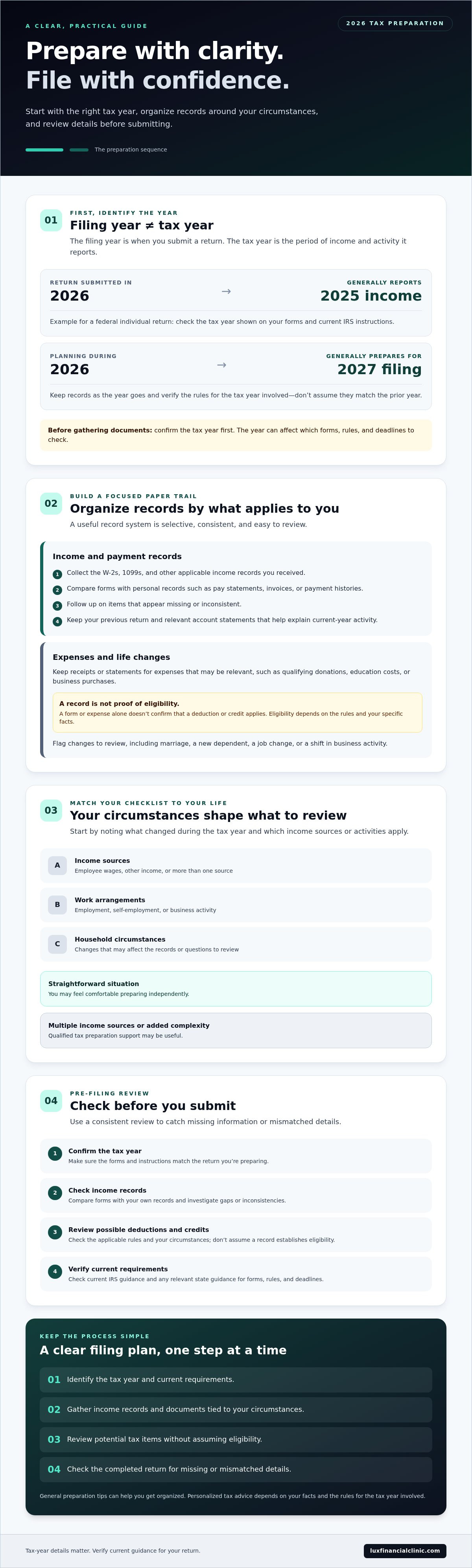
Tax year is the period whose income and activity a return reports. Filing year is the calendar year when you submit that return. For most individuals who use the calendar year, these dates fall in consecutive years.
Example: A federal individual return submitted in 2026 generally reports income and activity from the 2025 tax year. Planning during 2026 for income and activity in 2026, by contrast, is preparation for a return generally filed in 2027. Check the tax year shown on your forms and the current IRS instructions to confirm which rules and deadlines apply to your filing.
If you’re filing a prior-year return, focus on the documents and rules for that year. If you’re planning ahead during 2026, keep records as you go and verify the rules for the 2026 tax year rather than assuming they match the prior year.
Which tax tips apply to your situation?
Some steps are useful for nearly everyone: identify the tax year, keep relevant income records together, and review your return before submitting it. Other decisions depend on details such as income type, work arrangements, household circumstances, and business activity. A document or expense may be worth reviewing, but it doesn’t establish eligibility for a deduction or credit on its own.
Start by noting what changed during the year. Did your income sources, household, employment, self-employment, or business activity change? These details can help you identify which records and questions need closer attention. People with a straightforward situation may feel comfortable preparing independently. Multiple income sources or more complex circumstances can make qualified tax preparation support useful.
General preparation tips can help you get organized; personalized tax advice depends on your specific facts and the rules for the tax year involved. In the sections ahead, you’ll find a practical way to organize records, identify issues to review, and approach filing with greater clarity.
Build a Tax-Ready Paper Trail With These Organization Tips
A useful record system is selective, consistent, and easy to review. Instead of collecting every paper you receive, build your file around your income sources and circumstances for the tax year. These tax tips can help you prepare a focused set of records without assuming that any particular form or expense qualifies for a tax benefit.
Gather income and payment records
Start with documents that report income or payments relevant to your situation. You may receive a W-2 for employee wages or one or more 1099 forms for other types of income, but not every taxpayer receives each form. Depending on your activities, other records may also matter. Check current IRS instructions for reporting requirements that apply to your tax year and income.
- Income forms: Collect the W-2s, 1099s, and other applicable income records you received.
- Personal records: Compare forms with your own records, such as pay statements, invoices, or payment histories. Follow up on items that appear missing or inconsistent.
- Prior returns and statements: Keep a copy of your previous return and relevant account statements that help explain current-year activity.
Keep records that relate to your own income and circumstances. The IRS offers practical year-round tax planning pointers, including guidance on maintaining organized records.
Keep records for expenses and life changes
Save receipts and statements for expenses that may be relevant to deductions or credits, such as qualifying donations, education costs, or business purchases. Keeping a record doesn’t mean an expense is deductible. Eligibility depends on the rules and your specific facts. Also flag changes such as marriage, a new dependent, a job change, or a shift in business activity so you can review them carefully.
Complete records give you a clearer basis for checking income, reviewing potentially relevant expenses, and preparing a more accurate return.
For easier retrieval, use secure digital storage or a dedicated paper folder. Label files by tax year and category, such as “2025 income” or “2025 receipts,” and use the same system throughout the year. Protect digital files with appropriate security, and keep paper records somewhere private and orderly.
For a broader walkthrough, consult the site’s Tax Preparation in 2026: A Clear Guide to Filing Your Return. If you’d like help preparing an individual, self-employed, or small-business return, you can review tax preparation support from Lux Financial Clinic.
Match Tax Tips to Your Income, Work, and Household
The documents worth reviewing depend on how you earned income and what changed during the tax year. Use this comparison to identify relevant records and questions to check against current IRS guidance. It’s a starting point, not a determination that a particular deduction or credit applies.
| Situation | Documents to review | Questions to ask |
|---|---|---|
| Employee | W-2s, pay statements, and any records of other income | Do the income forms match your records? Did a job or income change affect withholding? |
| Family or household change | Relevant household records and documents related to dependents | Could a marriage, new dependent, or other change affect filing details or possible credits? |
| 1099 worker | 1099 forms, invoices, payment records, and business expense records | Are all income sources accounted for? Are business and personal transactions clearly separated? |
| Small-business owner | Business income records, expense documentation, and relevant account statements | Do the records explain business activity for the year, and are any items unclear or mixed with personal spending? |
Employees and households
Compare each income document with your own records and note differences to resolve before filing. If your household changed, review whether that change affects filing information or possible dependent-related credits. Eligibility depends on current IRS rules and your circumstances, so don’t assume that having a dependent automatically qualifies you for a credit.
A significant change in income or household circumstances may also be a reason to review your withholding. Check current IRS guidance for your situation, especially if your pay or household details changed during the year.
1099 Workers and small businesses
Keep business income and expenses organized separately from personal transactions where possible. Clear records help you and a preparer understand what happened during the year, but an expense entry or receipt alone doesn’t establish that a cost is deductible. Confirm applicable rules before treating an item as a deduction.
Schedule C and self-employment tax questions can involve details beyond this overview. For those, consult current IRS instructions or qualified preparation support rather than relying on a general checklist.
These tax tips help you focus on records relevant to your work and household. Before submitting a return, the IRS’s guidance on common tax filing mistakes can help you spot details that deserve a final check.
Avoid Common Tax Filing Mistakes With a Simple Review Routine
A deliberate final review can catch mismatched details before you submit a return. Set aside time to compare important entries with the documents you gathered. These tax tips provide a practical check, not a substitute for confirming current IRS instructions when a rule or procedure is unclear.
Review the return before submitting
Work through the return in a consistent order. Check names and identification details against official records, then compare income entries with the forms you received. Review filing status and dependent information. If you’re requesting a direct deposit or making an electronic payment, carefully verify the bank account and routing details.
- Confirm personal details: Review names, identification numbers, filing status, and dependent information for accuracy.
- Reconcile income: Match reported amounts to your W-2s, 1099s, and other relevant records. Pause if an amount is missing or doesn’t agree.
- Check payment details: Carefully verify bank information and any other payment entries before submitting.
- Review support: Make sure the records needed to support the return are available and consistent with what you’ve entered.
- Keep a copy: Save the filed return and your submission confirmation with your tax-year records.
Know when a tax question needs professional review
If you spot an error before filing, correct the draft and recheck the related entries. If you’ve already submitted a return or received an IRS notice, don’t assume the same steps apply. Read the notice carefully and follow its instructions, or check current IRS guidance for your specific situation. Procedures can depend on the issue and the status of your return.
Multiple income sources, business activity, or uncertainty about a deduction or credit may be good reasons to seek qualified preparation support. Consult authoritative IRS information for current eligibility rules and procedures rather than relying on assumptions or a general checklist.
Be thoughtful about claims of unusually large refunds or guaranteed tax relief. A refund depends on your circumstances and applicable rules. No promise should replace a careful review of the return and the records behind it. Verify the facts and filing details before trusting a refund promise.
If you’d like help reviewing and preparing an individual, self-employed, or small-business return, explore tax preparation support from Lux Financial Clinic.
Turn Your Tax Tips Into a Clear Filing Plan
Preparation becomes more manageable when each task has a place. Work through four steps: organize your records, review your situation, verify current requirements, then file. A straightforward return with familiar income and no unusual circumstances may be manageable on your own. Multiple income sources, business activity, or questions about eligibility may call for qualified preparation support.
Create a personal tax preparation checklist
Use a short checklist to see what’s ready and what still needs attention. Set a personal review date ahead of the applicable filing deadline, leaving time to find missing records or ask questions. Filing dates and requirements can change, so confirm current details with the IRS instead of relying on a past year’s calendar.
- Organize: List the income forms and other records you expect, then mark what has arrived.
- Review: Note unresolved questions and changes in income, household, work, or business activity.
- Verify: Check current IRS forms, rules, and deadlines for the tax year involved.
- File: Submit once your information is complete, and save the filed return and confirmation.
For a fuller walkthrough, look for the site’s Tax Preparation in 2026: A Clear Guide to Filing Your Return. Tailor your checklist to your circumstances. A form or expense is a prompt to review, not proof of eligibility for a tax benefit.
Consider professional tax preparation when your return is complex
If your return includes several income sources, self-employment, or small-business activity, a qualified preparer may help you work through the records and questions involved. Lux Financial Clinic provides individual, self-employed and 1099, and small-business tax preparation. Before proceeding, ask what documents are needed, what the preparation includes, and how the e-file process works. Confirm current service details, including remote filing availability, directly with the business.
These tax tips are intended to support an organized filing process, not promise a particular refund or tax result. If professional preparation would help you feel more confident, you can explore tax preparation support at your own pace.
Make Your Next Filing Step a Clear One
The most useful tax tips begin with knowing which tax year you’re filing and keeping your records aligned with your income, work, and household. Before submitting, review your personal details, income entries, and supporting documents. Then confirm that current rules and deadlines apply to your return.
A straightforward return may feel manageable on your own. If you have multiple income sources, self-employment, or small-business activity, qualified preparation support can help you work through the details. Lux Financial Clinic provides individual, 1099 self-employed, and small-business tax preparation. Remote e-file service is available across all 50 states; confirm current availability and service details directly with the business.
If you’d like support preparing your return, explore tax preparation support and ask about document needs, preparation scope, and the e-file process. A thoughtful review can help you move forward one organized step at a time.
Frequently Asked Questions
What are the most important tax tips for 2026?
Start by confirming the tax year, then organize records that match your income and household circumstances. A return filed in 2026 generally reports income from 2025, while planning during 2026 may affect a return filed later. Check current IRS forms, rules, and deadlines for the relevant year, compare income forms with your records, and review personal details before filing. These tax tips support careful preparation, but don’t replace advice for your specific situation.
How can I maximize my tax refund without breaking tax rules?
Review deductions and credits that may apply to your circumstances, and keep records that support the information on your return. Don’t claim an expense simply because you have a receipt. Eligibility depends on current rules and your facts. Check that all income is reported and that household and payment details are accurate. A refund isn’t guaranteed, and a larger refund isn’t the only measure of a correctly prepared return.
What documents should I gather before filing my taxes?
Gather the income forms relevant to you, such as W-2s or 1099s, along with personal records that help confirm those amounts. You may also need prior-year returns, relevant account statements, and receipts or records for expenses you want reviewed. If you have dependents, self-employment income, or business activity, include related documentation. Match your checklist to your circumstances, and check current IRS instructions for any additional records that may apply.
Can I deduct work-from-home expenses on my tax return?
Possibly, but working from home doesn’t automatically make household costs deductible. Federal rules generally treat employees and self-employed workers differently, and eligibility may depend on how a space is used and the nature of the work. Before claiming a home-office expense, review current IRS guidance for the tax year and your work arrangement. Keep relevant records, but don’t assume an expense qualifies solely because it relates to working at home.
What tax tips should 1099 workers follow?
Track payments and business expenses throughout the year, keep business and personal records distinct, and compare reported income with your own records. A 1099 form or expense receipt doesn’t by itself determine what must be reported or what may be deductible, so check current IRS requirements. Also review whether estimated tax payments apply to your situation and confirm the relevant schedule. If you have multiple income sources or uncertain business expenses, consider qualified preparation support.
When should I start preparing my taxes?
Begin organizing as income records and other relevant documents become available, and keep your system current throughout the year. Before filing, set a review date early enough to resolve missing forms or questions. First confirm which tax year you’re preparing for, then check current IRS filing dates and requirements for that year. Starting early can give you more time to review your information carefully, but it doesn’t change the applicable deadline or payment obligations.
Is it better to prepare my taxes myself or use a tax preparer?
Either option may suit you, depending on your comfort with the process and the complexity of your return. A straightforward return with familiar income sources may be manageable independently if you can follow current instructions and review your entries carefully. Multiple income sources, self-employment, small-business activity, or uncertain eligibility can make professional support helpful. Lux Financial Clinic offers individual, 1099 self-employed, and small-business tax preparation. Confirm current service details directly with the business.


