
The closest result for “tax services near me” may not be the right preparer for your return. A nearby office can feel reassuring when you want clear answers before sharing financial documents. But location alone won’t tell you whether a preparer handles your return type, what the service includes, or how your information is handled.
It makes sense to compare convenience, cost, and access to direct support. The key is to look beyond assumptions and confirm what each service actually provides. This guide covers five common myths about finding tax preparation, so you can compare options without pressure or unrealistic promises.
You’ll learn what to ask about individual, self-employed or 1099, and small-business returns; how free, paid, in-person, and remote options may differ; and what to check before sending documents. A nearby office isn’t the only way to get help: Lux Financial Clinic provides remote tax preparation across the United States, with e-file delivery. The right fit depends on your circumstances and the clarity of the service you receive.
Key Takeaways
- Use “tax services near me” as a starting point, then compare whether a preparer suits your return and communication preferences.
- Free, paid, in-person, and remote options differ in access and scope; confirm eligibility and services directly.
- Before choosing a preparer, ask who will prepare your return, how they handle questions or corrections, and how they protect your documents.
- Identify your return needs and gather relevant income, prior-year, and business records before comparing options.
- Lux Financial Clinic prepares individual, self-employed and 1099, and small-business returns remotely nationwide, with e-file delivery. Confirm current availability and intake details.
What does “tax services near me” really mean, and does proximity matter?
A search for “tax services near me” often signals a desire for accessible, trustworthy help, not necessarily a preference for a walk-in office. Distance can affect convenience, but it won’t tell you whether a preparer handles your return type, explains the process clearly, or offers a document-sharing method you’re comfortable using.
Start with your circumstances. A straightforward individual return may call for a different level of support than a return involving self-employment or small-business income. Compare each provider’s stated services with the help you need. Look for clear information about who prepares returns, how you can ask questions, what follow-up is available, and how financial documents are handled.
Marketing language can help you find options, but it doesn’t prove a provider is a good fit. Check service descriptions and any qualifications relevant to your needs. For example, a Certified Public Accountant (CPA) is a professional designation with specific education, examination, and licensing requirements. If a provider mentions a credential, verify what it means and whether it applies to the person preparing your return.
Myth: The closest tax preparer is automatically the best fit
A nearby office may make appointments or document drop-offs easier, but convenience doesn’t replace a careful fit check. Ask whether the provider works with your return type and circumstances, and how they handle questions, document exchange, and corrections if something needs attention. A clear explanation of what is and isn’t included is more useful than a broad claim that every return is welcome.
Distance matters if it makes communication easier for you. It shouldn’t be your only measure of trust.
Myth: “Near me” means you must meet a preparer in person
Tax preparation may be in person, self-guided through software, offered through a volunteer program for eligible taxpayers, or handled remotely with a preparer. These options differ in the support and service scope they provide. If you’re considering volunteer assistance, check eligibility and available services directly with the program. For paid or remote help, ask how to submit documents securely and how you’ll discuss questions.
Lux Financial Clinic provides individual, self-employed and 1099, and small-business tax preparation remotely across the United States, with e-file delivery. Confirm current availability and intake details before proceeding. For a broader overview of filing, see this personal tax preparation guide. A local office is one route, not a requirement for finding suitable support.
Free, paid, or remote tax services: what each option can, and cannot, promise
Searching for tax services near me may bring up volunteer programs, paid preparers, and remote options. These labels describe different parts of the choice: volunteer or paid refers to who provides help and under what model, while remote describes how you work together. Compare the scope and fit for your return, not just the label.
| Option | Access | Fit to check |
|---|---|---|
| Volunteer assistance | Available through programs such as VITA and TCE for qualifying taxpayers | Confirm eligibility, return types served, and site details with the program |
| Paid preparation | Work with a paid preparer, with the process varying by provider | Ask whether they handle your return circumstances and how questions are addressed |
| Remote preparation | Share information and communicate without relying on a nearby office | Check document exchange, communication, follow-up, and service scope |
Free assistance can be a valuable option for eligible taxpayers, and paid preparation isn’t automatically necessary. VITA and TCE eligibility and available services can vary, so verify current details through the IRS before making plans. The IRS also offers guidance on choosing a tax professional to help you assess a preparer and their qualifications.
Myth: Free tax preparation is available to every taxpayer
Volunteer programs serve qualifying taxpayers, and their services may not cover every return type or circumstance. Check current eligibility and the assistance a specific program provides directly with the IRS or program site. If it isn’t a fit, compare other options without assuming that paid preparation is automatically better. Eligibility is only one factor in choosing a suitable service.
Myth: Paid or remote preparation guarantees a larger refund
Neither a fee nor a remote process determines the tax result. Refunds depend on relevant income, filing information, and deductions or credits that apply to a taxpayer’s situation. A responsible preparer needs to review relevant information before offering a meaningful estimate, and the estimate may change as details are confirmed. Treat guaranteed-refund language as a reason to ask about assumptions and process, not as a promise to rely on.
Remote work isn’t automatically easier or more accurate. It changes how documents and questions are handled, so confirm the process before sharing financial information. Lux Financial Clinic offers individual, self-employed and 1099, and small-business tax preparation remotely nationwide, with e-file delivery. Confirm current availability and intake details. If this model may suit your circumstances, you can review Lux Financial Clinic’s tax preparation options.
How to compare tax services near you without relying on sales claims
A polished website or confident promise can make a provider sound like an obvious choice. A more useful comparison focuses on what you can confirm: whether the preparer handles your return type, how the work is done, what the service includes, and how your information is managed. Get clear answers before sharing sensitive documents.
Use this checklist when comparing providers:
- Return fit: Confirm they handle your situation, such as an individual return, self-employed or 1099 income, or a small-business return.
- Preparation process: Ask who will prepare and review the return, and what information they need from you.
- Communication: Find out how to ask questions and how the provider will explain items you don’t understand.
- Document handling: Ask how documents are submitted, protected, and returned or retained.
- Fees and boundaries: Confirm the fees, included services, and any work outside the arrangement before sending records.
- Follow-up: Ask what support is available after filing if you have a question or notice an error.
Marketing claims deserve a closer look, especially claims about credentials or expertise. Ask what a stated qualification means and who holds it. Then check current preparer guidance through the IRS instead of treating promotional language as proof. A provider who explains the process and its limits clearly gives you more useful information than one who relies on broad assurances.
Questions to ask before choosing a tax preparer
Be specific about your needs. Ask whether the preparer handles returns like yours, how your documents will be reviewed and protected, and who you’ll contact with questions. Clarify how corrections are handled and what follow-up is available after filing. The answers can help you assess the working relationship before your financial information enters the process.
Myth: A large refund claim is a reliable way to judge quality
A refund depends on your circumstances and the information reported on your return, not on a provider’s promotional claim. If you receive a preliminary estimate, ask what information and assumptions it’s based on, and what could change it as your documents are reviewed. No preparer can responsibly promise a specific outcome before understanding the relevant details. Treat a large-refund claim as a prompt for careful questions, not a measure of quality.
Taking time to compare these details can help you choose with greater confidence and understand what you’re agreeing to.
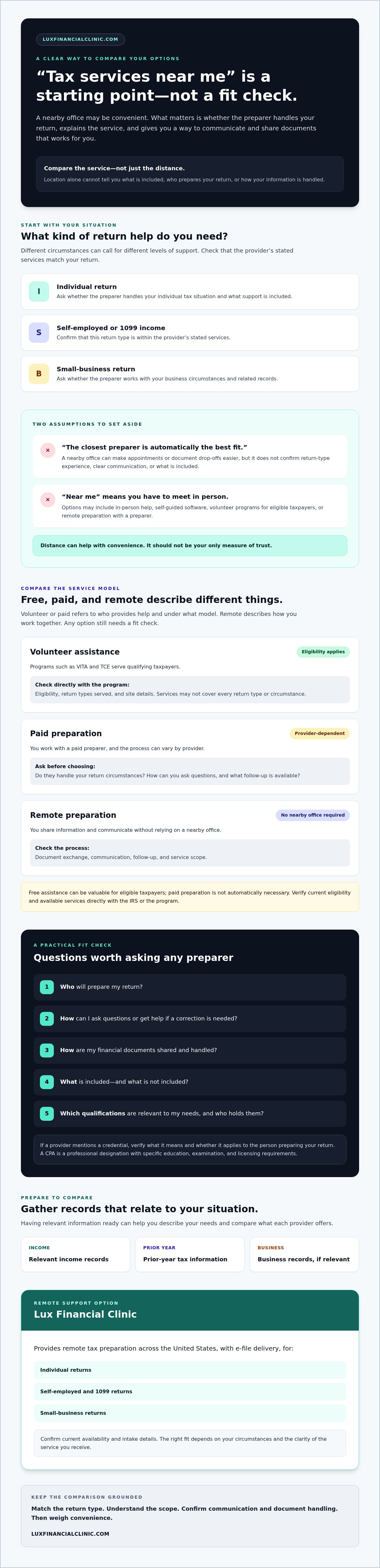
A practical checklist for finding tax services that fit your situation
A simple plan can make comparing tax services near you more manageable. Before contacting a provider, outline the return you need prepared, the support you want, and the questions you need answered. Then use these steps to assess your options without rushing into a commitment.
- Identify your return needs. Note whether you need help with an individual return, self-employed or 1099 income, or a small-business return. Write down relevant deadlines, questions, and your preferred way to communicate.
- Compare service models. Consider whether you prefer in-person, self-guided, volunteer, or remote preparation. Compare what each option covers and how it fits your circumstances, rather than relying on a headline or refund claim.
- Verify the provider’s fit and terms. Confirm that the provider handles your return type. Ask about current eligibility where relevant, fees, what the service includes, and how information is collected, reviewed, and protected.
- Prepare your questions and records. Ask who will prepare your return, how you’ll receive updates, and what follow-up is available. Gather income documents, prior-year tax information, and relevant business records as applicable.
Start with your return type and support needs
Be as specific as you can. For example, a return with self-employment income may require a preparer whose stated services include that kind of work. A small-business return may call for a different scope. Make a short list of anything that could affect the process, along with the communication approach you’re comfortable using. Don’t send sensitive documents until you understand how the provider handles them.
Compare the process before you commit
Ask how the provider collects information, explains next steps, and handles questions or follow-up. Confirm service boundaries and fees directly, and make sure you understand what happens if you need a correction or have a question later. A process you can follow with confidence is more useful than a polished promise you can’t evaluate.
For additional preparation habits, see these practical tax tips for 2026. If you’re comparing professional support, explore Lux Financial Clinic’s tax preparation services for individual, self-employed and 1099, and small-business returns. Confirm current availability and intake details before proceeding.
How Lux Financial Clinic supports taxpayers seeking tax services
A search for tax services near me can lead to providers with very different service scopes. Lux Financial Clinic prepares individual, self-employed and 1099, and small-business tax returns. Its remote preparation and e-file delivery are available across the United States, so a nearby office isn’t the only way to explore support. Whether this is the right fit depends on your return and the process you prefer.
Use the service description as a starting point, then confirm that it covers your circumstances. A return involving self-employment income, for example, may raise different questions from an individual return with only wage income. Small-business filing needs can vary too. Discuss your situation directly before deciding, and don’t assume that a service category guarantees a particular tax result.
Which tax preparation needs may be a fit?
Lux Financial Clinic’s stated preparation services are for individuals, self-employed and 1099 taxpayers, and small businesses. These categories describe the types of returns offered, not a promise that every situation within them can be handled. Before sharing records, explain what kind of income or business activity is involved and ask whether the clinic can support your return’s specific needs.
It’s also reasonable to ask how preparation works, how you’ll communicate questions, and how documents are handled. No preparer can responsibly promise a refund amount, tax savings, or a specific filing outcome before reviewing the relevant information. A clear conversation about scope can help you decide whether to proceed or compare other options.
What to do next if remote preparation suits you
Before contacting the clinic, make a short list of questions about your return and gather relevant income documents, prior-year information, and business records if applicable. You don’t need to send sensitive documents just to begin a conversation. First, confirm the current intake process, service availability, document procedures, and whether your return falls within the stated service scope.
Remote preparation may be convenient if you prefer not to visit an office, but it isn’t the right choice for everyone. Consider how you’d like to communicate and whether the process feels clear before moving forward. Confirming the details can make your decision more informed and comfortable.
If the stated services appear aligned with your needs, Explore tax preparation with Lux Financial Clinic and ask questions about fit before proceeding.
Choose tax support with clarity and confidence
The search for tax services near me is a starting point, not a reason to choose the closest listing automatically. The right fit depends on whether the preparer handles your return type, explains the process clearly, and uses document-handling practices you’re comfortable with. Free, paid, in-person, and remote options each have different access and service boundaries, so confirm details directly before sharing sensitive information.
Lux Financial Clinic provides individual, self-employed and 1099, and small-business tax preparation, with remote service and e-file delivery available nationwide. Whether that option suits your circumstances is best established through a direct conversation. Confirm current availability, intake steps, and return fit before proceeding.
If you’re considering support, explore tax preparation with Lux Financial Clinic and bring your questions to the discussion. A thoughtful comparison can help you move forward with greater peace of mind and a clearer sense of what to expect.
Frequently Asked Questions
Is the closest tax preparer always the best choice?
Not necessarily. A nearby office may be convenient, but location alone doesn’t show whether a provider handles your return type, explains the process clearly, or offers follow-up that suits your needs. When comparing tax services near me, check service scope, communication, document procedures, and terms. Remote preparation may also work if the provider serves your situation and the process fits your preferences.
Can I get tax preparation for free?
Some taxpayers may qualify for free preparation through IRS-supported VITA or TCE programs. Eligibility and available services depend on current program criteria and participating locations or providers. Check current IRS information before making plans, then confirm directly whether a program can handle your return needs. If it can’t, compare other preparation options. Paid help may be worth considering, but it isn’t automatically necessary for every taxpayer.
Can I use a tax preparer who is not near me?
Often, tax preparation can be handled remotely, but first confirm that the provider serves your location and return type. Ask how you’ll submit information, how questions are handled, and how documents are protected. Lux Financial Clinic states that it offers remote tax preparation and e-file delivery nationwide. Confirm current availability and the intake process directly before sending financial records, so you understand how the service works.
Does a tax preparer guarantee a bigger refund?
No responsible preparer can promise a specific refund before reviewing relevant information. Your result depends on your income, filing circumstances, and the details reported on your return. If you receive a preliminary estimate, ask what assumptions it uses and what could change it. Also clarify what the preparation service includes. A promised refund amount isn’t proof of quality or a sound reason to choose a preparer.
What should I ask before choosing a tax service?
Ask whether the service handles your return type, who will prepare it, and how documents are collected and protected. Confirm fees, service boundaries, communication steps, and what happens if you have a question after filing. You can also ask how corrections are handled. Clear answers help you compare providers based on fit and transparency, rather than relying only on a nearby listing or promotional claim.
Are remote tax services as reliable as in-person services?
The format alone doesn’t establish reliability. For either option, check the provider’s experience with your return type, document-handling process, communication, terms, and follow-up. Remote preparation may suit you if you’re comfortable exchanging information digitally; an in-person meeting may be preferable if you value face-to-face discussion. Choose a process that meets your needs, and confirm how it works before sharing sensitive information.
Can a tax preparer handle self-employed or small-business returns?
Some preparers do, but services vary. Ask whether the provider handles your type of self-employment or business return, what records they need, and what the service covers. Confirm the process and fees directly rather than assuming every tax service handles every filing situation. Lux Financial Clinic lists self-employed and 1099, as well as small-business, tax preparation among its services. Confirm your specific return needs and current service details before proceeding.


