
What if the best first step toward a business line of credit isn’t applying, but defining what you need the funds for and how you’ll repay them? A revolving credit line can help manage uneven cash flow, yet lender requirements, personal and business credit, and repayment terms can make the decision complicated. Effective business line of credit advisory starts with your business’s needs, not an application.
This checklist will help you assess whether a line of credit fits your cash-flow needs, organize information lenders may review, and compare terms against your ability to repay. It will also help you identify where personalized funding guidance could clarify your next steps.
Work through questions about timing, readiness, documentation, credit, costs, and repayment. By the end, you’ll have a clearer basis for comparing options and shaping a funding strategy that supports your business without putting unnecessary strain on cash flow.
Key Takeaways
- Clarify what the funds would cover and how repayment would fit your business’s cash flow before considering an application.
- Review your records, revenue patterns, and personal and business credit profile to identify readiness questions to address.
- Compare revolving credit lines with term loans and business credit cards by access to funds, repayment structure, and flexibility.
- Use a business line of credit advisory process to organize funding needs and consider possible next steps with greater clarity.
- Personalized funding consulting can help you explore potential options and lender introductions, without promising a particular approval or outcome.
Business Line of Credit: When Does This Flexible Funding Fit?
Uneven expenses can complicate planning when payroll, inventory, or supplier payments come due before customer invoices are paid. A business line of credit may help with this kind of timing gap, but borrowing is a tool to assess, not an automatic fix for every cash-flow problem. It provides revolving access to funds up to an approved limit, subject to the lender’s terms and approval. Whether it fits depends on the purpose, your cash flow, a realistic repayment plan, and the full agreement.
How a revolving business credit line works
The lender sets a maximum credit limit. Your business can draw funds as needed within that limit rather than receiving the entire amount at once. The balance is what your business has borrowed, while the limit is the maximum it may access. The unused portion is generally available to draw, subject to the agreement. For background on how lines of credit work, see Line of Credit - Wikipedia.
Repayment requirements apply to the borrowed balance, not simply to the full limit, although the agreement determines how interest and other charges are calculated. As your business repays, available credit may be restored, depending on the lender’s terms. Before relying on that flexibility, understand:
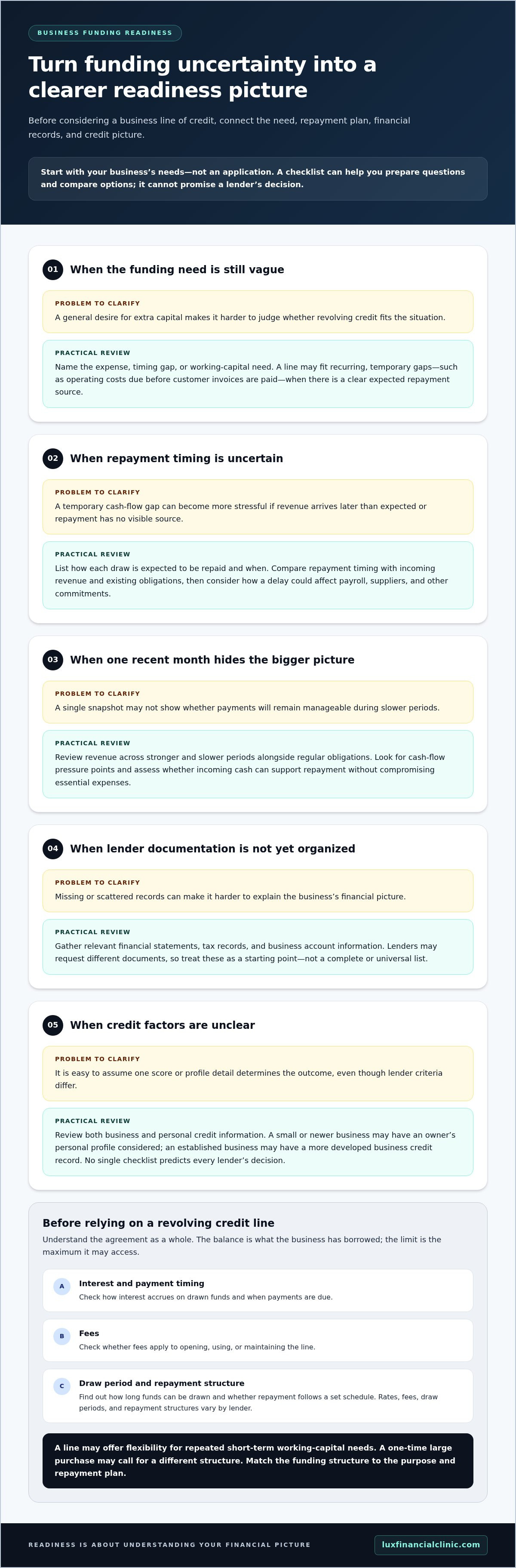
- How interest accrues on funds drawn and when payments are due.
- Whether fees apply to opening, using, or maintaining the line.
- How long you can draw funds and whether repayment follows a set schedule.
Rates, fees, draw periods, and repayment structures vary by lender. Evaluate them together as part of the total obligation, not as isolated details.
When a line of credit may suit a business need
A revolving line may suit recurring, temporary timing gaps when you can identify how each draw is expected to be repaid. For example, a business might need to cover operating expenses while waiting for customers to pay invoices. Ask whether the gap is temporary and visible in the cash-flow cycle, or a persistent shortfall without a clear repayment source.
Match the funding structure to the purpose. A line may offer flexibility for repeated short-term working-capital needs, while a one-time large purchase may call for a different structure with a repayment schedule aligned to that investment. Neither is automatically preferable. Consider whether the expected benefit and timing of incoming cash can support repayment without compromising essential expenses.
A practical business line of credit advisory discussion can help you work through these questions before applying: What will each draw fund? What cash flow will repay it, and when? What happens if revenue arrives later than expected? Clear answers can help distinguish a useful liquidity tool from borrowing that may add pressure to uneven cash flow.
Business Line of Credit Readiness: What Should You Assess First?
Preparation is less about predicting a lender’s decision and more about understanding your own financial picture. Before moving forward, take stock of the need, likely repayment source, available records, and credit factors a lender may review. This gives you a practical basis for identifying questions and comparing funding paths, without treating any checklist as a promise of approval.
Review cash flow, records, and funding purpose
Start with a specific use for the funds. A defined expense or timing gap is easier to assess than a general desire for extra capital. Then review recent revenue patterns, regular obligations, and expected repayment sources. Compare stronger and slower periods to see when repayments may be manageable and whether a revenue dip could create pressure.
Use this checklist to organize your review:
- Purpose: Identify the expense, timing gap, or working-capital need the funds would address.
- Repayment capacity: List expected repayment sources and compare their timing with incoming revenue and existing obligations.
- Cash-flow visibility: Review revenue across stronger and slower periods, not just a single recent month.
- Records: Gather relevant financial statements, tax records, and business account information. Lenders may request different documents, so use this as a starting point.
If repayment depends on revenue arriving on schedule, consider how a delay could affect payroll, suppliers, and other commitments. This helps you assess whether the need is a manageable timing gap or a deeper cash-flow challenge.
Understand business and personal credit considerations
Lenders may assess a combination of business history, business credit, and personal credit. For a small or newer business, an owner’s personal credit profile may be part of the review. An established business may have a more developed credit record of its own. The importance of each factor, and lender criteria overall, can differ. No single checklist predicts how every lender will decide.
You can review your personal credit information through major consumer credit bureaus. Looking over your records may help you identify details to understand or questions to prepare, but a lender’s underwriting process may consider additional information. Don’t assume that one score or profile detail determines the outcome.
For broader preparation on funding readiness, explore this credit readiness for business funding guide. To organize your funding purpose, readiness questions, and possible next steps, business funding consulting offers a structured, personalized review.
Compare Business Credit Lines by Terms, Flexibility, and Total Obligations
Once you understand the business need, compare how each funding structure provides funds and expects repayment. A lower-looking rate or convenient access doesn’t tell the whole story. Fees, payment rules, and agreement conditions affect both the total obligation and whether the financing fits your cash flow.
A revolving credit line lets a business draw funds as needed within an approved limit; a term loan provides a lump sum that the business repays under an agreed schedule. A business credit card offers another way to pay for transactions, with terms and payment patterns that may differ from both.
| Funding structure | Common purpose | Access to funds | Repayment pattern | Potential flexibility |
|---|---|---|---|---|
| Revolving credit line | Recurring or short-term working-capital needs | Draw funds as needed, up to the approved limit and subject to the agreement | Payments apply to the amount borrowed according to the lender’s terms | Can provide access at different times, within the draw and account conditions |
| Term loan | A defined, one-time purchase or planned expense | Receive a set amount, typically as a lump sum | Repay on an agreed schedule | Predictable structure, with less need to draw funds repeatedly |
| Business credit card | Business transactions that suit card-based payment | Make eligible purchases within the account’s credit limit | Payments follow the card agreement and billing cycle | May suit frequent purchases, subject to account terms and payment rules |
Which funding structure aligns with the expense?
Consider the expense’s pattern and size. Repeated working-capital needs may call for access at different times, while a single, well-defined purchase may align more naturally with a set loan amount and scheduled payments. A business credit card may suit particular transaction patterns, but weigh its repayment terms against how quickly your business expects to pay the balance. Choose based on fit, not flexibility alone.
Which agreement terms deserve a close review?
Before accepting an offer, review the complete agreement and disclosures. Rates and fees vary, and the stated rate alone may not show the full cost. Check:
- How interest is calculated, when it accrues, and how payments are applied.
- Any fees, minimum payment requirements, draw period, and repayment schedule.
- Whether collateral, a personal guarantee, or other conditions apply.
- How renewal, default, and account-closure provisions could affect access or repayment.
Read the terms together. A payment that appears manageable during a strong revenue period may be harder to meet if the agreement requires repayment on a different timeline. A business line of credit advisory review can help you organize these details and compare the obligations with your funding purpose and repayment capacity.
Business Line of Credit Application Checklist: Prepare Before You Apply
A thoughtful application starts with a clear request and records that tell a consistent story. Preparing in advance can help you understand what you’re asking for, what information may be needed, and how a potential draw fits your repayment capacity. Each lender may request different documents, so use this sequence as a practical starting point, not a complete or universal requirements list.
Gather documents and clarify the request
Work through these steps in order. Keep copies of the records you use so you can review them together before submitting an application.
- Define the purpose. Write down the expense or operating need the credit would address, when funds may be needed, and whether the need is expected to recur.
- Set a measured request. Estimate the draw needed for that purpose rather than defaulting to the largest available limit. Consider how the amount could be repaid alongside existing obligations.
- Identify repayment sources. Note the revenue or other business cash flow expected to support repayment, and when it is expected. Be candid about assumptions and possible delays.
- Organize business information. Gather relevant business identity and ownership details, account information, revenue records, financial statements, and tax records as applicable. The exact documents depend on the lender’s process.
- Review the request as a whole. Check that the amount, purpose, timing, and repayment expectations fit together. If they don’t, refine the request before applying.
Review the application for consistency
Before submitting, compare the application with the records supporting it. Revenue figures, regular obligations, ownership details, and banking information should align across your materials. If amounts differ because records cover different periods or use different accounting methods, explain the reason rather than leaving a lender to interpret the discrepancy.
Keep confirmed financial information separate from forecasts. If you include a projection, explain its assumptions, such as anticipated sales or customer payments, and don’t present projected revenue as money already earned. Clear context makes your preparation more useful, though it can’t predict a lender’s decision.
For related preparation, the business loan qualification guide offers additional context on getting ready to discuss funding. Owners reviewing their broader credit picture may also find the small business credit consulting guide useful. These resources complement, rather than replace, the specific instructions in an application.
A structured business line of credit advisory review can help connect your stated need, supporting records, and repayment plan. For personalized help preparing your funding strategy, explore business funding consulting.
How Business Line of Credit Advisory Can Clarify Your Next Step
A checklist can bring your questions into focus, but deciding what to do with the answers may still feel complex. Personalized funding consulting helps organize your business goals, readiness, and potential funding paths so you can make a considered choice. Borrowing isn’t the right next step for every business. A clearer view of cash flow or timing may be useful before pursuing financing.
What funding advisory can help you organize
Business line of credit advisory can connect the intended use of funds with your records, cash-flow planning, and repayment considerations. It can also help you identify and compare potential funding opportunities, including lines of credit and other types of financing, in light of your circumstances and goals.
A structured review can help you sort through questions such as:
- Does the proposed funding address a specific business need?
- What records or readiness questions need further attention?
- How might repayment fit alongside existing business obligations?
- Which potential funding paths merit further consideration?
Lux Financial Clinic offers business funding consulting and lender introductions as part of funding support. These introductions can connect your business with potential lending opportunities, but they don’t determine the outcome. Lenders make their own underwriting decisions and set their own terms. Advisory guidance cannot guarantee approval, a particular credit limit, or specific terms.
Choose a measured next step for your business
Before moving forward, revisit your checklist and note what remains unresolved. You might clarify the intended use, strengthen your understanding of cash flow, or organize financial information. You may also decide that borrowing isn’t appropriate right now. Each can be a considered next step when it reflects your business’s circumstances.
A funding consultation gives you a structured opportunity to discuss your goals, readiness questions, and potential funding sources. Use the conversation to understand where further preparation may help and which options could be worth exploring. An application isn’t the only measure of progress.
Lux Financial Clinic provides personalized guidance to help you align a funding strategy with your business purpose and ability to manage repayment. Lenders retain control of their own decisions.
To discuss your funding goals with a structured approach, explore business funding guidance through Lux Financial Clinic. Take the next step at a pace that gives you room to make an informed decision.
Move Forward With a Clearer Funding Strategy
Your next step doesn’t need to be an application. Start with a focused review of what your business is working toward, what questions remain, and what support would help you make a sound decision. A thoughtful business line of credit advisory process gives those considerations room, so your funding choices can reflect both your plans and your capacity.
Lux Financial Clinic’s personalized financial roadmaps and diagnostic consultations can help structure your funding goals and clarify possible next steps. If you’re ready to discuss your business’s needs, explore personalized business funding guidance. Take a measured approach and move forward with greater clarity.
Frequently Asked Questions
Can a new business qualify for a line of credit?
A new business may qualify, but lender criteria vary, and limited operating history can make it harder to demonstrate financial stability. Depending on its requirements, a lender may review revenue, business records, the owner’s credit, collateral, or a personal guarantee. Before applying, consider whether expected cash flow can support repayment during a slower period. Prepare accurate, current records, but remember that readiness does not guarantee approval.
Does applying for a business line of credit affect personal credit?
It can, depending on the lender’s inquiry process and whether the application involves a personal credit review or guarantee. A credit inquiry is separate from ongoing account reporting: an inquiry relates to reviewing an application, while account reporting concerns how an account may appear on a credit file over time. A business line of credit advisory review can help you prepare questions. Review the lender’s disclosures for its specific practices before applying.
Can a business line of credit be used for any business expense?
No, permitted uses depend on the agreement and any conditions set by the lender. A line may be intended for working-capital needs such as inventory purchases or routine operating expenses, but the specific terms govern. Before drawing funds, make sure the planned expense is allowed and supports a defined business purpose. Consider how the draw will be repaid rather than relying on future revenue without a reasonable basis.
Is a business line of credit secured or unsecured?
A business line of credit may be secured or unsecured, depending on the lender, product, and applicant’s profile. A secured arrangement involves collateral, while an unsecured offer may still require a personal guarantee or impose other obligations. Read the agreement carefully to understand which assets could be at risk, who may be responsible for repayment, and what conditions apply if your business cannot meet its obligations.
How is interest charged on a business line of credit?
Interest is commonly tied to the amount drawn, but the agreement determines the calculation and billing rules. The credit limit is the maximum available under the account; the outstanding balance is the amount currently borrowed. Rates, fees, and payment terms can vary, so review the disclosures before drawing funds. Check how interest accrues, when payments are due, and what other charges may affect the total amount your business must repay.
What happens if a business cannot make a line-of-credit payment?
Consequences depend on the agreement and circumstances. They may include fees, account restrictions, collection activity, or effects involving a guarantor or credit profile, but no single outcome applies to every account. If a payment may be missed, review the contract and communicate with the lender promptly to understand your obligations and possible next steps. Don’t assume a delay has no consequences.


